The Chemical Level of Organization
Every heartbeat, every thought, every drop of sweat begins as chemistry. Long before a cell can divide or a nerve can fire, atoms must bond, reactions must run, and water must do its quiet, essential work. This chapter takes you down to the chemical level — the foundation the whole rest of the book is built on. You will meet the atom and the handful of elements that make up almost all of you, learn the three bonds that hold molecules together, watch reactions rearrange matter and see how enzymes speed them up, discover why water is the perfect medium for life, learn to read pH and the buffers that guard your blood, and finish with the four great families of molecules that build your body. Get comfortable here — everything upstairs depends on this floor.
By the end of this chapter you can
- Describe the structure of an atom — protons, neutrons, and electrons — and explain how the atomic number defines an element.
- Name the major elements that make up most of the human body and distinguish them from trace elements and isotopes.
- Compare ionic, covalent (polar and nonpolar), and hydrogen bonds, and explain the octet rule that drives bonding.
- Classify chemical reactions as synthesis, decomposition, or exchange, and explain activation energy and how enzymes lower it.
- Explain how water's polarity makes it the body's solvent, temperature buffer, and lubricant.
- Interpret the pH scale, distinguish acids from bases, and describe how buffers hold blood near 7.4.
- Identify the four organic macromolecule families — carbohydrates, lipids, proteins, nucleic acids — plus ATP, and give a job for each.
- Contrast dehydration synthesis with hydrolysis as the way polymers are built and broken.
Section 1Atoms & the elements
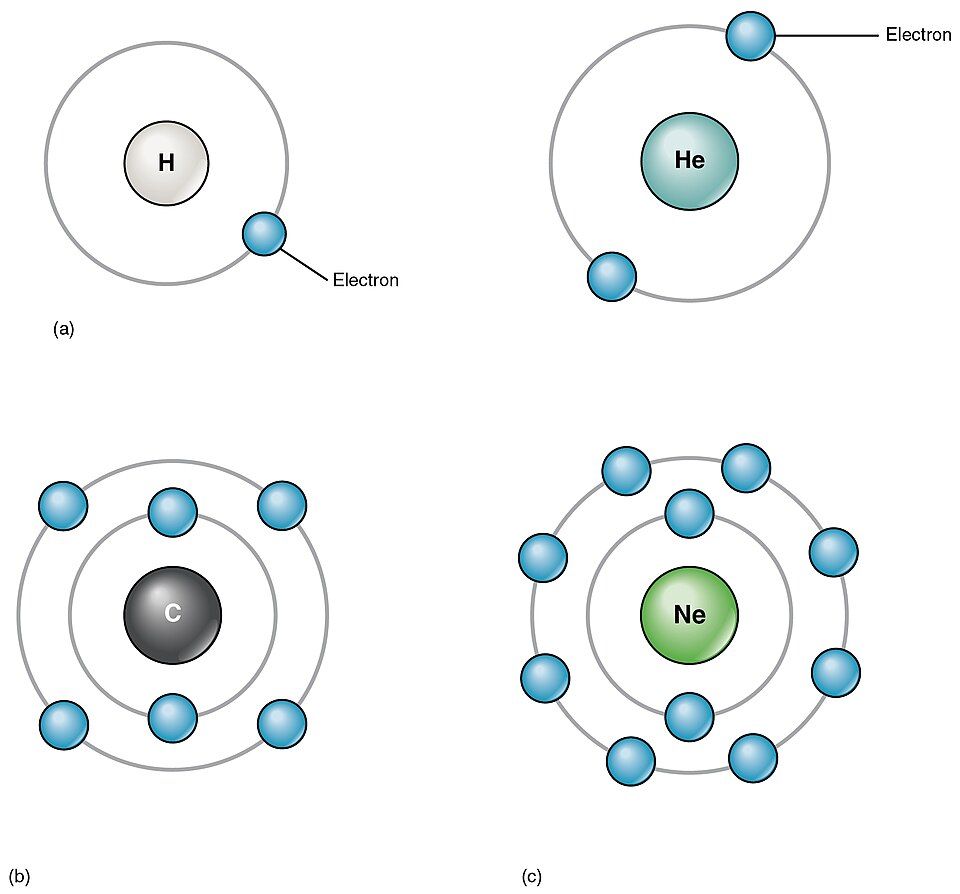
Matter, elements, and the atom
Anything that takes up space and has mass is matter — your bones, your blood, the air in your lungs. All matter is built from elements, pure substances that cannot be broken down into anything simpler by ordinary chemistry. There are 118 known elements, but life is surprisingly economical: only about two dozen appear in the body, and just six — oxygen, carbon, hydrogen, nitrogen, calcium, and phosphorus — account for roughly 99% of your mass. The smallest particle of an element that still behaves like that element is the atom. Split an atom apart and you no longer have the element; you have its raw ingredients.
| Element | Symbol | ~% of body mass | A job it does |
|---|---|---|---|
| Oxygen | O | 65% | Part of water; final electron acceptor in respiration |
| Carbon | C | 18% | The backbone of every organic molecule |
| Hydrogen | H | 10% | Part of water; sets pH as the H⁺ ion |
| Nitrogen | N | 3% | In every protein and nucleic acid |
| Calcium | Ca | 1.5% | Bone mineral; muscle and nerve signaling |
| Phosphorus | P | 1% | Bone; the energy bonds of ATP and DNA |
Inside the atom: three particles
An atom has a dense center, the nucleus, surrounded by a cloud of moving electrons. Only three subatomic particles matter for this course. Protons carry a positive charge and sit in the nucleus. Neutrons carry no charge and share the nucleus with the protons, adding mass but no charge. Electrons carry a negative charge and are almost weightless, whirling around the nucleus in layered shells (energy levels). Because protons and electrons carry equal and opposite charges, a neutral atom has exactly as many electrons as protons, and the whole thing balances out to no net charge.
| Particle | Charge | Location | Relative mass |
|---|---|---|---|
| Proton | +1 | Nucleus | 1 (heavy) |
| Neutron | 0 | Nucleus | 1 (heavy) |
| Electron | −1 | Shells around the nucleus | ~1/1800 (negligible) |
Atomic number, isotopes, and the outer shell
One number is the atom's fingerprint: the atomic number, the count of protons in the nucleus. Change it and you change the element itself — 1 proton is always hydrogen, 6 is always carbon, 8 is always oxygen. The mass number adds protons and neutrons together. Atoms of the same element that carry different numbers of neutrons are called isotopes: carbon-12 and carbon-14 are both carbon (6 protons each), but carbon-14 has two extra neutrons and is radioactive, which is exactly why radioactive isotopes are so useful in medical imaging and dating. What drives an atom's chemistry, though, is not its nucleus but its outermost electrons — the valence shell. Atoms are “happiest” (most stable) when that outer shell is full, which for most biological atoms means eight electrons — the octet rule. An atom with a full outer shell is inert; an atom short a few electrons is reactive and ready to bond.
Pick an element and watch its atom assemble — nucleus in the center, electrons filling their shells — in the interactive below.
- An atom has a nucleus of positive protons and neutral neutrons, orbited by negative electrons in shells.
- The atomic number (proton count) defines the element; a neutral atom has equal protons and electrons.
- Isotopes are the same element with different neutron counts; some are radioactive and medically useful.
- The valence (outer) shell drives chemistry — atoms bond to reach a stable, full shell (the octet rule).
Section 2Chemical bonds
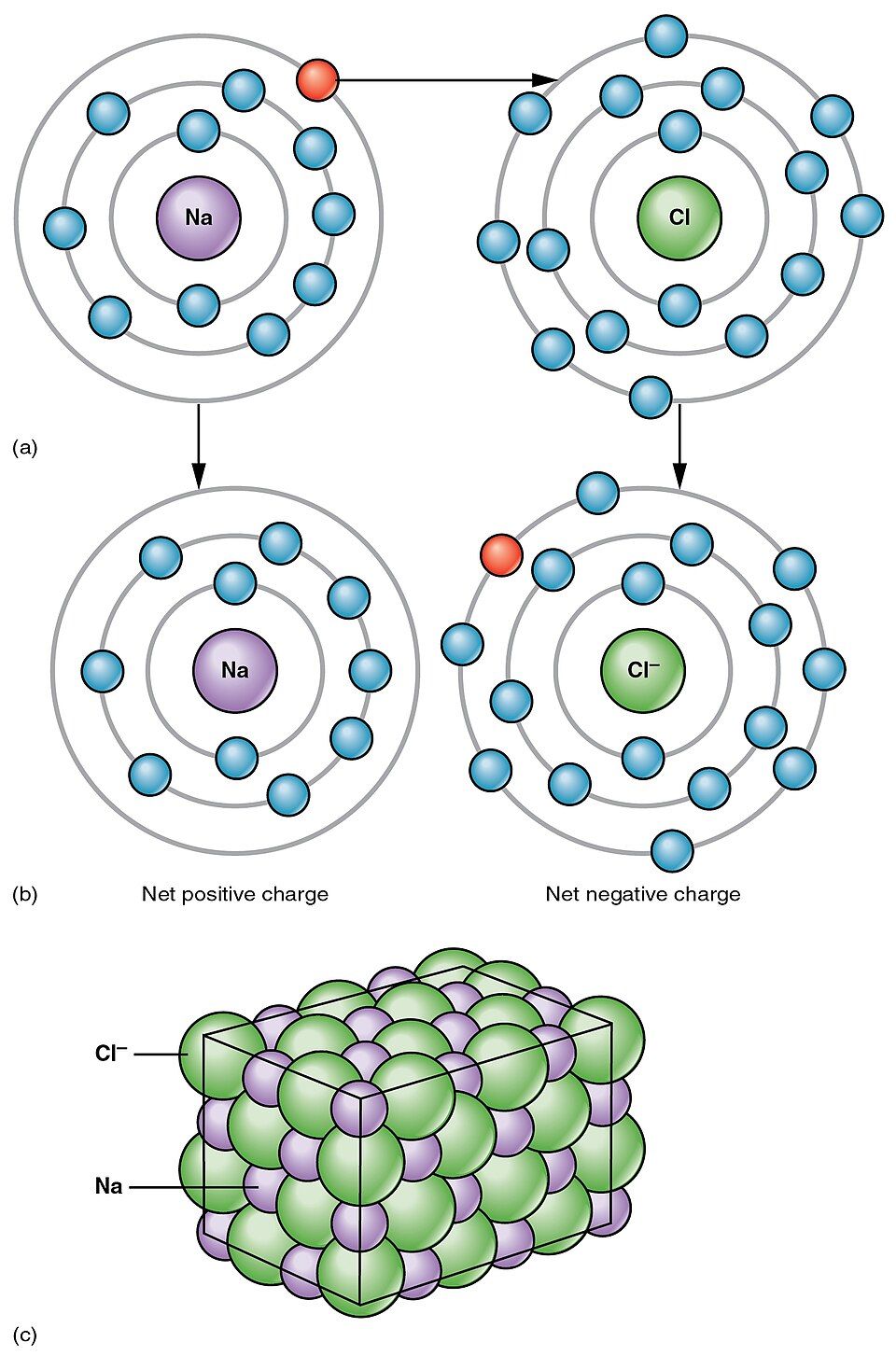
Why atoms bond at all
Atoms bond for one reason: to reach a stable, full outer shell. An atom with a lonely, half-empty valence shell will do almost anything to fill it — give electrons away, take them, or share them — and each of those strategies produces a different kind of bond. The noble gases (helium, neon, argon) already have full shells, so they drift through the world refusing to react. Everything else is looking for a partner. Understanding the three main bonds — ionic, covalent, and hydrogen — lets you predict how nearly every molecule in the body behaves.
Ionic bonds: give and take
Sometimes the cleanest way to fill a shell is to hand an electron over completely. When one atom donates an electron and another accepts it, both walk away charged: the donor becomes a positive cation, the acceptor a negative anion. Opposite charges attract, and that electrostatic pull is the ionic bond. Table salt is the classic case: sodium hands its lone outer electron to chlorine, becoming Na⁺, while chlorine becomes Cl⁻, and the two cling together as NaCl. In water, ionic compounds pull apart into their separate ions — these dissolved, charged particles are your electrolytes (Na⁺, K⁺, Ca⁺⁺, Cl⁻), and they run nerve signals, muscle contraction, and fluid balance.
Covalent bonds: sharing — polar and nonpolar
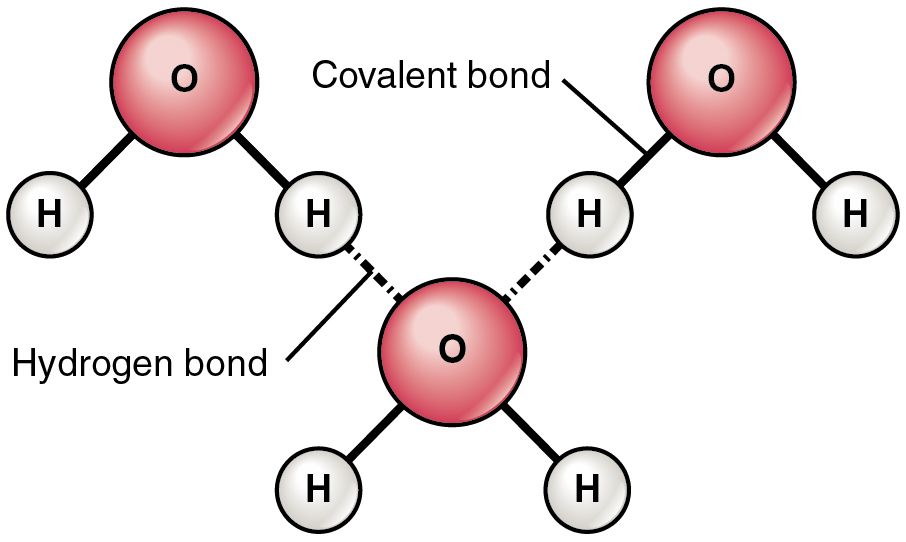
More often, two atoms simply share a pair of electrons so that both count it toward a full shell — a covalent bond, the strongest and most common bond in the body. Carbon builds all of life on covalent bonds. But sharing is not always fair. When both atoms pull equally, the shared electrons sit in the middle and the bond is nonpolar (as in O₂ or the carbon–hydrogen bonds of fats). When one atom pulls harder, it hogs the electrons and the bond becomes polar, leaving one end slightly negative and the other slightly positive. Water is the great polar molecule: oxygen pulls the shared electrons away from its two hydrogens, so oxygen carries a partial negative charge and the hydrogens a partial positive — a lopsidedness that, as you will see, makes life possible.
Hydrogen bonds: weak but mighty
A hydrogen bond is not a bond within a molecule but a gentle attraction between molecules (or between distant parts of one big molecule). It forms when the slightly positive hydrogen of one polar molecule is drawn to the slightly negative oxygen or nitrogen of another. Any single hydrogen bond is feeble — a fraction of the strength of a covalent bond — but in the millions they become mighty. Hydrogen bonds hold liquid water together, zip the two strands of DNA into a double helix, and fold proteins into their working shapes. They are strong enough to give structure yet weak enough to break and re-form, which is exactly what living molecules need.
| Bond | How it forms | Strength | Example |
|---|---|---|---|
| Ionic | One atom donates an electron to another; opposite charges attract | Strong (weak once dissolved in water) | Na⁺Cl⁻ (table salt) |
| Covalent (nonpolar) | Electrons shared equally | Strong (covalent bonds are the strongest in the body) | O₂; C–H bonds in fats |
| Covalent (polar) | Electrons shared unequally — partial charges | Strong (covalent bonds are the strongest in the body) | Water (H₂O) |
| Hydrogen | Attraction between partial + and partial − on polar molecules | Weak (strong in numbers) | Between water molecules; DNA strands |
Flip between ionic, covalent, and hydrogen bonds and watch how each one forms in the interactive.
- Atoms bond to fill their valence shell; a full shell is stable and unreactive.
- Ionic bonds transfer electrons, making charged ions (electrolytes) that separate in water.
- Covalent bonds share electrons — equally (nonpolar) or unequally (polar); they are the body's strongest bonds.
- Hydrogen bonds are weak individual attractions between polar molecules that add up to hold water, DNA, and proteins together.
Section 3Chemical reactions & enzymes
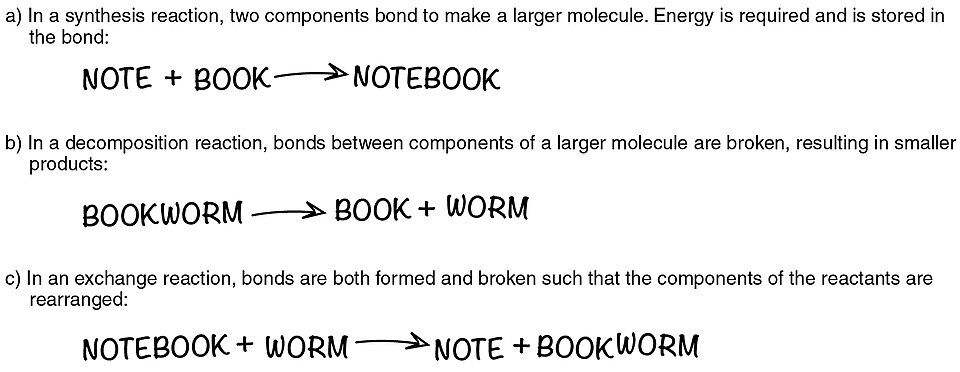
Reactants, products, and three ways to rearrange atoms
A chemical reaction is simply the making or breaking of bonds — atoms let go of old partners and grab new ones. The starting materials are the reactants; what you end up with are the products. No atoms are created or destroyed; they are only rearranged. Almost every reaction in the body fits one of three patterns. Synthesis reactions join smaller parts into a larger molecule (A + B → AB) — the building, or anabolic, reactions. Decomposition reactions break a large molecule into smaller pieces (AB → A + B) — the demolishing, or catabolic, reactions, like digesting a meal. Exchange reactions do both at once, swapping partners (AB + CD → AC + BD). Many reactions are also reversible, running either direction depending on conditions.
| Type | Pattern | What it does | Body example |
|---|---|---|---|
| Synthesis (anabolic) | A + B → AB | Builds larger molecules | Amino acids joined into a protein |
| Decomposition (catabolic) | AB → A + B | Breaks molecules apart | Digesting starch into glucose |
| Exchange | AB + CD → AC + BD | Swaps partners | Buffers trading H⁺ in the blood |
Energy: the hill every reaction must climb
Chemical bonds are little reservoirs of energy, so rearranging them always involves an energy change. Reactions that release energy (usually as heat) are exergonic — these power the body, like breaking down glucose. Reactions that absorb energy are endergonic — building big molecules costs energy. But here is the catch: even a reaction that releases energy overall must first be nudged over an initial hump called the activation energy — the energy needed to get the reactants unstable enough to react at all. Think of a boulder resting in a small dip near the top of a hill: it will roll down and release a lot of energy, but only after something lifts it over the lip first. That lip is activation energy, and at body temperature most reactions would sit stuck behind it for hours or years.
Enzymes: shrinking the hill
The body cannot wait hours, and it cannot simply crank up the heat — so it uses enzymes. An enzyme is a biological catalyst (nearly always a protein) that lowers the activation energy of a reaction, letting it run thousands or millions of times faster at a safe 37 °C. Crucially, an enzyme is not consumed — it does its job and is freed to do it again. Each enzyme is exquisitely specific, with an active site shaped to fit one particular substrate like a key in a lock (or, more accurately, a glove that molds around the hand). Because enzymes are proteins, anything that unfolds a protein — a high fever, the wrong pH — can cripple them, which is one reason your body guards its temperature and pH so fiercely.
Watch a reaction run over its energy hill, then switch on an enzyme and see the hill shrink in the interactive below.
- Reactions rearrange atoms from reactants into products as synthesis, decomposition, or exchange.
- Exergonic reactions release energy; endergonic reactions absorb it; every reaction must first clear its activation energy.
- Enzymes are protein catalysts that lower activation energy, are reused, and are highly specific to their substrate.
- Enzymes depend on their shape, so heat and pH extremes can disable them.
Section 4Water, the solvent of life
Polarity: the source of all water's tricks
You are roughly 60% water, and that is no accident — nearly every remarkable thing water does traces back to a single feature: it is polar. Recall from Section 2 that oxygen hogs the shared electrons in each O–H bond, so a water molecule (H₂O) carries a slightly negative pole at the oxygen and slightly positive poles at the two hydrogens. Because opposite partial charges attract, every water molecule clings by hydrogen bonds to the water molecules around it. That constant, shifting web of hydrogen bonds is the hidden machinery behind water's role as a solvent, a temperature buffer, and a lubricant.
The universal solvent
Water is called the universal solvent because its charged poles surround and pull apart other charged or polar substances, scattering them evenly into solution. The dissolving liquid is the solvent, the dissolved substance the solute. Molecules that mix into water — salts, sugars, amino acids — are hydrophilic (“water-loving”), while nonpolar molecules like fats are hydrophobic (“water-fearing”) and refuse to dissolve. This split does real anatomical work: it is exactly why cell membranes, made of hydrophobic lipids, form watertight barriers in your watery body. And because so much of the body's chemistry happens in solution, water is the medium in which nutrients travel, wastes dissolve, and reactions occur — blood plasma is, at heart, water carrying dissolved cargo.
Heat, cushioning, and chemistry
Water's hydrogen bonds also give it a very high heat capacity: it takes a lot of energy to raise water's temperature, so your water-rich body resists sudden swings in temperature and stays near 37 °C. Better still, evaporating water carries away enormous heat, which is why sweating cools you so effectively on a hot day. The same cohesive stickiness lets water form protective, cushioning films — the slippery fluid in serous membranes, the synovial fluid in joints, the mucus lining your airways all rely on it. Finally, water is not just a bystander to chemistry; it is a participant. The body builds big molecules by removing water (dehydration synthesis) and breaks them down by adding water (hydrolysis) — the two reactions you will meet again in Section 6.
| Property | Why (from polarity) | What it does for you |
|---|---|---|
| Solvent | Charged poles pull solutes apart | Transports nutrients, wastes, and ions in blood |
| High heat capacity | Hydrogen bonds absorb heat | Buffers body temperature near 37 °C |
| Evaporative cooling | Breaking H-bonds carries off heat | Sweating cools the body |
| Cohesion / lubrication | Molecules stick to one another | Slippery films in joints, membranes, airways |
| Reactant | Can be added or removed in reactions | Builds and breaks macromolecules |
Explore what water's lopsided charge buys you — dissolving, sticking, and buffering heat — in the interactive.
- Water is polar, so its molecules hydrogen-bond to one another — the source of all its special properties.
- As the universal solvent, water dissolves hydrophilic solutes but not hydrophobic ones, a split that shapes membranes.
- High heat capacity and evaporative cooling let water stabilize body temperature and enable sweating.
- Water is a reactant — removed in dehydration synthesis, added in hydrolysis.
Section 5pH, acids, bases & buffers
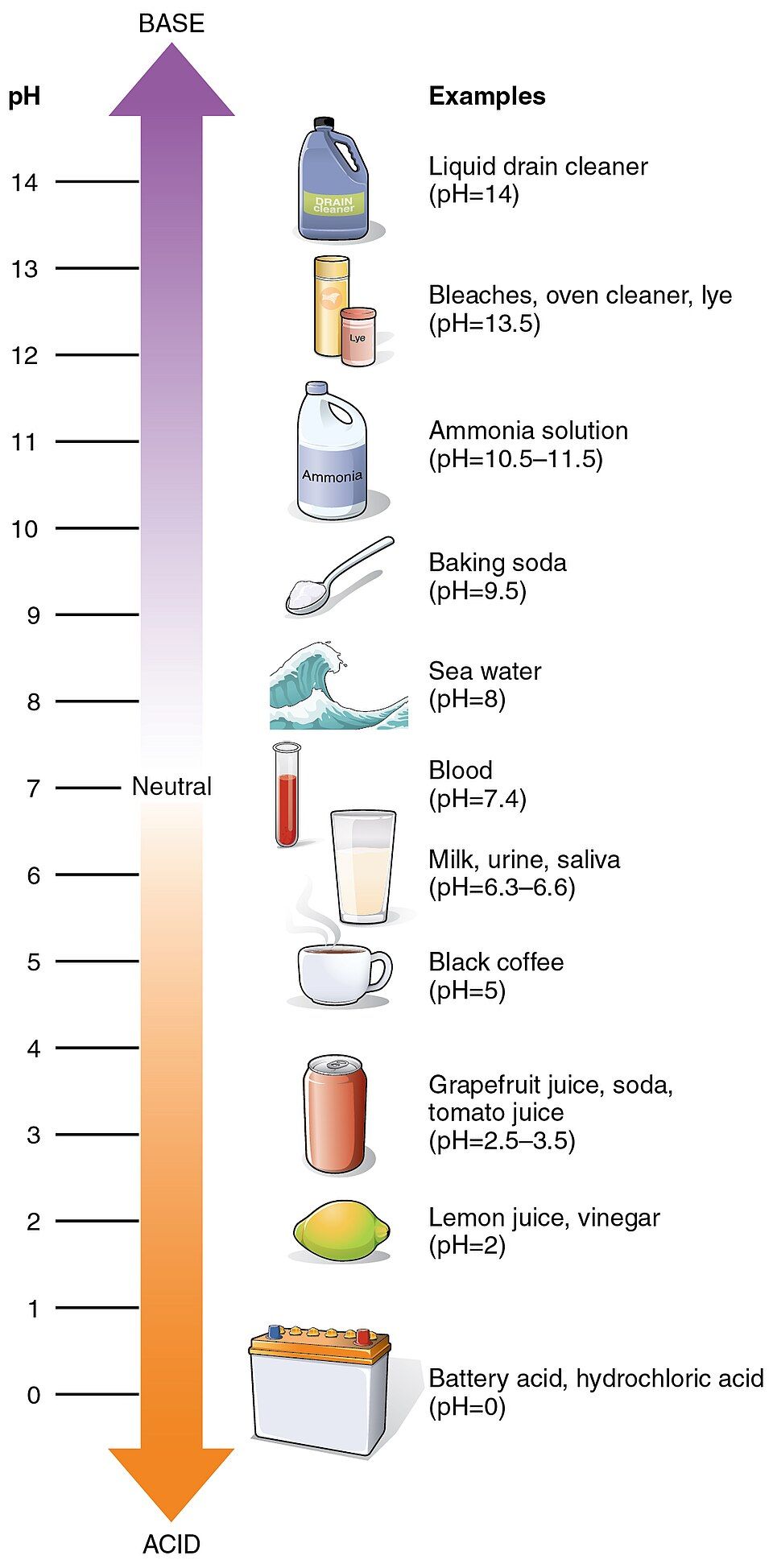
What pH actually measures
pH is a measure of how many free hydrogen ions (H⁺) are floating loose in a fluid. The more H⁺, the more acidic the fluid; the fewer, the more basic (alkaline). The scale runs from 0 to 14, with 7 as neutral (pure water). Below 7 is acidic, above 7 is basic. The one twist students must respect is that the scale is logarithmic: each whole step is a tenfold change in H⁺. A fluid at pH 4 is not slightly more acidic than pH 5 — it holds ten times more hydrogen ions. That is why a drift of even a few tenths of a pH unit in the blood is a genuine emergency.
Acids, bases, and the number that matters most
An acid is a substance that releases H⁺ into solution, driving pH down — stomach acid sits near pH 2. A base accepts H⁺ (or releases OH⁻), driving pH up — household bleach and pancreatic secretions are basic. The number that matters most in all of physiology is the pH of blood, which must stay locked in the razor-thin range of 7.35 to 7.45 (about 7.4). Slip below 7.35 and you are in acidosis; rise above 7.45 and you are in alkalosis. Push past roughly 6.8 or 7.8 and proteins denature, enzymes fail, and the situation becomes life-threatening. Compared with the wild pH swings of the world outside, the body keeps its blood almost eerily steady.
| Fluid | Approx. pH | Acidic / basic |
|---|---|---|
| Stomach acid | ~2 | Strongly acidic |
| Urine | ~6 | Slightly acidic |
| Pure water | 7 | Neutral |
| Blood | 7.35–7.45 | Slightly basic |
| Pancreatic juice | ~8 | Basic |
Buffers: holding the line at 7.4
How does blood hold its pH so steady while acids pour in from every meal and every muscle? The answer is buffers — chemical partnerships that soak up excess H⁺ when a fluid turns too acidic and release H⁺ when it turns too basic. The body's front-line buffer is the bicarbonate system: carbonic acid (H₂CO₃) and bicarbonate ion (HCO₃⁻) sit in equilibrium, trading hydrogen ions back and forth to blunt any swing. Buffers do not make acid disappear; they cushion the blow long enough for the lungs (which blow off CO₂) and kidneys (which excrete H⁺) to restore true balance. It is homeostasis at the molecular level — and a preview of the acid–base chapters ahead.
Push the pH up and down and watch buffers fight to pull it back toward neutral in the interactive.
- pH measures free H⁺: below 7 is acidic, above 7 is basic, and the scale is logarithmic (each unit = 10×).
- Acids release H⁺; bases accept it; blood must stay in the narrow range 7.35–7.45.
- Straying gives acidosis (too low) or alkalosis (too high), both dangerous.
- Buffers — chiefly the bicarbonate system — absorb or release H⁺ to hold pH steady.
Section 6The molecules of life
Organic molecules and the carbon backbone
Turn from the small inorganic molecules — water, salts, gases — to the big organic ones, and you meet the true building blocks of the body. Organic molecules are, by definition, built on a skeleton of carbon. Carbon is the perfect construction atom because it can form four covalent bonds at once, letting it chain into long backbones, branch, and close into rings. The largest of these — macromolecules — are usually polymers: long chains snapped together from small repeating units called monomers. The body assembles a polymer by dehydration synthesis (removing a water molecule to bond two monomers) and takes it apart by hydrolysis (adding water to split the bond). Nearly everything you are made of belongs to just four families — plus one special molecule that powers the whole enterprise.
The four families
Carbohydrates are sugars and their chains — monomers called monosaccharides (glucose) link into polysaccharides (glycogen, starch). They are the body's quick, preferred fuel. Lipids are the oily, water-fearing molecules: triglycerides store energy and insulate, phospholipids build every cell membrane, and steroids like cholesterol become hormones. Their hydrophobic nature is exactly what makes membranes work. Proteins are the body's workhorses, built from twenty kinds of amino acids strung together and then folded into precise three-dimensional shapes — and because shape determines function, a protein that unfolds (denatures) from heat or wrong pH stops working, like an egg white turning solid in a hot pan. Proteins serve as enzymes, structural fibers, transporters, and messengers. Nucleic acids — DNA and RNA — are chains of nucleotides that store and carry the genetic instructions for building every protein you own.
| Family | Monomer / unit | Example | Main job |
|---|---|---|---|
| Carbohydrate | Monosaccharide (glucose) | Glycogen, starch | Quick energy; short-term fuel storage |
| Lipid | Fatty acids + glycerol | Triglyceride, phospholipid, cholesterol | Energy storage, insulation, membranes, hormones |
| Protein | Amino acid (20 kinds) | Enzymes, keratin, hemoglobin | Structure, catalysis, transport, signaling |
| Nucleic acid | Nucleotide | DNA, RNA | Store and express genetic information |
ATP: the cell's energy currency
One small molecule deserves its own spotlight: adenosine triphosphate, or ATP. It is the universal energy currency every cell spends. ATP holds three phosphate groups on a tail, and the bond to the last phosphate is a coiled spring of energy. When the cell needs power — to contract a muscle, pump an ion, or build a molecule — it snaps off that last phosphate (ATP → ADP + phosphate) and the released energy drives the work. The cell then recharges ADP back into ATP using energy from food. You are, in a very real sense, rebuilding your body weight in ATP every day, spending and remaking it billions of times a second.
Pick a macromolecule family and watch it snap together from its monomers in the interactive below.
- Organic molecules are built on carbon, which forms four bonds; big ones are polymers of repeating monomers.
- Polymers form by dehydration synthesis (removing water) and break by hydrolysis (adding water).
- The four families: carbohydrates (fuel), lipids (membranes, storage, hormones), proteins (workhorses whose shape is their function), and nucleic acids (genetic information).
- ATP is the cell's energy currency, releasing energy when its last phosphate is removed.
The chapter in one breath
- All matter is built from elements, and the smallest unit of an element is the atom — a nucleus of protons and neutrons orbited by electrons; the atomic number (protons) defines the element.
- Six elements — O, C, H, N, Ca, P — make up about 99% of the body; atoms bond to fill their outer shell (the octet rule).
- Three bonds hold molecules together: ionic (transfer electrons → ions), covalent (share electrons, polar or nonpolar), and weak hydrogen bonds.
- Reactions rearrange atoms by synthesis, decomposition, or exchange; each must clear an activation energy hill that enzymes lower.
- Water is polar, making it the body's solvent, temperature buffer, and lubricant, and a reactant in building and breaking molecules.
- pH tracks free H⁺ on a logarithmic scale; blood is held at 7.35–7.45 by buffers such as bicarbonate.
- Life is built from four organic families — carbohydrates, lipids, proteins, nucleic acids — plus ATP, assembled by dehydration synthesis and broken by hydrolysis.
ReferenceWords worth knowing
A quick reference for the terms in this chapter — skim it now, or circle back whenever a word trips you up.
- Acid
- A substance that releases hydrogen ions (H⁺) into solution, lowering pH below 7.
- Activation energy
- The initial energy hump that reactants must overcome before a reaction can proceed; enzymes lower it.
- Atom
- The smallest unit of an element that retains the element's properties; a nucleus of protons and neutrons orbited by electrons.
- Atomic number
- The number of protons in an atom's nucleus, which defines the element.
- ATP (adenosine triphosphate)
- The cell's energy currency; it releases usable energy when its terminal phosphate is removed to form ADP.
- Base
- A substance that accepts hydrogen ions (or releases OH⁻), raising pH above 7.
- Buffer
- A chemical system that resists changes in pH by absorbing or releasing H⁺, such as the bicarbonate buffer of blood.
- Carbohydrate
- An organic family of sugars and their polymers (glucose, glycogen) used mainly for quick energy.
- Covalent bond
- A bond in which atoms share electrons; equal sharing is nonpolar, unequal sharing is polar.
- Dehydration synthesis
- Building a polymer by removing a water molecule to link two monomers.
- Electron
- A negatively charged, nearly massless particle that orbits the nucleus in shells and drives chemical bonding.
- Element
- A pure substance that cannot be broken down chemically; the body is built mostly from six of them.
- Enzyme
- A biological catalyst (usually a protein) that lowers a reaction's activation energy without being consumed.
- Hydrogen bond
- A weak attraction between the partial-positive hydrogen of one polar molecule and a partial-negative atom of another.
- Hydrolysis
- Breaking a polymer apart by adding a water molecule across the bond.
- Ionic bond
- A bond formed when one atom donates an electron to another, creating oppositely charged ions that attract.
- Isotope
- An atom of an element with the usual number of protons but a different number of neutrons.
- Lipid
- A hydrophobic organic family including triglycerides, phospholipids, and steroids; used for storage, membranes, and hormones.
- Nucleic acid
- A polymer of nucleotides (DNA or RNA) that stores and expresses genetic information.
- pH
- A logarithmic measure of free hydrogen-ion concentration; 7 is neutral, lower is acidic, higher is basic.
- Polar molecule
- A molecule with an uneven charge distribution, such as water, where one end is slightly negative and the other slightly positive.
- Protein
- A polymer of amino acids folded into a specific shape; its shape determines its function as an enzyme, structure, transporter, or messenger.