CONSEQUENTIALISM AND UTILITARIANISM
Almost every institution you work inside already thinks like a consequentialist. Hospitals run triage protocols, insurers price risk pools, public health agencies count life-years, and legislatures commission cost-benefit analyses. All of these say the same thing in different vocabularies: the right action is the one that produces the best outcome. That claim sounds obvious until you press it, and then it fractures into hard questions. Best by what measure? Best for whom? Best judged when — before you act, or after the results are in? This chapter takes consequentialism seriously as the most administratively powerful moral theory yet devised, traces it from Jeremy Bentham’s campaign to rationalize English law through John Stuart Mill’s revision of it to the QALY spreadsheets that shape which drugs the National Health Service in England pays for, and then examines the objections that have never been fully answered. You will finish able to use the theory well and to name precisely where it breaks.
By the end of this chapter you can
- Define consequentialism and distinguish it from utilitarianism, which is one species of it.
- Explain the three commitments — welfarism, consequentialism proper, and impartial aggregation — that classical utilitarianism combines.
- Compare hedonistic, preference, and objective list theories of well-being and identify which one a given argument assumes.
- Contrast act utilitarianism with rule utilitarianism and evaluate the charge that rule utilitarianism collapses into act utilitarianism.
- Apply the expected value framework to decisions under uncertainty and explain why subjective and objective rightness can diverge.
- Analyze the standard objections — the separateness of persons, demandingness, the transplant case, and the Repugnant Conclusion — and state the strongest replies.
- Read a cost-effectiveness analysis using QALYs or DALYs and identify the value judgments buried in the arithmetic.
- Use consequentialist reasoning in a professional decision while naming its limits out loud.
Section 1The Core Idea and Its Machinery
What the theory actually claims
Consequentialism is the view that the moral quality of an act is determined entirely by its outcomes. Nothing else counts intrinsically — not the actor’s intentions, not the kind of act it is, not who is doing it to whom. Motives may matter instrumentally, because a person with good motives tends to produce good results, but on a strict consequentialist view a lie that saves a life is simply better than a truth that costs one. The whole theory turns on a single evaluative question: which available action makes the world go best?
Utilitarianism is the most famous version, but it is a species and not the genus. To get from consequentialism to classical utilitarianism you add two more claims. The first is welfarism: the only thing that makes an outcome good or bad is its effect on the well-being of sentient creatures. Beautiful landscapes, biodiversity, and cultural heritage matter, on this view, only because and insofar as somebody experiences or benefits from them. The second is impartial aggregation: you total up the well-being across everyone affected, counting each person’s interests equally, and the outcome with the highest total wins. The usual slogan for the impartiality clause — everybody to count for one, nobody for more than one — is Mill’s phrasing of a commitment he credited to Bentham; the exact words appear nowhere in Bentham’s own writing, but the commitment is unmistakably his.
Change any of those three components and you get a different theory that is still recognizably consequentialist. Drop welfarism and keep the rest and you get pluralistic consequentialism, which might treat knowledge, justice, or ecological integrity as good in themselves. Replace summing with something else — maximize the position of the worst off, or minimize the variance — and you get a distribution-sensitive consequentialism. G. E. Moore’s Principia Ethica (1903) is the standard example of ideal utilitarianism, holding that beauty and personal affection are good in themselves and not merely as sources of pleasure. Keeping the architecture clear helps: most objections aimed at “utilitarianism” actually target one component, and you should know which.
Bentham, Mill and the reform project
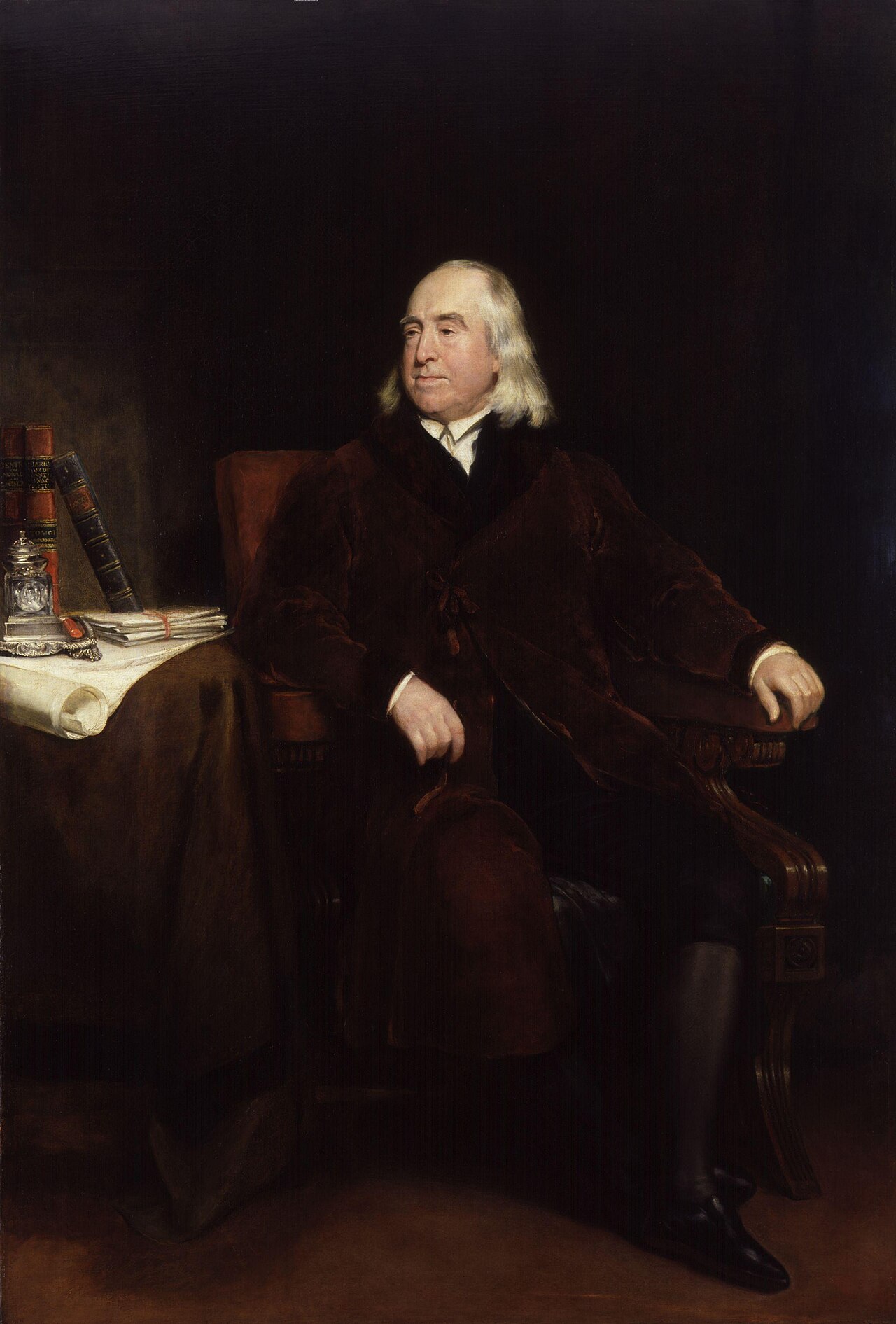
Jeremy Bentham (1748–1832) did not invent the theory as an academic exercise. He was a legal reformer who wanted a rational basis for criticizing English law, which in his day still hanged people for theft and criminalized homosexuality. His Introduction to the Principles of Morals and Legislation (printed 1780, published 1789) opens with the claim that nature has placed humanity under two sovereign masters, pain and pleasure, and that the principle of utility approves or disapproves of every action according to its tendency to increase or diminish happiness. From this he derived a program: punishment should be exactly severe enough to deter and no more, because punishment is itself a harm; laws that criminalize consensual acts producing no victim are simply bad arithmetic.
The theory’s radicalism came from its impartiality. If each person counts for one, then the pain of an enslaved person counts equally with the pleasure of a slaveholder, and the suffering of a woman denied property rights counts equally with the convenience of the men who benefit. Bentham wrote against slavery, for animal welfare, for the decriminalization of homosexual acts — in an essay drafted around 1785 that was too dangerous to publish and did not appear until 1978 — and for extending the vote to women, in a parliamentary reform plan he wrote in 1809 and published in 1817. Almost nobody else was willing to defend that list in print. His famous line about animals is that the question is not whether they can reason or talk, but whether they can suffer. Utilitarianism in its origin was not a corporate cost-benefit tool; it was a battering ram against inherited privilege.
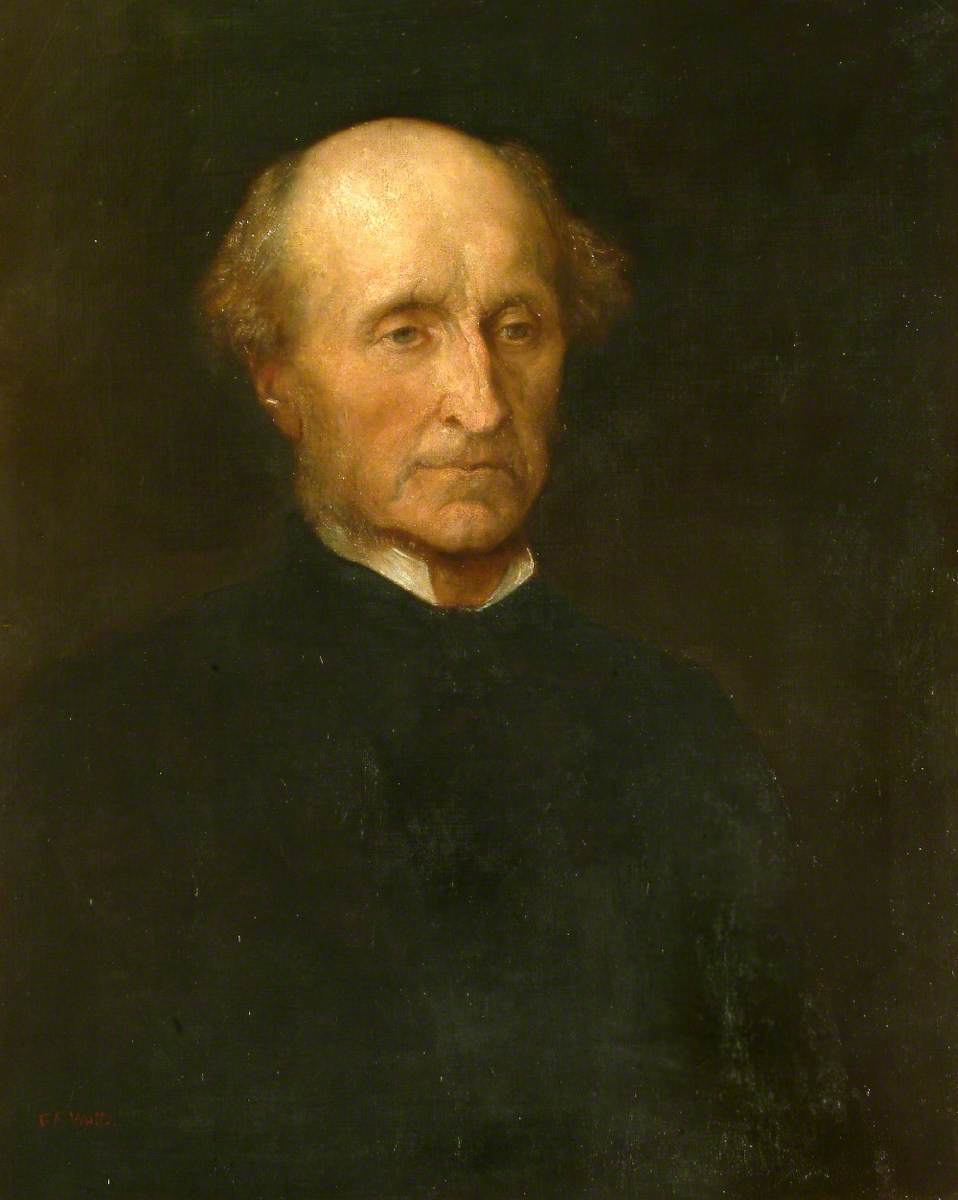
John Stuart Mill (1806–1873) inherited the project from his father James Mill and from Bentham himself, then repaired what he saw as its crudest feature. In Utilitarianism (serialized 1861, book 1863) he insisted that pleasures differ in kind and not only in amount. Some are higher pleasures — those engaging the intellect, the imagination, the moral sentiments — and are more valuable even when less intense. His test was the verdict of competent judges who have experienced both, and his conclusion was that it is better to be a human being dissatisfied than a pig satisfied. Critics from Bentham’s side have argued ever since that this smuggles in a non-hedonic standard: if quantity of pleasure is not the whole story, something other than pleasure is doing the ranking.
The felicific calculus and its descendants
Bentham proposed measuring pleasures and pains along seven dimensions: intensity, duration, certainty, propinquity (how soon), fecundity (whether it breeds more of the same), purity (whether it is free of contrary sensations), and extent (how many are affected). This felicific calculus was mocked in his own century as absurd precision about the unmeasurable, and as literal arithmetic it is unusable. But look at what survived. Intensity and duration reappear in health utility weights. Certainty reappears as probability in expected-value calculation. Propinquity reappears as the discount rate in economics and climate policy. Extent reappears as the population denominator in every epidemiological rate you read.
The lineage matters because it explains why consequentialism dominates policy without anyone declaring allegiance to it. When the U.S. Office of Management and Budget requires a regulatory impact analysis, when a hospital ethics committee weighs a scarce-resource protocol, when the World Health Organization ranks disease burdens, the underlying logic is Benthamite even if nobody at the table has read Bentham. Learning the theory is therefore not optional cultural literacy. It is learning to read the machinery you already work inside.
| Component | What it claims | Deny it and you get |
|---|---|---|
| Consequentialism proper | Only outcomes determine rightness | Deontology, virtue ethics (Ch. 4–5) |
| Welfarism | Only well-being makes outcomes good | Ideal or pluralistic consequentialism |
| Impartiality | Everyone’s well-being counts equally | Ethical egoism; partialist views |
| Aggregation by summing | Maximize the total | Prioritarianism; maximin; egalitarianism |
| Maximizing | Anything short of the best is wrong | Satisficing consequentialism |
Consequentialism is a family, and classical utilitarianism is one member of it defined by welfarism plus impartial summing — so identify which component an objection targets before you accept or reject the whole theory.
Section 2What Counts as a Good Outcome
Three theories of well-being
Consequentialism is an empty frame until you say what makes an outcome good. Derek Parfit’s Reasons and Persons (1984) gave the standard taxonomy, and it is still the cleanest map available. Hedonism says well-being consists in pleasant experience and the absence of pain. This is Bentham’s view, and its virtue is that it explains why well-being matters — nobody needs an argument for why agony is bad. Its problem is illustrated by Robert Nozick’s experience machine thought experiment (1974): a tank that gives you any experience you want, indistinguishable from reality, for life. Most people say they would not plug in. If hedonism were true, refusing would be irrational. Something other than the feel of a life apparently matters to us.
Preference satisfaction theories say well-being consists in getting what you actually want. This is the view baked into modern economics, where utility just means a ranking of preferences revealed by choice. It handles the experience machine easily: you prefer real achievement, so simulated achievement does not satisfy your preference. But it inherits new troubles. People want things that are bad for them, want things based on false beliefs, and want things whose satisfaction they will never experience. Most preference utilitarians therefore retreat to informed or idealized preferences — what you would want if you were fully informed and thinking clearly. That repair works, but notice it has quietly moved the standard away from what people actually want.
Objective list theories say certain things make a life go well whether or not they are enjoyed or wanted: health, knowledge, deep friendship, autonomy, meaningful work, achievement. Martha Nussbaum and Amartya Sen’s capabilities approach is the most developed policy version, and it underwrites the United Nations Human Development Index, which since 1990 has ranked countries by life expectancy, education, and income rather than GDP alone. The obvious objection is paternalism: who assembles the list? The obvious reply is that every welfare policy already presupposes one, and it is more honest to argue about the list openly than to pretend a preference survey is neutral.
| Theory | Well-being is… | Strongest case | Hardest problem |
|---|---|---|---|
| Hedonism | Pleasure minus pain | Explains why suffering matters at all | Experience machine; wireheading |
| Preference satisfaction | Getting what you want | Respects individual difference; measurable | Adaptive, uninformed and malicious preferences |
| Informed preference | What an informed you would want | Filters out error | Idealization does the real work, not the person |
| Objective list | Health, knowledge, friendship, autonomy | Matches how we judge lives | Who writes the list? Paternalism |
Adaptive preferences and the measurement trap
Amartya Sen documented a pattern that should unsettle any preference-based measure. In a survey taken in 1944, after the Bengal famine of 1943, widows reported themselves in good health at rates that bore almost no relation to how badly the famine had left them. The same inversion runs through modern Indian data: Kerala, which has the longest life expectancy and the best medical coverage in the country, reports the highest rates of illness, while states such as Bihar, with far worse health services and shorter lives, report the least. People calibrate what they report to what they have learned to expect and to what they have been taught to recognize as illness. Philosophers call the underlying phenomenon adaptive preference, a term from Jon Elster’s Sour Grapes (1983), and it means a satisfaction survey taken in a deprived community can return numbers as high as one taken in a prosperous one. If you allocate resources by self-reported satisfaction, you will systematically underfund the people who have learned not to ask.
This is not a reason to abandon measurement. It is a reason to triangulate. Good welfare analysis pairs subjective reports with objective indicators — anemia prevalence, functional status, school completion — precisely because each catches what the other misses. The nurse who charts a patient’s pain as “three out of ten” while watching them guard the abdomen and refuse to move has encountered the same phenomenon on a single-patient scale.
Every consequentialist calculation smuggles in a theory of well-being, and naming that theory out loud is the single most clarifying move you can make in an applied ethics argument.
Section 3Act, Rule and the Problem of Uncertainty

Act utilitarianism and its practical costs
Act utilitarianism applies the principle directly to each individual choice: perform the act, among those available, whose consequences are best. It is elegant and it is unforgiving. It implies that if breaking a promise, telling a lie, or violating a confidence would produce even slightly more good than keeping faith, you are required to do it. There is no room for a rule to stand between you and the calculation.
Three practical problems follow. The first is calculation cost: deliberating about consequences takes time you often do not have, and the deliberation itself has costs. A nurse who paused to run a felicific calculus at every med pass would harm patients. The second is epistemic limitation: consequences ramify indefinitely, and our predictions decay fast. The third is coordination failure: institutions like promising, contracts, and professional confidentiality generate their benefits precisely because they are reliable. An agent who breaks them whenever the immediate math favors it destroys the practice that made them valuable.
Sophisticated act utilitarians answer that the theory is a criterion of rightness, not a decision procedure. It tells you what makes an act right; it does not tell you to compute in the moment. If following simple rules, cultivating honest dispositions, and trusting professional protocols produces better outcomes than case-by-case calculation — and empirically it usually does — then act utilitarianism itself instructs you to follow rules. R. M. Hare developed this as a two-level view in Moral Thinking (1981): intuitive-level rules for daily life, critical-level utilitarian reasoning for hard cases and for designing the rules.
Rule utilitarianism and the collapse objection
Rule utilitarianism shifts the object of evaluation. An act is right if it conforms to a rule whose general acceptance would produce the best consequences. Richard Brandt, who coined the term in 1959, and Brad Hooker in Ideal Code, Real World (2000) are its leading defenders. The appeal is immediate: rule utilitarianism can forbid the judge from framing an innocent man, because a rule permitting judicial frame-ups would be catastrophic if generally accepted, even though this particular frame-up might maximize utility.
The classic attack, which J. J. C. Smart pressed from 1956 onward and restated in Utilitarianism: For and Against (1973), is that rule utilitarianism either collapses into act utilitarianism or becomes irrational rule worship. Consider the rule “keep your promises.” A better rule is “keep your promises unless breaking one saves a life.” Better still is one with a second exception, and a third. Push the refinement to its limit and you reach “do whatever maximizes utility,” which is act utilitarianism wearing a rule’s clothing. Refuse to refine, and you are telling someone to keep a trivial promise while a person drowns — which is fetishizing the rule over the point of the rule.
Hooker’s reply is that the collapse argument ignores the cost of rules. Rules have to be internalized by ordinary people with limited memory and motivation; a code with unlimited exceptions could not be taught or learned, so the best code to internalize is genuinely simpler than act utilitarianism. This is a real reply and many philosophers find it sufficient. Others hold that it makes rule utilitarianism a theory about codes rather than about acts, which changes the subject. The dispute is genuinely unsettled.
Expected value and the two senses of “right”
Real decisions are made under uncertainty, so mature consequentialism evaluates acts by expected value: for each possible outcome, multiply its value by its probability, and sum. A treatment with a 90 percent chance of a good result and a 10 percent chance of a bad one is compared against alternatives on that basis. This is exactly what a number needed to treat, a risk-benefit discussion, or an actuarial reserve calculation is doing.
Expected value forces a distinction. An act is objectively right if it in fact produces the best outcome, and subjectively right if it maximizes expected value given the evidence reasonably available. These come apart constantly. A physician who prescribes the drug with the best evidence base and whose patient suffers a rare fatal reaction did the subjectively right thing and the objectively wrong one. Most working consequentialists hold that praise, blame, and professional accountability track subjective rightness, because that is the only thing an agent can control. Outcome bias — judging a decision harshly because it turned out badly — is the practical error this distinction exists to prevent.
Uncertainty also generates a real technical worry. If a tiny probability is attached to an enormous value, expected value calculation can be hijacked — the problem of Pascal’s mugging, named by Eliezer Yudkowsky in 2007 and given its best-known philosophical statement in Nick Bostrom’s 2009 Analysis paper of that title. Some theorists respond with bounded value functions, some with skepticism about tiny unsupported probabilities, some with risk-averse decision rules. There is no settled solution, and honest practitioners treat vanishingly small probabilities attached to astronomically large payoffs with suspicion rather than arithmetic.
Act utilitarianism is a criterion of rightness that usually recommends rule-following, rule utilitarianism must explain why it does not collapse into act utilitarianism, and under uncertainty both must be run on expected value rather than actual outcomes.
Section 4The Objections That Bite
The separateness of persons
The deepest objection is not about arithmetic errors; it is about what the arithmetic assumes. John Rawls argued in A Theory of Justice (1971) that utilitarianism extends to society a principle of choice that is only appropriate for one person. Within a single life, it makes sense to accept pain now for greater benefit later — the person who bears the cost is the person who reaps the reward. Utilitarianism treats humanity as if it were one great person, summing across individuals as though a burden imposed on you could be compensated by a benefit to someone else. But there is no experiential ledger where that balancing happens. Rawls called this failure to take seriously the distinction between persons.
The consequence is that classical utilitarianism is indifferent to distribution. Ten units of well-being spread evenly across five people and ten units concentrated in one are, on the raw theory, equally good. Utilitarians have real replies. The diminishing marginal utility of income means that in practice, transferring a dollar from a wealthy person to a poor one usually increases the total — so utilitarianism supports redistribution on empirical grounds. But that is a contingent argument, and it fails wherever the concentration of benefit is efficient. Prioritarianism, defended by Parfit in the Lindley Lecture he delivered in 1991 and published as “Equality or Priority?”, offers a structural fix: give extra weight to benefits that go to the worse off, so a gain to someone badly off counts for more than the same gain to someone flourishing. Many contemporary theorists find this the most defensible form of the view.
Transplant, the trolley, and the integrity objection
Judith Jarvis Thomson’s transplant case (1976) is the sharpest counterexample. A surgeon has five patients dying of organ failure and one healthy person in for a checkup whose organs would save all five. Killing the healthy patient maximizes lives saved. Virtually nobody thinks the surgeon may do it. Compare Philippa Foot’s trolley case (1967), where diverting a runaway trolley kills one instead of five and most people judge that permissible. The numbers are identical; the intuitions are not. Something about using a person as a means, rather than harming them as a side effect, is doing moral work that a pure sum cannot capture. Chapter 4 takes up the doctrine that tries to explain the difference.
The utilitarian reply is institutional. A world in which surgeons harvest healthy patients is a world where nobody goes to the hospital, so the practice would be catastrophic and the rule against it is easily justified on utilitarian grounds. This is correct as far as it goes. Critics answer that it gets the right verdict for the wrong reason: the surgery is not wrong because it would erode public trust, it is wrong because it wrongs that person. If your theory says the killing would be permissible in a perfectly secret one-off case, many people take that as a reductio.
Bernard Williams pressed a different attack in 1973 with the case of Jim and the Indians. Jim, a botanist, stumbles on a captain about to execute twenty villagers; the captain offers to release nineteen if Jim personally shoots one. Utilitarianism says shoot, and Williams conceded that is probably the right answer. His objection was to the ease of it — to a theory that treats Jim’s deep revulsion at becoming a killer as one more preference to be weighed. Williams called this an assault on integrity: utilitarianism alienates agents from the projects and commitments that constitute who they are, because it requires them to be a neutral channel for the best outcome regardless of authorship.
| Objection | The charge | Best utilitarian reply | Does it fully work? |
|---|---|---|---|
| Separateness of persons | Summing ignores who bears the cost | Diminishing marginal utility; adopt prioritarianism | Only by amending the theory |
| Transplant | Permits using a person as a means | Rule-level and institutional trust effects | Right verdict, arguably wrong reason |
| Integrity | Alienates agents from their own commitments | Good agents with projects produce more good | Instrumental, so it concedes Williams’ point |
| Demandingness | Leaves no morally free space | Distinguish rightness from blameworthiness | Contested; some bite the bullet |
| Repugnant Conclusion | Total view favors vast barely-worth-living populations | Average view; critical-level views | No, each fix generates new paradoxes |
Demandingness and population paradoxes
If everyone counts equally and you must maximize, then every dollar you spend on a restaurant meal is a dollar not spent preventing a death from malaria. Peter Singer’s “Famine, Affluence, and Morality,” written in 1971 during the East Bengal refugee crisis and published in 1972, argued that if we can prevent something bad from happening without thereby sacrificing anything of comparable moral importance, we ought to do it. Consistently applied, this eliminates the category of the supererogatory — the good deed beyond the call of duty — because nothing is beyond the call. Some utilitarians accept this and simply live differently; the effective altruism movement grew directly from it. Others distinguish being wrong from being blameworthy, arguing that ordinary people are not blameworthy for failing to be saints even if a better act was available.
The strangest problem is Parfit’s Repugnant Conclusion (1984). If what matters is the total sum of well-being, then a population of ten billion people living excellent lives is worse than a sufficiently enormous population — say a hundred trillion — whose lives are barely worth living, because the sum is larger. Parfit found this repugnant and spent decades failing to escape it. Switching to average well-being avoids it but implies that adding a happy person to a very happy world is bad, and that a world containing one blissful person beats a world containing billions of merely happy ones. Critical-level views set a threshold but then imply that adding lives just below it is bad even though those lives are worth living. This is a live and genuinely unresolved area, not a settled embarrassment; in 2021 a large group of population ethicists published a statement arguing the Repugnant Conclusion should not by itself be treated as decisive against a theory.
The strongest objections — separateness of persons, using people as means, integrity, demandingness, and the Repugnant Conclusion — are not refuted so much as managed, usually by amending the theory rather than defending it whole.
Section 5Consequentialism in Working Institutions

QALYs, DALYs and the arithmetic of health policy
The quality-adjusted life year is utilitarianism operationalized. One QALY equals one year in full health; a year lived at a health utility of 0.5 counts as half a QALY. Cost-effectiveness analysis divides the incremental cost of an intervention by the incremental QALYs it produces, yielding a cost per QALY that lets a hip replacement be compared with a cancer drug. The National Institute for Health and Care Excellence, created in 1999 as the National Institute for Clinical Excellence, has since 2004 used a reference range of roughly £20,000 to £30,000 per QALY in advising the NHS in England on what to fund; above the top of that range the case for a technology has to be increasingly strong. The disability-adjusted life year, developed for the World Bank’s 1993 World Development Report and central to the Global Burden of Disease studies, counts in the opposite direction — years of healthy life lost — so lower is better.
These tools do real good. They made explicit what was previously arbitrary, and they exposed enormous variation in value for money. But every value judgment in them is contestable, and disability rights scholars have pressed the hardest case. If a year lived with quadriplegia is weighted at 0.6, then saving the life of a person with quadriplegia produces fewer QALYs than saving an otherwise identical non-disabled person — the calculation encodes a judgment that some lives are worth less to extend. There is also strong evidence of a disability paradox: people living with serious impairments consistently rate their own quality of life far higher than the general public rates it for them, and standard weights are derived largely from the general public. U.S. federal law reflects the worry directly. Section 6301 of the Affordable Care Act added section 1182 to the Social Security Act, which bars the Patient-Centered Outcomes Research Institute from developing or employing a dollars-per-QALY threshold — the statute describes it as a measure that discounts the value of a life because of a disability — and bars the Secretary of Health and Human Services from using such a threshold to determine Medicare coverage or reimbursement.
| Measure | Direction | Origin | Typical use | Chief criticism |
|---|---|---|---|---|
| QALY | Higher is better | Health economics, 1970s | NICE technology appraisal | Discounts life with disability |
| DALY | Lower is better | World Bank / WHO, 1993 | Global Burden of Disease | Original age weights valued young-adult years most |
| Cost per life saved | Lower is better | Regulatory analysis | Safety rulemaking | Ignores quality and duration of life |
| Value of a statistical life | Higher justifies more spend | Wage-risk studies | U.S. DOT and EPA rules | Derived from workers’ constrained choices |
Triage, pandemics and crisis standards
Triage is consequentialism you can watch happen. Emergency departments use five-level acuity systems to sort by urgency; mass-casualty START protocols sort by survivability with available resources. During the COVID-19 pandemic, U.S. states published crisis standards of care that would govern ventilator allocation if demand exceeded supply. Most used the Sequential Organ Failure Assessment score to estimate short-term survival, and several added tiebreakers for life-cycle considerations or for essential workers.
The controversies that followed are a case study in the theory’s limits. Several states’ early protocols categorically excluded people with certain disabilities or set aside advance directives; disability rights groups filed federal civil rights complaints in March and April 2020, and the U.S. Office for Civil Rights secured revisions in Alabama, Pennsylvania, and elsewhere. The lesson is not that triage is wrong — refusing to prioritize under genuine scarcity simply means allocating by queue position or luck, which saves fewer people. The lesson is that maximizing lives saved is a defensible goal only when the survival estimate is individualized, evidence-based, and free of proxies that encode social judgments about whose life is worth living.
Using the theory well
A working professional does not need to be a utilitarian to reason like one competently. Three habits carry most of the value. First, always ask who is inside the calculation and who was left out — future patients, family caregivers, the night shift, the people downstream. Boundary-drawing is where most consequentialist analyses go wrong, and it is usually invisible. Second, be explicit about the well-being measure and its uncertainty. A cost per QALY reported to four significant figures with no confidence interval is a rhetorical device, not a finding. Third, treat side constraints as real. Whether you ground them in rights, in rule-level utility, or in professional codes, some things stay off the table — and a decision process that never says “not that, regardless of the numbers” should worry you.
Notice too where the theory is genuinely at its best. It handles scale and probability far better than its rivals, which is why it dominates public health, safety regulation, and resource allocation. It is impartial by construction, which makes it a good corrective to institutional favoritism. And it forces you to look at results, which is a discipline any profession that has ever defended a harmful tradition on the grounds that it was tradition badly needs. The mature position, held by many working ethicists, is pluralist: run the consequentialist analysis, take it seriously, and then check it against the duties, rights, and character questions the next three chapters develop.
Consequentialist tools already govern health policy, safety regulation, and triage, so the practical skill is not choosing whether to use them but auditing their boundaries, their well-being measure, and the constraints they must not override.
The chapter in one breath
Consequentialism holds that outcomes alone determine rightness; utilitarianism adds that only well-being counts and that it should be summed impartially across everyone affected. Bentham built the theory as a reform weapon against a legal system he thought cruel and irrational, and its impartiality made it radical — it counted the enslaved, the poor, women, and animals when almost nothing else did. Mill softened it by distinguishing higher from lower pleasures, at some cost to its hedonic purity. Every application requires a theory of well-being, and the choice between hedonism, preference satisfaction, and objective lists determines who gets counted and how. Act utilitarianism supplies a criterion of rightness that usually recommends following rules; rule utilitarianism supplies the rules directly but must answer the charge that it either collapses into act utilitarianism or worships rules. Under uncertainty the theory runs on expected value, which separates being right from being lucky. The serious objections — the separateness of persons, the transplant surgeon, integrity, demandingness, the Repugnant Conclusion — are managed rather than defeated, usually by amending the theory. Meanwhile QALYs, DALYs, and triage protocols run consequentialist logic in every hospital and health ministry on earth, which makes reading the arithmetic critically a professional skill and not an academic one.
Words worth knowing
| Term | What it means |
|---|---|
| Consequentialism | The view that only the outcomes of an act determine whether it is right. |
| Utilitarianism | Consequentialism plus welfarism plus impartial aggregation of well-being. |
| Welfarism | The claim that only effects on well-being make an outcome good or bad. |
| Principle of utility | Bentham’s standard: approve of actions in proportion to their tendency to increase happiness. |
| Felicific calculus | Bentham’s seven dimensions for measuring pleasure and pain, including intensity, duration and extent. |
| Higher pleasures | Mill’s category of intellectual and moral enjoyments held superior in kind, not merely amount. |
| Hedonism | The theory that well-being consists in pleasant experience and the absence of pain. |
| Preference satisfaction | The theory that well-being consists in getting what one wants, often idealized to informed wants. |
| Objective list theory | The view that specific goods such as health, knowledge and friendship make a life go well regardless of enjoyment. |
| Adaptive preference | A want or self-report shaped downward by deprivation, which distorts satisfaction-based measurement. |
| Act utilitarianism | Each individual act is right if it produces the best available outcome. |
| Rule utilitarianism | An act is right if it conforms to a rule whose general acceptance would produce the best outcomes. |
| Criterion vs. decision procedure | What makes an act right versus how an agent should actually deliberate; the two can differ. |
| Expected value | The probability-weighted sum of an act’s possible outcomes, used for decisions under uncertainty. |
| Separateness of persons | Rawls’ objection that summing across people ignores that burdens and benefits fall on different individuals. |
| Prioritarianism | The view that a benefit matters more the worse off its recipient is. |
| Demandingness objection | The charge that impartial maximizing leaves no space for personal projects or optional good deeds. |
| Supererogatory | Morally praiseworthy but not required; a category strict utilitarianism struggles to accommodate. |
| Repugnant Conclusion | Parfit’s result that a vast population with lives barely worth living can outrank a smaller flourishing one on the total view. |
| QALY | Quality-adjusted life year: one year in full health, used to compare the value of health interventions. |
| DALY | Disability-adjusted life year: a year of healthy life lost, used to measure disease burden. |