Theories of Development
No one has ever watched a person grow up and understood everything they saw. A child says her first word, refuses a nap, lies about a broken cup, falls in love, grieves a parent — and behind each moment sit questions too large to answer by watching alone. A theory is a disciplined attempt at those answers: an organized set of ideas that explains observations and predicts what comes next. This chapter introduces the great families of developmental theory — psychoanalytic, learning, cognitive, and contextual — and the thinkers who built them. None of them is the whole truth; each is a different lens on the same growing human, and learning to switch lenses is the real skill.
By the end of this chapter you can
- Explain the core claim of the psychoanalytic approach and outline Freud's psychosexual stages and Erikson's eight psychosocial crises.
- Distinguish classical conditioning, operant conditioning, and Bandura's observational learning.
- Summarize Piaget's four stages of cognitive development and the ideas of assimilation and accommodation.
- Contrast Piaget's constructivism with Vygotsky's sociocultural theory and the zone of proximal development.
- Describe the information-processing model of the developing mind.
- Map Bronfenbrenner's five ecological systems and give an example of each.
- Compare the theories on the great debates — nature versus nurture, continuity versus discontinuity, active versus passive — and say what each explains best.
Section 1Psychoanalytic theories
The idea beneath the surface
The psychoanalytic tradition begins with a single unsettling claim: much of what drives us is hidden from us. Sigmund Freud, a Viennese physician working at the turn of the twentieth century, argued that behavior is shaped by unconscious forces — drives, memories, and conflicts we cannot directly see — and that the shape of the adult personality is set early, in the emotional weather of the first years of life. You do not have to accept Freud's every conclusion to feel the pull of the idea. Anyone who has watched a toddler melt down over a demand they cannot name, or an adult repeat a pattern they swear they hate, has met the unconscious at work.
Freud pictured the mind as a contest among three parts. The id is the newborn's raw engine of want — it demands satisfaction now. The ego, forming across infancy, is the negotiator that finds realistic ways to meet those wants. The superego, arriving with early childhood, is the internalized voice of conscience and culture. Development, in this view, is the long project of balancing appetite, reality, and rule.
Freud's psychosexual stages
Freud proposed that a child's energy settles, stage by stage, on a different region of the body, and that how caregivers handle the tension at each stage leaves a lasting imprint. Too little or too much gratification produces fixation — a bit of the personality left permanently parked at that stage. The oral stage (birth to ~1 year) centers on the mouth and on trust in being fed; the anal stage (~1–3 years) on toilet training and control; the phallic stage (~3–6 years) on identification with the same-sex parent; a quiet latency period (~6–puberty) when the drives go underground and skills bloom; and finally the genital stage of mature adult intimacy. Modern developmentalists treat the specific mechanisms with heavy skepticism — the theory is hard to test and reflects its era's biases — but Freud's larger gifts endure: the unconscious, the importance of early relationships, and the very idea of stages.
Erikson's eight psychosocial crises
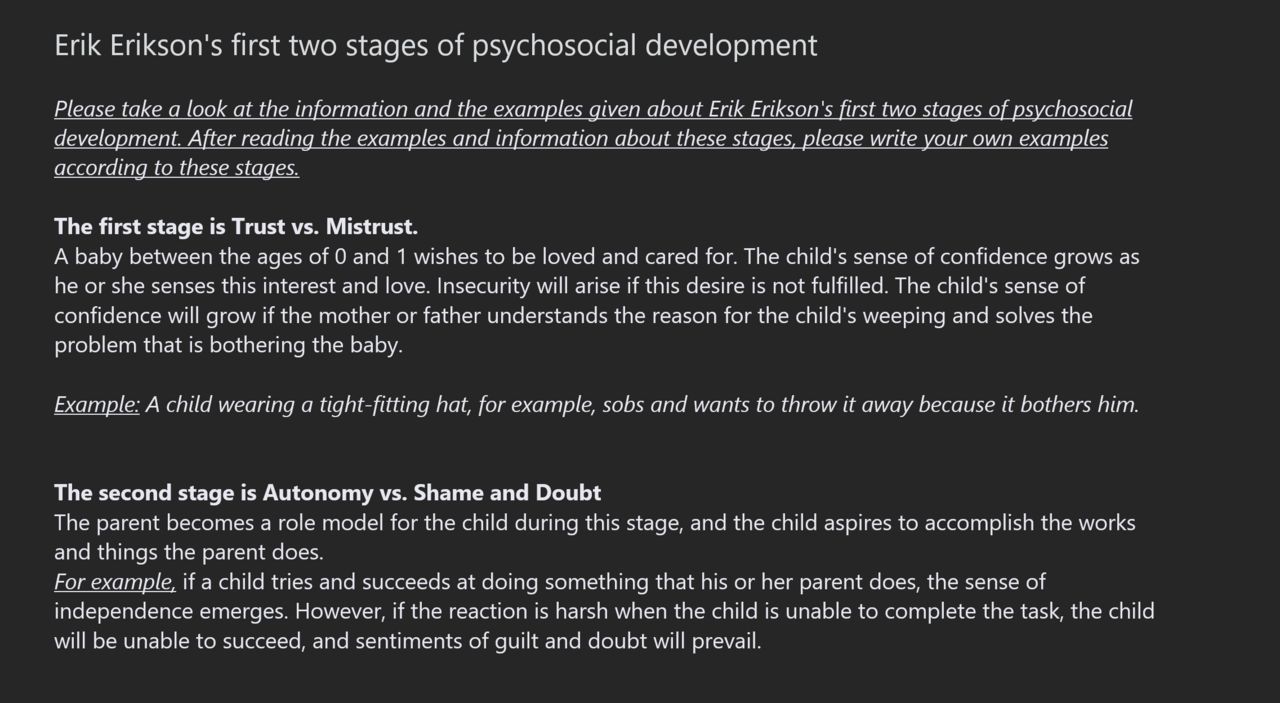
Erik Erikson, trained in Freud's circle, kept the stage structure but changed its engine. Development, he said, is driven not by bodily zones but by psychosocial tasks — the demands that relationships and society place on us — and it does not stop at puberty. Erikson mapped eight stages across the whole lifespan, each a crisis, a turning point between a healthier and a less healthy resolution. Resolve it well and you gain a lasting virtue; resolve it poorly and the difficulty is carried forward. Crucially, the stages are not pass–fail: earlier crises can be reworked, and later ones build on what came before.
| Stage (age) | Crisis | Central question | Virtue |
|---|---|---|---|
| Infancy (0–1) | Trust vs. mistrust | Can I count on the world? | Hope |
| Toddler (1–3) | Autonomy vs. shame & doubt | Can I do things myself? | Will |
| Preschool (3–6) | Initiative vs. guilt | Is it okay to make and plan? | Purpose |
| School age (6–12) | Industry vs. inferiority | Am I capable and competent? | Competence |
| Adolescence (12–18) | Identity vs. role confusion | Who am I? | Fidelity |
| Young adult (18–40) | Intimacy vs. isolation | Can I love and be close? | Love |
| Midlife (40–65) | Generativity vs. stagnation | Have I made my life count? | Care |
| Late life (65+) | Integrity vs. despair | Was my life worthwhile? | Wisdom |
Erikson's very first crisis — trust versus mistrust — overlaps a research tradition of its own. Building on John Bowlby's work, Mary Ainsworth devised the Strange Situation, watching how one-year-olds react when a caregiver leaves and returns. She described distinct attachment patterns: secure (upset at the leaving, comforted and quickly settled at the return), insecure-avoidant (little reaction either way), and insecure-resistant (also called ambivalent — hard to soothe, clingy and angry at once); a fourth, disorganized, was added later by Mary Main and Judith Solomon for children with no coherent strategy. A securely attached baby is Erikson's trusting baby, seen through a different instrument.
- The psychoanalytic approach says unconscious forces and early relationships shape the personality.
- Freud proposed psychosexual stages (oral, anal, phallic, latency, genital) and the id–ego–superego structure; the specifics are now largely rejected, the framing kept.
- Erikson recast development as eight lifelong psychosocial crises, each yielding a virtue — from trust vs. mistrust to integrity vs. despair.
- Ainsworth's attachment patterns — secure, avoidant, resistant — grew from this tradition; a fourth, disorganized, was added later by Main and Solomon.
Section 2Learning theories
Development as learning
Where psychoanalysts looked inward at hidden drives, the behaviorists looked outward and refused to guess about the unseen. John Watson, their American founder, insisted that psychology study only what can be measured: observable behavior and the environment that shapes it. Development, on this view, is not the unfolding of stages but the steady accumulation of learning — and it is continuous, without the sharp steps the stage theorists loved. Watson's famous boast, that he could take any healthy infant and train it into any profession, is a caricature of nurture — but it names the learning theorist's core faith: experience, not destiny, writes the person.
Classical conditioning
The first mechanism came from a Russian physiologist studying dog saliva. Ivan Pavlov noticed that his dogs began drooling before food arrived — at the footsteps of the attendant. In classical conditioning, a neutral signal that reliably precedes a meaningful event comes to trigger the response on its own. Food (the unconditioned stimulus) naturally produces salivation (the unconditioned response); pair a bell with the food enough times and the bell alone (now a conditioned stimulus) produces salivation (a conditioned response). Watson showed the same process builds emotions in humans: in the ethically notorious “Little Albert” study, an infant learned to fear a white rat after it was paired with a frightening noise. Much of how children come to love a lullaby or dread a doctor's office runs on exactly this machinery.
Operant conditioning
Edward Thorndike's law of effect added a second mechanism: behaviors followed by satisfying consequences are repeated, and those followed by unpleasant ones fade. B. F. Skinner built this into operant conditioning, the shaping of voluntary behavior by its consequences. Reinforcement makes a behavior more likely; punishment makes it less likely. Each comes in two flavors, and the words positive and negative here mean “adding” and “removing,” not “good” and “bad” — the single most misread pair of terms in the field.
| Procedure | What happens | Effect | Everyday example |
|---|---|---|---|
| Positive reinforcement | Add something pleasant | Behavior ↑ | Praise for sharing → more sharing |
| Negative reinforcement | Remove something unpleasant | Behavior ↑ | Nagging stops when chore is done → more chores |
| Positive punishment | Add something unpleasant | Behavior ↓ | Scolding after a tantrum → fewer tantrums |
| Negative punishment | Remove something pleasant | Behavior ↓ | Losing screen time for hitting → less hitting |
Timing and pattern matter enormously. Reinforcement that comes immediately teaches faster than reinforcement delayed, and — counterintuitively — behaviors rewarded only sometimes are the hardest to extinguish, which is exactly why a child who occasionally gets candy for whining at the checkout will whine louder and longer than one who never does.
Bandura's social learning
Albert Bandura agreed that consequences matter but showed they need not be your own. In his classic Bobo doll experiments, children who merely watched an adult punch an inflatable clown were far more likely to punch it themselves — observational learning, learning by watching a model. This one finding cracked behaviorism open: between the stimulus and the response sits a thinking child who attends, remembers, and decides whether to imitate. Bandura called the mature version social cognitive theory, and he added a pivotal idea — self-efficacy, your belief in your own ability to succeed at a task, which shapes what you will even attempt. A child surrounded by capable, encouraging models does not just copy skills; she builds the confidence to try.
- Learning theories explain development as continuous change driven by the environment.
- Classical conditioning (Pavlov, Watson) links a neutral signal to an automatic response.
- Operant conditioning (Thorndike, Skinner) shapes voluntary behavior through reinforcement and punishment — where positive/negative mean add/remove.
- Bandura added observational learning and self-efficacy: children learn by watching models and by believing they can.
Section 3Cognitive theories
Piaget: the child as scientist
Jean Piaget, a Swiss biologist who came to psychology in Paris around 1920 while helping standardize Binet's intelligence tests — where the patterned wrong answers children gave caught his attention — gave development its most influential map of the mind. He saw children not as small adults who simply know less, but as thinkers who reason in qualitatively different ways at different ages. Knowledge, he argued, is built — constructivism — through mental structures he called schemas. A baby with a “grasping” schema meets the world by grabbing it. When new experience fits an existing schema, the child uses assimilation (calling a whale a “fish”); when it will not fit, the child must accommodate — revise the schema (learning that whales are something else). The push and pull between these two, seeking a balance Piaget called equilibration, is the motor of cognitive growth.
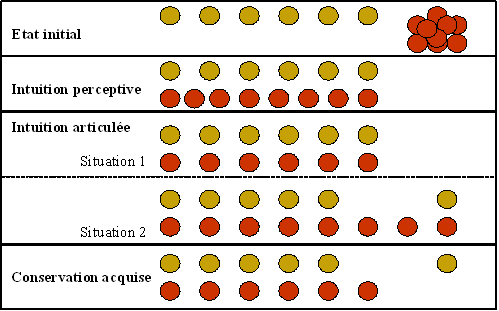
Piaget proposed four broad stages, each a reorganization of how thought works. The infant in the sensorimotor stage — a stage he mapped through years of detailed observation of his own three children — knows the world through action and senses, and its great achievement is object permanence — grasping that things still exist when out of sight. The preoperational child is a fountain of language and imagination but reasons by appearance, is egocentric (struggles to take another's viewpoint), and fails conservation — the understanding that quantity survives a change in shape. The concrete operational child masters logic about tangible things and now conserves, but stumbles on the abstract. Only in formal operational thought can the adolescent reason about hypotheticals, ethics, and what merely might be.
| Stage | Age (approx.) | Hallmark of thinking | Key achievement |
|---|---|---|---|
| Sensorimotor | 0–2 | Knows through senses & movement | Object permanence |
| Preoperational | 2–7 | Symbols & language; egocentric; no conservation | Pretend play, language |
| Concrete operational | 7–11 | Logic about concrete things; conserves | Reversibility, classification |
| Formal operational | 11+ | Abstract & hypothetical reasoning | “What if” thinking |
Lawrence Kohlberg extended Piaget's logic to right and wrong. Using moral dilemmas, he described three levels of moral reasoning: preconventional (avoid punishment, seek reward), conventional (follow rules and please others), and postconventional (reason from abstract principles of justice). As with Piaget, it is the reasoning behind the choice, not the choice itself, that marks the level.
Vygotsky: thinking is social first
Lev Vygotsky, a Russian psychologist who died young but whose ideas surged decades later, agreed that children build knowledge — but insisted they never build it alone. In his sociocultural theory, cognition grows out of relationships and the tools a culture hands down, language chief among them. His signature idea is the zone of proximal development (ZPD): the gap between what a learner can do alone and what she can do with help from a more knowledgeable other. Learning happens inside that zone, through scaffolding — support that is rich at first and withdrawn as the child takes over, exactly as scaffolding comes off a finished building. Where Piaget saw a solitary young scientist, Vygotsky saw an apprentice; the child's private muttering during a hard puzzle (private speech) is, for him, thought being born from conversation.
Information processing: the mind as computer
A third cognitive approach borrows its metaphor from the machine. Information-processing theory drops the idea of stages entirely and asks how the mind takes information in, holds it, and gets it back out — encoding, storage, and retrieval. It pictures a flow: fleeting sensory memory, a limited working memory where thinking actually happens, and a vast long-term memory for lasting storage. On this account children get smarter not by leaping to a new stage but by gradual, continuous gains — a bigger working-memory span, faster processing, better attention, and richer strategies like rehearsal and organization. It explains beautifully why a six-year-old cannot hold a long instruction in mind that a twelve-year-old handles with ease.
- Piaget saw children constructing knowledge through schemas, assimilation, and accommodation, across four stages: sensorimotor, preoperational, concrete operational, formal operational.
- Landmarks: object permanence (sensorimotor) and conservation (concrete operational); Kohlberg extended the model to moral reasoning.
- Vygotsky made cognition social — the zone of proximal development and scaffolding.
- Information-processing theory frames the mind as encoding, storage, and retrieval, improving gradually with working memory and attention.
Section 4Contextual theories
The child in the whole picture
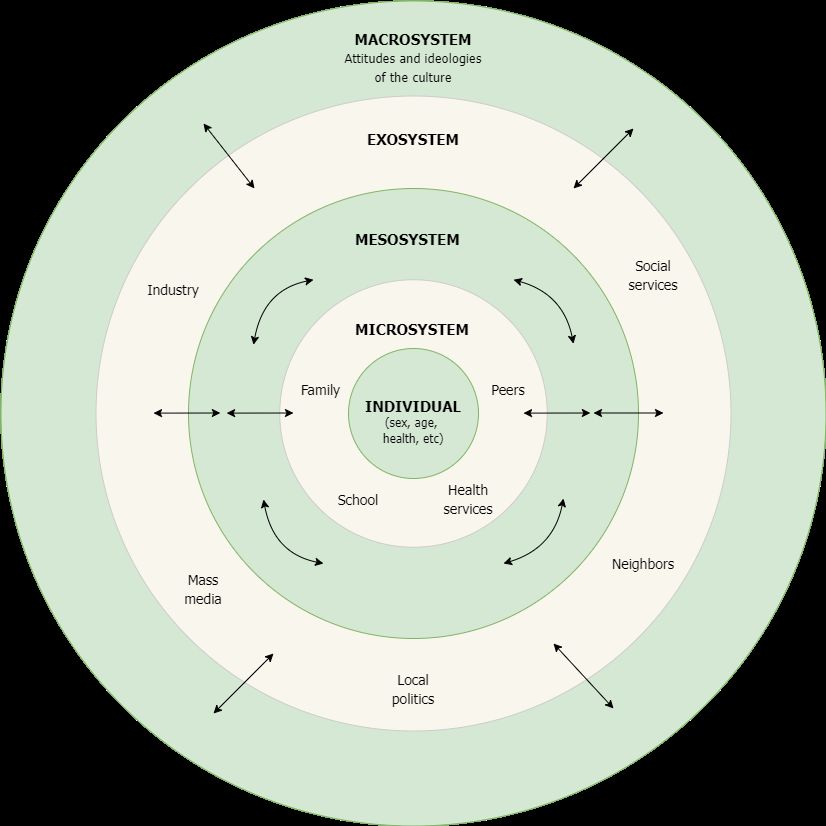
Every theory so far puts something inside the child at the center — a drive, a habit, a mind. The contextual approach turns the camera around and widens the shot. Urie Bronfenbrenner argued that you cannot understand a developing person apart from the layered environments that surround them, from the intimate to the sweeping. His ecological systems theory pictures the child at the center of a set of nested circles, like the rings of an onion, each influencing the person and being influenced in return.
The five systems
The innermost ring, the microsystem, is the child's immediate, face-to-face world — family, close friends, a classroom. One ring out, the mesosystem, is not a place but a set of connections: how the microsystems talk to each other, such as whether a parent and a teacher coordinate. The exosystem holds settings the child never enters but that shape their life anyway — a parent's workplace, the local school board. The vast macrosystem is the surrounding culture: its economy, laws, values, and beliefs about childhood itself. And running through all of them is the chronosystem, the dimension of time — how a person and their world change across years and across history, so that growing up during a pandemic or a boom is itself a developmental force.
| System | What it is | Example |
|---|---|---|
| Microsystem | Immediate settings the child is in | Home, classroom, best friend |
| Mesosystem | Links between microsystems | Parent–teacher communication |
| Exosystem | Settings that affect the child indirectly | A parent's job, the school board |
| Macrosystem | The broad culture and its values | Laws, economy, beliefs about childhood |
| Chronosystem | Change over time | A divorce; growing up during a recession |
Why context is not just background
The power of the ecological view is that it forbids easy blame. A child who struggles in school is not simply “unmotivated”; the same child sits inside a family under stress (microsystem), a broken line between home and school (mesosystem), a parent working two jobs with no leave (exosystem), and a culture that funds some schools far better than others (macrosystem) — all shifting over time (chronosystem). Bronfenbrenner later stressed that these layers act through everyday proximal processes: the reliable, back-and-forth interactions — reading together, sharing meals, working a puzzle — that are the true engines of development. Context matters most in how it reaches down into those ordinary daily moments.
- Contextual theories place the developing person inside layered environments rather than inside a single inner mechanism.
- Bronfenbrenner's ecological systems nest five layers: microsystem, mesosystem, exosystem, macrosystem, and chronosystem (time).
- The layers act through everyday proximal processes — the ordinary repeated interactions that actually drive growth.
- The view reframes problems and solutions at the level of family, community, and culture, not the child alone.
Section 5Comparing the theories
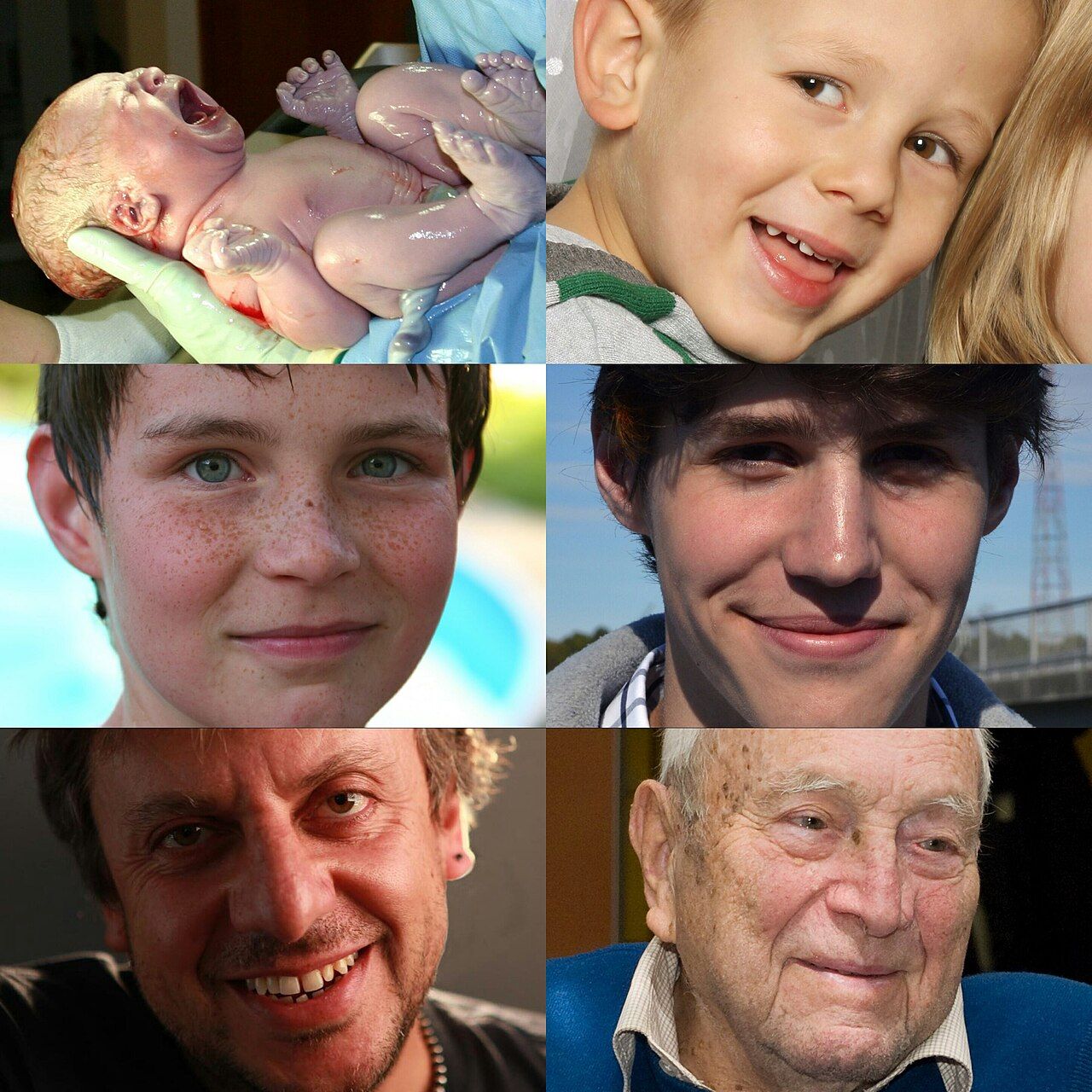
Different lenses on the same child
It is tempting to ask which theory is right, but that is the wrong question — like asking whether a map of roads is better than a map of rivers. Each theory was built to answer a particular kind of question, and each is strongest exactly where it looks hardest. Watch a four-year-old refuse to share a toy: a psychoanalyst asks what her early relationships taught her about trust, a learning theorist asks what sharing has been reinforced or punished, a cognitive theorist asks whether she can yet grasp another child's point of view, and a contextual theorist asks about the family and culture that frame the moment. All four are partly right. The mature developmentalist keeps every lens on the shelf and reaches for the one the question needs.
The great debates
Theories divide along a few deep fault lines, and knowing a theory's stance on these predicts almost everything else about it. The nature–nurture debate asks how much of development is written by biology and how much by experience — though today's answer is nearly always “both, interacting.” The continuity–discontinuity debate asks whether development is a smooth ramp (the learning and information-processing theorists) or a staircase of distinct stages (Freud, Erikson, Piaget). The active–passive debate asks whether children build their own development (Piaget's little scientist) or are shaped by forces around them (classical behaviorism). And the stability–change debate asks whether early traits last a lifetime or whether we keep remaking ourselves — Erikson's lifespan optimism against Freud's early determinism.
| Theory | Explains best | Watch out for |
|---|---|---|
| Psychoanalytic (Freud, Erikson) | Emotion, personality, early relationships, lifespan identity | Hard to test scientifically |
| Learning (Pavlov, Skinner, Bandura) | How specific behaviors, fears, and habits are acquired | Can slight thought, biology, and stages |
| Cognitive (Piaget, Vygotsky, info-processing) | How thinking, reasoning, and knowledge change with age | Underplays emotion and motivation |
| Contextual (Bronfenbrenner) | How culture, family, and society shape the person | Less precise about internal mechanisms |
Choosing a lens — and beyond childhood
Because these theories are complementary, most modern research is frankly eclectic: it borrows what fits the question and the age. Studying language delay? Reach for information-processing and Vygotsky. Designing a behavior plan? Operant conditioning. Understanding an adolescent's search for self? Erikson. And because this is a lifespan book, remember that development does not end at adulthood or even at illness. Elisabeth Kübler-Ross, studying dying patients, described five reactions to loss — denial, anger, bargaining, depression, and acceptance — that many people move through unevenly, out of order, and never as a neat checklist. Her work, like Erikson's, insists that the final chapters of life are developmental too, and it will return when we reach the end of the human arc.
- The theories are complementary lenses, each strongest on the question it was built to answer.
- Know a theory by its stance on the great debates: nature–nurture, continuity–discontinuity, active–passive, and stability–change.
- Stage theories (Freud, Erikson, Piaget) favor discontinuity; learning and information-processing favor continuity.
- Real research is eclectic, and a lifespan view — through Erikson and Kübler-Ross — extends development all the way to loss and old age.
The chapter in one breath
- A theory organizes observations and predicts development; four great families each offer a different lens.
- Psychoanalytic theory (Freud's psychosexual stages, Erikson's eight psychosocial crises) centers unconscious drives and early relationships, and Erikson stretched it across the whole lifespan.
- Learning theory explains behavior through classical conditioning (Pavlov), operant conditioning (Skinner's reinforcement and punishment), and Bandura's observational learning and self-efficacy.
- Cognitive theory maps how thinking changes: Piaget's four stages, Vygotsky's socially built mind and the zone of proximal development, and the information-processing model.
- Contextual theory (Bronfenbrenner) nests the child inside micro-, meso-, exo-, macro-, and chronosystems.
- The theories are complementary, dividing along nature–nurture, continuity–discontinuity, and active–passive; good practice is eclectic.
- Attachment (Ainsworth), moral reasoning (Kohlberg), and grief (Kübler-Ross) extend these ideas across the full arc of life.
ReferenceWords worth knowing
A quick reference for the terms in this chapter — skim it now, or circle back whenever a word trips you up.
- Accommodation
- In Piaget's theory, revising an existing schema to fit new information that will not otherwise fit.
- Assimilation
- In Piaget's theory, interpreting new experience by fitting it into an existing schema.
- Attachment
- The enduring emotional bond between child and caregiver; Ainsworth described secure, avoidant, and resistant patterns; a fourth, disorganized, was added later by Main and Solomon.
- Behaviorism
- The school of psychology that studies only observable behavior and the environment that shapes it.
- Classical conditioning
- Learning in which a neutral stimulus, paired with a meaningful one, comes to trigger the same response (Pavlov).
- Continuity–discontinuity debate
- The question of whether development is gradual and smooth or proceeds in distinct stages.
- Ecological systems theory
- Bronfenbrenner's model of the person nested within micro-, meso-, exo-, macro-, and chronosystems.
- Id, ego, and superego
- Freud's three parts of the mind: raw desire, the realistic negotiator, and the internalized conscience.
- Information processing
- A cognitive approach that models the mind as encoding, storing, and retrieving information, improving gradually with age.
- Nature and nurture
- The interacting contributions of biology (nature) and experience (nurture) to development.
- Object permanence
- The understanding that objects continue to exist when out of sight; a sensorimotor achievement.
- Observational learning
- Learning by watching and imitating a model, central to Bandura's social cognitive theory.
- Operant conditioning
- Learning in which voluntary behavior is shaped by its consequences — reinforcement and punishment (Skinner).
- Psychosexual stages
- Freud's sequence — oral, anal, phallic, latency, genital — through which personality is thought to form.
- Psychosocial crisis
- In Erikson's theory, the central conflict of each of eight life stages, resolved toward a lasting virtue.
- Reinforcement
- Any consequence that makes a behavior more likely; positive adds a stimulus, negative removes one.
- Scaffolding
- Support a more knowledgeable person gives a learner, gradually withdrawn as skill grows (Vygotsky).
- Schema
- A mental structure that organizes knowledge and guides how a person interprets the world.
- Self-efficacy
- A person's belief in their own ability to succeed at a task; a key idea in Bandura's theory.
- Zone of proximal development
- The gap between what a learner can do alone and what they can do with help (Vygotsky).