The Endocrine System, Abbreviations and Documentation
The endocrine system speaks in chemical messages, and its vocabulary follows suit: a gland, a hormone, an organ that responds, and a word part for each. Once you know that aden/o means gland, crin/o means to secrete, and -tropin names a hormone that stimulates another gland, terms like adenohypophysis and thyrotropin stop being alphabet soup and start being sentences. This chapter walks the glands from pituitary to pancreas, decoding the pathology, diagnostic and surgical terms you will meet on a real chart. Then it turns to the other half of the title: the abbreviations and documentation conventions that carry all of this vocabulary through a working shift. You will learn the SOAP note, the sections of a chart, and the short list of abbreviations that the Joint Commission has ruled too dangerous to write — because in endocrine care especially, a misread U can cost a patient ten times the insulin dose intended.
By the end of this chapter you can
- Define the combining forms aden/o, crin/o, thyr/o, adren/o, pancreat/o, glyc/o and calc/i, and use them to decode unfamiliar endocrine terms.
- Distinguish endocrine from exocrine secretion and explain what the suffixes -tropin, -tropic and -uria contribute to a term.
- Break down and pronounce acromegaly, exophthalmos, myxedema, pheochromocytoma, hypophysectomy and ketoacidosis.
- Separate the classic look-alikes: aden/o vs adren/o, gluc/o vs glyc/o, calc/i vs kal/i, and -tropin vs -trophy.
- Contrast diabetes mellitus with diabetes insipidus, and Cushing disease with Cushing syndrome.
- Interpret the endocrine abbreviations a student meets on a chart, including TSH, PTH, ADH, A1C, FBG, OGTT, DKA and SIADH.
- Name the four parts of a SOAP note and place a finding in the correct one.
- List the entries on the Joint Commission Do Not Use abbreviation list and write the approved alternative for each.
- Apply the standard singular-to-plural rules to cortex, medulla, testis, adenoma and diagnosis.
Section 1Glands, Hormones and the Language of Chemical Control
Two ways to secrete, one root
The word endocrine (EN-doh-krin) is built from endo-, meaning within, and crin/o, meaning to secrete. An endocrine gland secretes within — it has no duct, so it releases its product straight into the bloodstream and lets the circulation carry it to a distant target. Its opposite is exocrine (EK-soh-krin), from exo-, meaning outside: an exocrine gland pours its product through a duct onto a surface or into a hollow organ. Sweat glands, salivary glands and the enzyme-producing part of the pancreas are exocrine. The same anatomical term, pancreas, therefore covers both kinds of tissue, which is exactly why the pancreas shows up twice in this chapter.
The chemical messenger itself is a hormone, from a Greek verb meaning to set in motion. That is a fair description: a hormone released in the neck can change how a cell in the foot burns fuel. The study of these glands and messengers is endocrinology, and the physician who practices it is an endocrinologist. Decode it: endo/crin/o/logy = within + to secrete + study of = the study of internal secretions. A gland that is underworking is hypofunctioning; one that is overproducing is hyperfunctioning. Almost every endocrine disease in this chapter is one of those two words attached to one gland name.
The general root for gland is aden/o. A benign glandular tumor is an adenoma (ad-eh-NOH-mah): aden/oma = gland + tumor. A malignant one is an adenocarcinoma. Enlarged glands are adenomegaly. Notice how much mileage one root gives you before a single specific gland has been named.
| Word part | Meaning | Example term | What the example means |
|---|---|---|---|
| aden/o | gland | adenoma | Tumor of a gland (usually benign) |
| crin/o | to secrete | endocrinology | Study of internal (ductless) secretions |
| endo- | within | endocrine | Secreting within, into the bloodstream |
| exo- | outside | exocrine | Secreting outward through a duct |
| hormon/o | hormone | hormonal | Pertaining to a hormone |
| home/o | sameness, unchanging | homeostasis | Maintaining a steady internal state |
| gonad/o | sex glands (ovaries, testes) | gonadotropin | Hormone that stimulates the sex glands |
| thym/o | thymus gland | thymectomy | Surgical removal of the thymus |
| pineal/o | pineal gland | pinealoma | Tumor of the pineal gland |
| toxic/o | poison | thyrotoxicosis | Abnormal condition of thyroid poisoning (severe excess) |
The suffixes that name hormones and their effects
Endocrine vocabulary leans hard on a small set of suffixes. The most important is -tropin, which names a hormone that stimulates another gland, and its adjective form -tropic, meaning stimulating or acting on. Thyrotropin is the hormone that stimulates the thyroid; the adjective thyrotropic describes anything that acts on the thyroid. Decode adren/o/cortic/o/tropic = adrenal + cortex + stimulating: adrenocorticotropic hormone, or ACTH, is the pituitary hormone that stimulates the adrenal cortex. Once you see the pattern, the whole anterior pituitary panel reads itself.
Two more suffixes carry most of the clinical weight. -emia means a condition of the blood, and -uria means a condition of the urine. They combine with the same roots to make paired terms that mean very different things: glycemia is sugar in the blood, glycosuria (gly-kohs-YOO-ree-ah) is sugar in the urine. A patient can have one without the other, and a nurse who mixes them up will chart the wrong finding. Add hyper- and hypo- and you have four terms from one root.
The remaining suffixes are the general-purpose ones you already own. -megaly is enlargement, -osis is an abnormal condition, -ism is a state or condition, -itis is inflammation, -ectomy is surgical removal. Hyperthyroidism decodes as hyper/thyroid/ism = excessive + thyroid + condition. Thyroiditis is inflammation of the thyroid. Thyroidectomy (thy-royd-EK-toh-mee) is its removal. Nothing new — only a new root feeding familiar endings.
| Suffix or prefix | Meaning | Example term | What the example means |
|---|---|---|---|
| -tropin | hormone that stimulates a gland | somatotropin | Growth hormone (stimulates body growth) |
| -tropic | stimulating, acting on | gonadotropic | Acting on the sex glands |
| -emia | blood condition | hypercalcemia | Excessive calcium in the blood |
| -uria | urine condition | polyuria | Excessive production of urine |
| -dipsia | thirst | polydipsia | Excessive thirst |
| -phagia | eating, swallowing | polyphagia | Excessive eating (hunger) |
| -physis | growth | hypophysis | The pituitary gland (grows beneath the brain) |
| eu- | normal, good | euthyroid | Having normal thyroid function |
| hyper- | excessive, above normal | hyperglycemia | Excessive sugar in the blood |
| hypo- | deficient, below normal | hypoglycemia | Deficient sugar in the blood |
| pan- | all | panhypopituitarism | Deficiency of all pituitary hormones |
The one-letter trap that runs through this whole chapter. Aden/o means gland in general. Adren/o and adrenal/o mean the adrenal gland specifically — and they contain an extra r. An adenoma is a glandular tumor anywhere; an adrenalectomy (ah-dree-nal-EK-toh-mee) removes an adrenal gland. Read the root letter by letter before you commit. And do not let adenoid/o join the confusion: the adenoids are lymphoid tissue in the nasopharynx, not an endocrine structure at all.
Homeostasis and the feedback loop
The word that explains why endocrine terms come in hyper- and hypo- pairs is homeostasis (hoh-mee-oh-STAY-sis): home/o (sameness) + -stasis (control, stopping, standing still) = keeping the internal environment constant. Glands hold hormone levels inside a narrow range using negative feedback, in which a rising hormone level shuts off the signal that produced it. That single mechanism explains a lab result students find backwards: in primary hypothyroidism, the thyroid hormone is low and the TSH is high, because the pituitary is shouting at a gland that will not answer.
Because feedback runs in a loop, endocrine disease is described as primary or secondary. Primary means the target gland itself has failed or gone rogue. Secondary means the problem is upstream, in the pituitary that controls it. Tertiary puts the fault one level higher still, in the hypothalamus. These three words appear constantly in endocrine documentation, and they are not vague adjectives — each names a specific level of the loop.
Endocrine terminology is built from a gland root plus a familiar ending, so learning aden/o, crin/o, -tropin, -emia and -uria unlocks most of the chapter before any individual gland is memorized.
Section 2The Pituitary, Thyroid and Parathyroid Glands
The pituitary: two glands in one small space
The pituitary sits in a bony pocket at the base of the skull and carries two names. Pituitar/o gives the familiar adjective pituitary; hypophys/o gives the formal anatomical name hypophysis (high-POF-ih-sis), which decodes as hypo- (beneath) + -physis (growth) = the growth beneath the brain. Surgeons use the second root, which is why the operation is a hypophysectomy (high-poff-ih-SEK-toh-mee), not a pituitarectomy. The gland has a front and a back lobe with different tissue and different hormones: the adenohypophysis (ad-eh-noh-high-POF-ih-sis), literally the glandular pituitary, is the anterior lobe, and the neurohypophysis is the posterior lobe, which stores hormones made in the hypothalamus.
Because the pituitary directs so many other glands, it is nicknamed the master gland, and its disorders are named for the hormone in excess or deficit. Too much growth hormone before the growth plates close produces gigantism. Too much after they close produces acromegaly (ak-roh-MEG-ah-lee): acr/o (extremities) + -megaly (enlargement) = enlargement of the extremities, since the hands, feet and jaw thicken rather than lengthen. Deficiency of all pituitary hormones is panhypopituitarism (pan-high-poh-pih-TOO-ih-tah-rizm), a four-part word that reads cleanly once split: pan/hypo/pituitar/ism = all + deficient + pituitary + condition.
The posterior lobe releases antidiuretic hormone (ADH), which tells the kidney to conserve water. Break it down: anti- (against) + diuretic, itself from dia- (through) + ur/o (urine) = acting against the loss of water in urine. Too little ADH causes diabetes insipidus, in which the patient passes enormous volumes of dilute urine. Too much causes SIADH, the syndrome of inappropriate antidiuretic hormone, in which water is retained and the serum sodium falls — charted as hyponatremia (high-poh-nah-TREE-mee-ah), from natr/o, sodium.
| Word part | Meaning | Example term | What the example means |
|---|---|---|---|
| pituitar/o | pituitary gland | hypopituitarism | Deficient pituitary hormone production |
| hypophys/o | pituitary gland | hypophysectomy | Surgical removal of the pituitary gland |
| acr/o | extremities, top | acromegaly | Enlargement of hands, feet and facial bones |
| somat/o | body | somatotropin | Growth hormone acting on body tissues |
| thyr/o, thyroid/o | thyroid gland (shield) | thyroiditis | Inflammation of the thyroid gland |
| parathyroid/o | parathyroid glands | hyperparathyroidism | Excessive parathyroid hormone production |
| calc/i, calc/o | calcium | hypocalcemia | Deficient calcium in the blood |
| iod/o | iodine | radioiodine | Radioactive iodine used to image or treat the thyroid |
| myx/o | mucus | myxedema | Mucus-like swelling of severe hypothyroidism |
| ophthalm/o | eye | exophthalmos | Outward protrusion of the eyeballs |
| natr/o | sodium | hypernatremia | Excessive sodium in the blood |
| kal/i | potassium | hyperkalemia | Excessive potassium in the blood |
Calc/i is calcium, kal/i is potassium. They differ by two letters and they are both electrolytes, which makes them one of the most dangerous look-alike pairs in the chapter. Hypercalcemia is too much calcium; hyperkalemia is too much potassium. The chemical symbols help: calcium is Ca, potassium is K (from kalium), and it is the k spelling that points to potassium. Sodium follows the same logic — natr/o from natrium, symbol Na.
The thyroid: metabolism, and the words for its extremes
Thyr/o and thyroid/o both mean the thyroid gland, whose name comes from the Greek for shield. It sits over the trachea as two lobes joined by a narrow bridge called the isthmus. It makes triiodothyronine (T3) and thyroxine (T4), named for the number of iodine atoms each carries — which is why iod/o matters here and almost nowhere else, and why radioactive iodine can both image and treat the gland.
Excess thyroid hormone is hyperthyroidism, and its severe form is thyrotoxicosis (thy-roh-tok-sih-KOH-sis): thyr/o + toxic/o (poison) + -osis = abnormal condition of thyroid poisoning. The most common cause is Graves disease, an autoimmune disorder that may produce exophthalmos (ek-sof-THAL-mos), from ex- (out) + ophthalm/o (eye) = eyes bulging outward. Deficiency is hypothyroidism, most often from Hashimoto thyroiditis; its extreme, with puffy non-pitting swelling of the face and hands, is myxedema (mik-seh-DEE-mah), from myx/o (mucus) + -edema (swelling). A patient with normal thyroid function is euthyroid (yoo-THY-royd), from eu-, normal.
Any visible enlargement of the thyroid is a goiter (GOY-ter). Notice that goiter is a description of size, not of function: a goiter can occur in hyperthyroidism, in hypothyroidism, or with perfectly normal labs. That is a distinction charts depend on, and it is why a note will say euthyroid goiter without contradicting itself.
The parathyroids: four small glands, one mineral
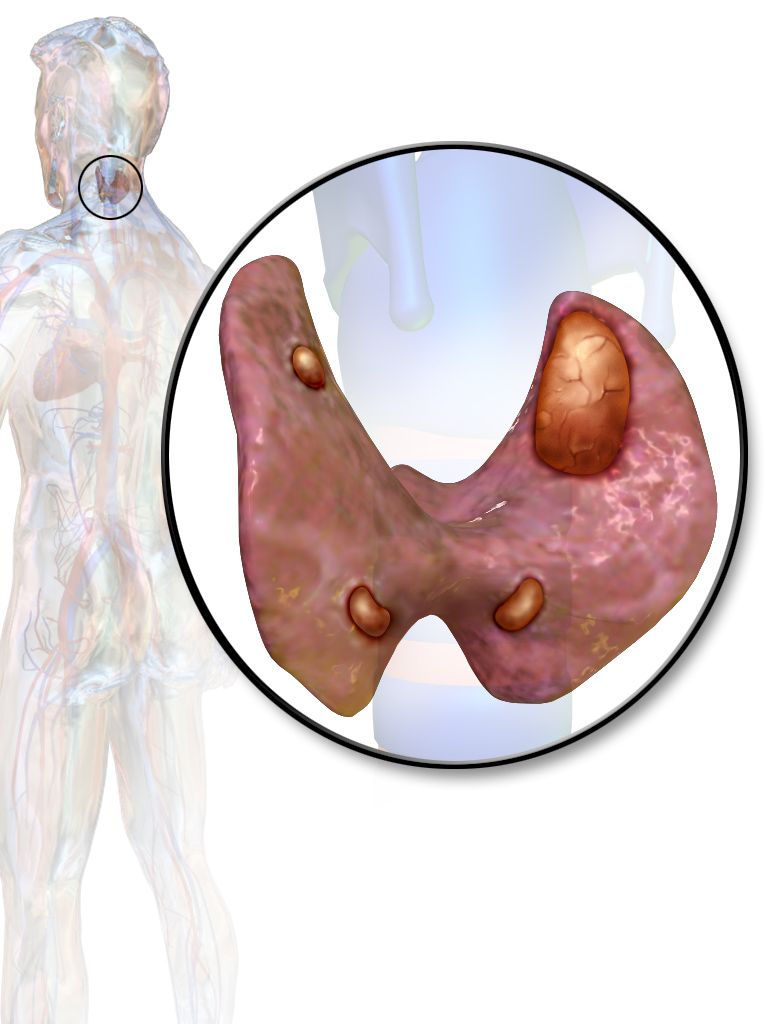
Behind the thyroid sit four glands the size of grains of rice. The prefix para- means beside, so parathyroid means beside the thyroid — a name that describes location only. Their job is unrelated to metabolism: they release parathyroid hormone (PTH), which raises blood calcium by pulling it from bone and conserving it in the kidney. Hyperparathyroidism therefore produces hypercalcemia, weakened bones and kidney stones; hypoparathyroidism produces hypocalcemia with muscle spasm and tetany.
Look closely at that pairing, because it reverses the usual intuition: hyper-parathyroidism causes hyper-calcemia, while removing or damaging the glands causes hypocalcemia. This is the clinical reason a thyroidectomy note always mentions the parathyroids — they sit so close that surgery on one gland can silence the other four, and postoperative calcium is monitored for exactly that reason.
Thyroid and parathyroid are neighbors, not relatives. The names look like a family, but the thyroid governs metabolic rate and the parathyroids govern calcium. Nothing in the word parathyroid tells you about calcium; para- only tells you where the glands are. Read anatomical prefixes as addresses, not as job descriptions.
Pituitary terms are built on hypophys/o and -tropin, thyroid terms on thyr/o with hyper- or hypo-, and parathyroid terms on calcium — so the gland root plus the direction of the imbalance tells you most of what the term means.
Section 3The Adrenal Glands, the Pancreas and the Gonads

Adrenal: the gland named for its address
Adren/o and adrenal/o both mean adrenal gland, and the word itself decodes as ad- (toward, near) + ren/o (kidney) = near the kidney. Its synonym, suprarenal, says almost the same thing with a different prefix: supra- (above) + ren/o = above the kidney. Each gland has two functional layers that supply two more combining forms. Cortic/o means cortex or outer portion; medull/o means medulla or inner portion. The adrenal cortex makes steroid hormones — cortisol, aldosterone and androgens — while the adrenal medulla makes epinephrine and norepinephrine, the catecholamines of the stress response.
Excess cortisol produces Cushing syndrome: central weight gain, a rounded face, thin skin, hyperglycemia and hypertension. Deficiency produces Addison disease, with fatigue, weight loss, low sodium, high potassium and darkened skin. Excess aldosterone alone is hyperaldosteronism, also called Conn syndrome. Excess adrenal androgen in a female produces hirsutism (HER-soot-izm), male-pattern hair growth, and virilization. A tumor of the adrenal medulla is a pheochromocytoma (fee-oh-kroh-moh-sigh-TOH-mah), a word worth splitting slowly: phe/o (dusky) + chrom/o (color) + cyt/o (cell) + -oma (tumor) = a tumor of dusky-staining cells, named for how the tissue looks under the microscope.
Cushing syndrome versus Cushing disease. These are not interchangeable, and charts use both. Cushing syndrome is the clinical picture caused by too much cortisol from any source — an adrenal tumor, an ectopic tumor, or, most commonly, prescribed steroid medication. Cushing disease is the narrower term reserved for the case in which a pituitary adenoma secretes excess ACTH and drives the adrenals. Disease names the cause; syndrome names the picture. Note also that current style writes these eponyms without the possessive apostrophe: Cushing syndrome, Addison disease, Graves disease.
The pancreas: sugar, ketones and two roots that look alike
The endocrine pancreas is a scatter of cell clusters called the islets of Langerhans. Beta cells make insulin, which moves glucose into cells and lowers blood sugar; alpha cells make glucagon, which raises it. The combining form is pancreat/o, giving pancreatitis (pan-kree-ah-TYE-tis), inflammation of the pancreas, and pancreatectomy, its removal.
Diabetes mellitus (DM) is the disorder of insulin production or insulin action. The classic presenting triad is three poly- words that decode themselves: polyuria (excessive urine), polydipsia (pol-ee-DIP-see-ah, excessive thirst) and polyphagia (excessive eating). When cells cannot use glucose, the body burns fat and produces ketones, which acidify the blood. The resulting emergency is diabetic ketoacidosis (kee-toh-as-ih-DOH-sis), or DKA: ket/o (ketones) + acid + -osis (abnormal condition). Ketones spilling into the urine are ketonuria; sugar spilling into the urine is glycosuria.
Long-term high glucose damages small and large vessels, producing complications with their own transparent names: retinopathy (disease of the retina), nephropathy (disease of the kidney), neuropathy (disease of the nerves). Each is a root plus -pathy. Notice that none of these terms mention diabetes — the chart supplies that context by writing diabetic retinopathy, and the suffix does the rest of the work.
| Word part | Meaning | Example term | What the example means |
|---|---|---|---|
| adren/o, adrenal/o | adrenal gland | adrenalectomy | Surgical removal of an adrenal gland |
| cortic/o | cortex, outer portion | adrenocortical | Pertaining to the adrenal cortex |
| medull/o | medulla, inner portion | adrenomedullary | Pertaining to the adrenal medulla |
| phe/o | dusky, dark | pheochromocytoma | Tumor of dusky-staining adrenal medulla cells |
| pancreat/o | pancreas | pancreatitis | Inflammation of the pancreas |
| insulin/o | insulin | insulinoma | Insulin-secreting tumor of the pancreas |
| gluc/o, glycos/o | glucose, sugar | glucosuria | Glucose in the urine |
| glyc/o | sugar, sweet | hyperglycemia | Excessive sugar in the blood |
| ket/o, keton/o | ketones, acetone | ketonuria | Ketones in the urine |
| andr/o | male | androgen | Hormone producing male characteristics |
| estr/o | female | estrogen | Hormone producing female characteristics |
| oophor/o | ovary | oophorectomy | Surgical removal of an ovary |
| orch/o, orchi/o, orchid/o, test/o | testis | orchiectomy | Surgical removal of a testis |
| -pathy | disease | neuropathy | Disease of the nerves |
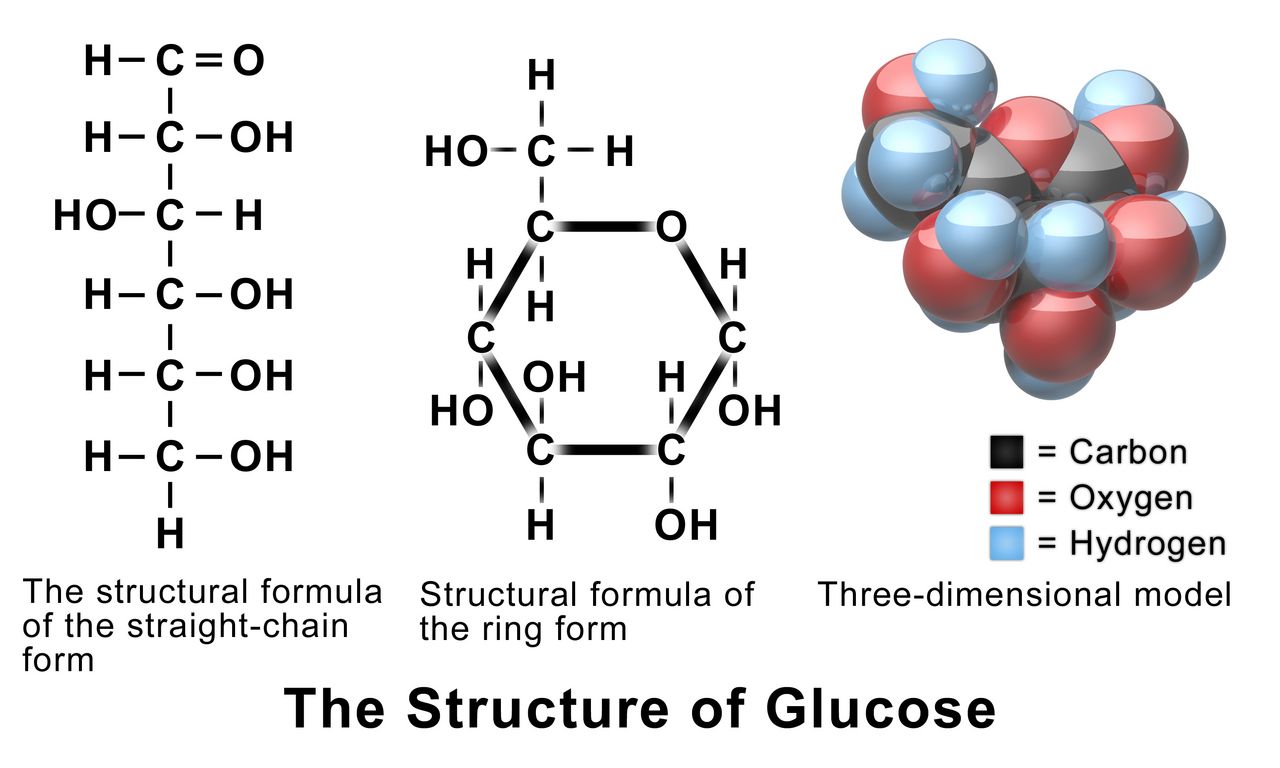
Gluc/o, glyc/o and glycos/o all point at sugar — but the spelling is fixed per term. You will see gluc in glucose, glucagon and glucocorticoid; glyc in glycemia, glycogen and hemoglobin A1C reports; and either glucosuria or glycosuria for sugar in the urine, both accepted. Do not try to reason your way to the spelling — recognize all three as sugar and copy the spelling the term uses. What you must keep straight is the ending: -emia is in the blood, -uria is in the urine.
Gonads: the endocrine side of the reproductive glands
The ovaries and testes are gonads, and they are endocrine glands as well as reproductive organs. The pituitary drives them with two gonadotropins: follicle-stimulating hormone (FSH) and luteinizing hormone (LH). The gonads answer with estrogen and progesterone from the ovary and testosterone from the testis. Deficient gonadal function is hypogonadism, decoded as hypo/gonad/ism = deficient + sex glands + condition.
Two crossover terms appear often enough to learn now. Gynecomastia (gy-neh-koh-MAS-tee-ah) is gynec/o (woman) + mast/o (breast) + -ia = breast enlargement in a male, seen with hormonal imbalance and with several medications. Amenorrhea is a- (without) + men/o (menstruation) + -rrhea (flow) = absence of menstrual periods, which can be a first clue to a pituitary, thyroid or adrenal problem rather than a gynecologic one. Endocrine complaints travel: a hormone made in the head can present as a symptom in the pelvis.
Adrenal terms split along cortic/o and medull/o, pancreatic terms turn on sugar and ketone roots with -emia or -uria, and gonadal terms come from the same -tropin pattern that governs the rest of the pituitary’s targets.
Section 4Diagnostic Tests, Surgical Procedures and Endocrine Abbreviations
How endocrine disease is measured
Because hormones circulate in the blood, most endocrine diagnosis is laboratory work. The general word for measuring a substance in a sample is an assay. A radioimmunoassay (RIA) measures very small hormone concentrations using radioactive labels and antibodies; the term stacks three ideas — radi/o (radiation) + immun/o (immune, meaning antibody) + assay. A thyroid function test panel measures TSH along with free T4 and sometimes T3. Because of the feedback loop from Section 1, TSH alone screens well: it rises in primary hypothyroidism and falls in hyperthyroidism.
Glucose is measured four familiar ways. Fasting blood glucose (FBG, also written FBS or FPG) is drawn after an overnight fast. A random blood glucose is drawn at any time. The oral glucose tolerance test (OGTT) gives a measured sugar load and samples blood at intervals to see how quickly it clears. And glycosylated hemoglobin, reported as HbA1C or simply A1C, reflects average glucose over roughly the previous three months, because glucose attaches irreversibly to hemoglobin for the life of the red cell. That last point explains why an A1C cannot be improved overnight and why it is the number used to judge long-term control.
Imaging adds the rest. A thyroid scan with radioactive iodine uptake (RAIU) shows how avidly the gland takes up iodine, distinguishing an overactive nodule from an inflamed gland. Ultrasonography characterizes thyroid nodules, and a fine-needle aspiration (FNA) biopsy samples them. CT and MRI image the adrenals and the pituitary. A bone density study, or DEXA, is ordered when hyperparathyroidism or long-term steroid use threatens the skeleton.
| Word part | Meaning | Example term | What the example means |
|---|---|---|---|
| -ectomy | surgical removal, excision | thyroidectomy | Removal of the thyroid gland |
| -otomy | cutting into, incision | laparotomy | Incision into the abdomen |
| -ostomy | creating a new opening | colostomy | New opening from colon to body surface |
| -graphy | process of recording | ultrasonography | Recording images with sound waves |
| -scopy | visual examination | laparoscopy | Visual examination inside the abdomen |
| -metry | process of measuring | densitometry | Measurement of bone density |
| radi/o | radiation, x-ray | radioiodine therapy | Treatment using radioactive iodine |
| trans- | across, through | transsphenoidal | Through the sphenoid sinus (pituitary approach) |
| -plasia | formation, development | hyperplasia | Excessive formation of cells or tissue |
| -trophy | nourishment, development | hypertrophy | Excessive growth in the size of a tissue |
Compare the last two rows against -tropin from Section 1. -Trophy and -trophic come from a root meaning nourishment or development and describe how big a tissue grows. -Tropin and -tropic come from a different root meaning to turn toward, and describe a hormone stimulating a target. Hypertrophy is enlargement of existing cells; thyrotropin is a hormone aimed at the thyroid. Older texts sometimes spell hormone names with -trophin, which is why the pair is worth deliberate attention rather than a quick glance.
Surgery on glands, and the plurals that follow
Endocrine surgery is mostly -ectomy attached to a gland root: thyroidectomy, parathyroidectomy, adrenalectomy, pancreatectomy, hypophysectomy. A partial thyroid removal is a lobectomy or subtotal thyroidectomy; the prefix sub- tells you some gland remains. The pituitary is usually reached through the nose and the sphenoid sinus, so the operative note reads transsphenoidal (trans-sfee-NOY-dal) hypophysectomy — a term that describes the route, not the target.
Anatomy in this system also supplies a clean review of the plural rules. Latin and Greek endings change in predictable ways, and a chart that says adrenal cortices or multiple adenomata is not using exotic language, only the older grammar.
| Singular ending | Plural ending | Example singular | Example plural |
|---|---|---|---|
| -ex | -ices | cortex | cortices |
| -a | -ae | medulla | medullae |
| -us | -i | isthmus | isthmi |
| -um | -a | ovum | ova |
| -is | -es | testis, diagnosis | testes, diagnoses |
| -oma | -omata | adenoma | adenomata (or adenomas) |
| -nx | -nges | larynx | larynges |
| -y | -ies | ovary | ovaries |
The endocrine abbreviations on a real chart
Endocrine notes are dense with abbreviations because hormone names are long. Most are simple initialisms of the full term, so learning the full term first makes the abbreviation free: adrenocorticotropic hormone becomes ACTH, thyroid-stimulating hormone becomes TSH. A handful are not obvious — A1C is not initials at all, and DI and DM differ by one letter while naming unrelated diseases.
| Abbreviation | Full term | What it means in practice |
|---|---|---|
| ACTH | Adrenocorticotropic hormone | Pituitary hormone that drives the adrenal cortex |
| ADH | Antidiuretic hormone | Posterior pituitary hormone that conserves water |
| GH | Growth hormone | Also called somatotropin |
| TSH | Thyroid-stimulating hormone | Best single screening test of thyroid function |
| T3 / T4 / FT4 | Triiodothyronine, thyroxine, free thyroxine | The thyroid hormones themselves |
| PTH | Parathyroid hormone | Raises blood calcium |
| FSH / LH | Follicle-stimulating hormone, luteinizing hormone | The two pituitary gonadotropins |
| PRL | Prolactin | Pituitary hormone of milk production |
| DM / T1DM / T2DM | Diabetes mellitus, type 1, type 2 | Disorders of insulin production or action |
| DI | Diabetes insipidus | ADH deficiency causing dilute polyuria |
| DKA | Diabetic ketoacidosis | Acid emergency of uncontrolled diabetes, most often type 1 |
| HHS | Hyperosmolar hyperglycemic state | Extreme hyperglycemia without significant ketones |
| SIADH | Syndrome of inappropriate antidiuretic hormone | Excess ADH causing water retention and hyponatremia |
| FBG / FBS / FPG | Fasting blood glucose, sugar, plasma glucose | Glucose drawn after an overnight fast |
| OGTT | Oral glucose tolerance test | Timed glucose measurements after a sugar load |
| HbA1C, A1C | Glycosylated hemoglobin | Average glucose over about three months |
| RAIU | Radioactive iodine uptake | Thyroid scan measuring iodine uptake |
| BMP / CMP | Basic or comprehensive metabolic panel | Blood panel including glucose and electrolytes |
Two of these deserve a second look. Diabetes by itself means only “passing through,” a reference to large urine volume, so the second word carries the diagnosis: mellitus means honey-sweet, and insipidus means tasteless. Both diseases cause polyuria and polydipsia; only diabetes mellitus involves glucose. A chart that says only “diabetes” is therefore ambiguous, and a careful writer never abbreviates it that way.
Endocrine diagnosis is mostly assays and scans, endocrine surgery is mostly -ectomy on a gland root, and every abbreviation on the chart is easier to hold once you can say the full term it stands for.
Section 5Documentation, Chart Sections and the Do Not Use List
The SOAP note and what belongs in each letter
The most portable note format in health care is the SOAP note, and the letters are a decoding exercise of their own. S is subjective: what the patient reports — symptoms, history, concerns, in the patient’s own account. “Reports fatigue, cold intolerance and a fifteen-pound weight gain over four months” is subjective. O is objective: what you measure or observe — vital signs, physical findings, laboratory and imaging results. “TSH 14.2, free T4 low, thyroid diffusely enlarged and nontender” is objective.
A is assessment: the interpretation, the working diagnosis, or the change since the last note. “Primary hypothyroidism, likely Hashimoto thyroiditis” is an assessment. P is plan: what happens next — medications, tests, referrals, teaching, follow-up. The discipline of the format is that nothing crosses lanes. A symptom the patient describes is never objective data, and a conclusion is never charted as an observation. Students lose points, and clinicians lose credibility, by putting an interpretation in the O section.
The other formats are variations on the same idea. A narrative note tells the story in prose. Charting by exception records only findings that depart from a defined standard. DAR or focus charting uses Data, Action, Response. Whatever the format, three rules hold everywhere: chart what you did and observed, not what you assume; chart in a timely way; and never alter an earlier entry — correct it with a dated, signed addendum, because the record is a legal document.
| Abbreviation | Full term | Where it appears |
|---|---|---|
| CC | Chief complaint | Opening line of the history, in the patient’s words |
| HPI | History of present illness | The story of the current problem |
| PMH | Past medical history | Prior diagnoses, surgeries, hospitalizations |
| FH / SH | Family history, social history | Inherited risk; work, housing, substances, supports |
| ROS | Review of systems | Head-to-toe symptom checklist, subjective |
| PE | Physical examination | Examiner’s findings, objective |
| H&P | History and physical | The full admission assessment document |
| A&P | Assessment and plan | Diagnosis and next steps at the end of a note |
| SOAP | Subjective, objective, assessment, plan | Standard progress-note structure |
| NKDA | No known drug allergies | Allergy section of the chart |
| WNL | Within normal limits | Objective findings and lab comments |
| PRN | As needed (pro re nata) | Medication orders |
| NPO | Nothing by mouth (nil per os) | Orders before surgery or testing |
| DC, D/C | Discharge or discontinue | Ambiguous — many facilities ban this one |
Why abbreviations became a patient-safety problem
Abbreviations save keystrokes and cost lives. A shorthand that is unambiguous to the writer can be genuinely ambiguous to the reader, and in medication orders that ambiguity translates directly into a wrong dose or a wrong drug. The Joint Commission, which accredits most hospitals in the United States, responded with an official Do Not Use list that applies to all orders and all handwritten, free-text medication-related documentation. Every one of these entries traces back to real, repeated harm.
| Do not use | Why it is dangerous | Write instead |
|---|---|---|
| U, u (for unit) | Mistaken for 0, 4 or cc — a “4u” read as “40” is a tenfold insulin overdose | unit |
| IU (international unit) | Mistaken for IV (intravenous) or the number 10 | international unit |
| Q.D., QD, q.d., qd (daily) | The period after the Q is mistaken for an I, so q.d. is read as q.i.d. — four times a day instead of once | daily |
| Q.O.D., QOD, q.o.d., qod (every other day) | Mistaken for q.d. or q.i.d. | every other day |
| Trailing zero (1.0 mg) | The decimal point is missed and the dose is read as 10 mg | 1 mg |
| Missing leading zero (.5 mg) | The decimal point is missed and the dose is read as 5 mg | 0.5 mg |
| MS | Means either morphine sulfate or magnesium sulfate | morphine sulfate or magnesium sulfate, whichever is meant |
| MSO4 and MgSO4 | Confused for one another | morphine sulfate; magnesium sulfate |
Two clarifications students routinely need. First, the trailing-zero rule has an exception: a trailing zero may be used where it is required to show the precision of a reported value, such as a laboratory result or a lesion size — it is banned in medication orders. Second, the Joint Commission maintains an additional list of abbreviations recommended for possible future inclusion, including the greater-than and less-than symbols, the Greek-letter abbreviation for microgram, drug-name abbreviations such as HCT and HCTZ, apothecary units, and cc for cubic centimeter, which is misread as u. Many facilities have already banned these locally, and the facility policy always governs.
The endocrine ward is where the Do Not Use list earns its keep. Insulin is dosed in units — often single-digit units — and it is a high-alert medication with no forgiving margin. Writing “6U regular insulin” puts a hand-drawn U immediately after a 6, where it reads as a zero: 60 units instead of 6. Spell out unit every time, spell out international unit, use a leading zero and never a trailing one, and read back verbal insulin orders. This is the one page of this chapter where a vocabulary error is a dosing error.
Writing terminology that survives being read by someone else
Everything in this book converges on documentation, because documentation is where your vocabulary meets another person’s eyes. A few habits carry the weight. Spell the term out on first use and put the abbreviation in parentheses after it, then use the abbreviation for the rest of the note: syndrome of inappropriate antidiuretic hormone (SIADH). Use the facility’s approved abbreviation list rather than one you learned elsewhere; the same letters mean different things in different specialties, and PT alone can be physical therapy, prothrombin time or patient.
Be exact about direction and site. Hyper- and hypo- differ by two letters and reverse the meaning of the term, which is why many electronic records now render HYPERglycemia and HYPOglycemia with the prefix capitalized — a technique called tall man lettering, also used to separate look-alike drug names. Write right and left out, avoid the abbreviations R and L for laterality, and never let an eponym stand alone if a descriptive term is clearer: chronic autoimmune thyroiditis (Hashimoto thyroiditis) tells a reader what is happening as well as who described it. Current style also drops the possessive apostrophe from eponyms — Down syndrome, Cushing disease, Graves disease — a small change that signals you are writing in the present-day convention.
A note is only as safe as it is unambiguous, so use the SOAP structure to keep observation separate from interpretation, and avoid every abbreviation on the Do Not Use list — especially in insulin and other high-alert medication orders.
The chapter in one breath
The endocrine system is a set of ductless glands that release hormones into the blood, and its vocabulary is built the same way every other system’s is: a gland root plus a familiar ending. Aden/o is gland, crin/o is to secrete, and endo- distinguishes ductless glands from the duct-bearing exocrine kind. The suffixes -tropin and -tropic name hormones that stimulate other glands, while -emia and -uria tell you whether a substance is in the blood or in the urine. Gland by gland the roots stack up: hypophys/o and pituitar/o for the pituitary, thyr/o and parathyroid/o in the neck, adren/o with its cortic/o and medull/o layers, and pancreat/o with the sugar and ketone roots gluc/o, glyc/o and ket/o. Attach hyper- or hypo- and you have named most endocrine disease. Diagnosis is assays and scans; surgery is -ectomy on a gland. The chapter closes where all terminology closes: in the chart, where the SOAP note keeps observation separate from interpretation and the Joint Commission Do Not Use list keeps a misread U from becoming a tenfold insulin overdose.
Words worth knowing
| Term | What it means |
|---|---|
| acromegaly (ak-roh-MEG-ah-lee) | acr/o + -megaly: enlargement of the hands, feet and facial bones from excess growth hormone after the growth plates close. |
| adenoma (ad-eh-NOH-mah) | aden/oma: a benign tumor of glandular tissue; a pituitary adenoma is the cause of Cushing disease. |
| adrenalectomy (ah-dree-nal-EK-toh-mee) | Surgical removal of an adrenal gland — note the extra r that separates adren/o from aden/o. |
| endocrine (EN-doh-krin) | endo- + crin/o: secreting within, releasing hormones directly into the bloodstream through no duct. |
| euthyroid (yoo-THY-royd) | eu- + thyroid: having normal thyroid function, regardless of gland size. |
| exophthalmos (ek-sof-THAL-mos) | ex- + ophthalm/o: outward protrusion of the eyeballs, classically seen in Graves disease. |
| glycosuria (gly-kohs-YOO-ree-ah) | Sugar in the urine; contrast with hyperglycemia, which is sugar in the blood. |
| goiter (GOY-ter) | Visible enlargement of the thyroid gland; describes size only, not function. |
| homeostasis (hoh-mee-oh-STAY-sis) | home/o + -stasis: maintenance of a steady internal environment, the purpose of hormonal feedback. |
| hypophysectomy (high-poff-ih-SEK-toh-mee) | Surgical removal of the pituitary gland, usually by a transsphenoidal approach through the nose. |
| hypercalcemia | Excessive calcium in the blood, the hallmark of hyperparathyroidism — do not confuse with hyperkalemia, excess potassium. |
| ketoacidosis (kee-toh-as-ih-DOH-sis) | ket/o + acid + -osis: acid buildup from burning fat when glucose cannot enter cells; the DKA emergency. |
| myxedema (mik-seh-DEE-mah) | myx/o + -edema: the non-pitting, mucus-like swelling of severe hypothyroidism. |
| pheochromocytoma (fee-oh-kroh-moh-sigh-TOH-mah) | phe/o + chrom/o + cyt/o + -oma: a catecholamine-secreting tumor of the adrenal medulla. |
| polydipsia (pol-ee-DIP-see-ah) | poly- + -dipsia: excessive thirst, one of the three classic diabetes symptoms. |
| thyrotoxicosis (thy-roh-tok-sih-KOH-sis) | thyr/o + toxic/o + -osis: the severe clinical state of thyroid hormone excess. |
| SIADH | Syndrome of inappropriate antidiuretic hormone: too much ADH, water retention and hyponatremia. |
| SOAP note | Progress-note format: Subjective, Objective, Assessment, Plan — report, measurement, interpretation, next step. |
| Do Not Use list | Joint Commission list of error-prone abbreviations banned from orders, including U, IU, Q.D., Q.O.D., trailing zeros and MS/MSO4/MgSO4. |
| tall man lettering | Capitalizing the distinguishing part of look-alike terms, as in HYPERglycemia and HYPOglycemia, to prevent misreading. |