Controlling Microbes — Sterilization, Disinfection & Asepsis
Every time you clean your hands, wipe down a bedrail, open a sterile dressing kit, or hang an IV, you are practicing microbial control — the deliberate work of killing microbes or holding their numbers down so they cannot harm your patient. The trouble is that the words for this work are used loosely in everyday speech and precisely in the clinical world, and the gap between "clean," "disinfected," and "sterile" is exactly where infections slip through. This chapter sorts out that vocabulary, walks through the physical and chemical tools we use to kill microbes, explains why killing follows a predictable curve rather than an on/off switch, and finishes at the bedside with the two kinds of asepsis every nurse practices by hand, many times a shift. Master this, and infection prevention stops being a list of rules and becomes something you understand.
By the end of this chapter you can
- Define and rank sterilization, disinfection, antisepsis, and sanitization, and use the -cidal vs -static suffixes correctly.
- Compare the major physical methods of control — moist and dry heat, the autoclave, radiation, and filtration — and match each to what it can and cannot sterilize.
- Explain how the autoclave achieves sterilization and how its success is verified.
- Describe the major families of chemical disinfectants and antiseptics and how they kill microbes.
- Interpret the microbial death curve, the meaning of D-value, and why sterility is defined statistically.
- List the factors that make microbial killing faster or slower, and rank microbes by their resistance to control.
- Distinguish medical (clean) from surgical (sterile) asepsis and apply the rules of a sterile field.
Section 1The vocabulary of control
A ladder, not a light switch
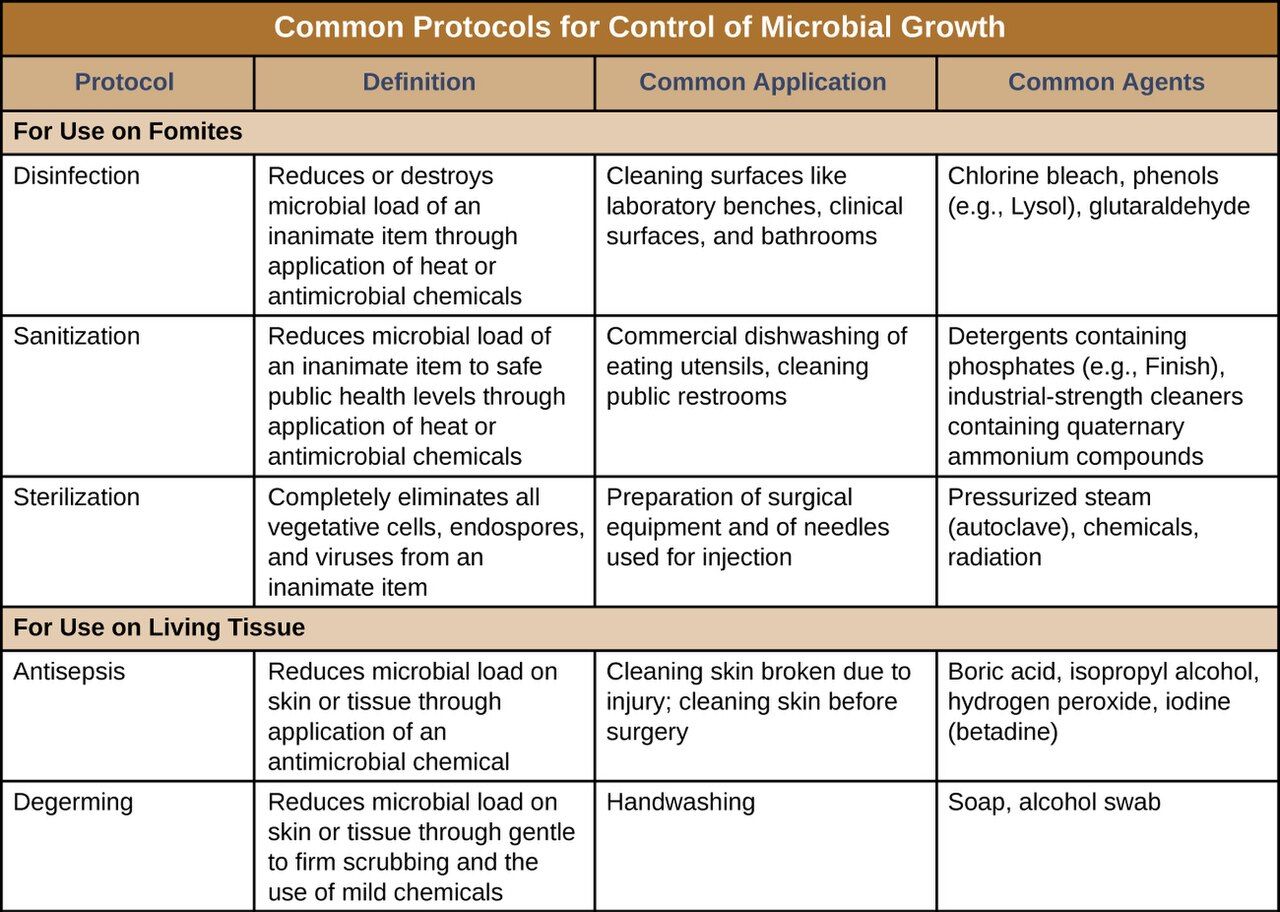
The single most important idea in this chapter is that "getting rid of germs" is not one thing — it is a ladder of increasingly complete removal, and each rung has a precise name and a precise job. At the top sits sterilization: the complete destruction or removal of all microbial life, including the toughest of all targets, bacterial endospores. A sterile object has nothing living on it, full stop. One step down is disinfection, which destroys most pathogens on a non-living surface but does not reliably kill endospores. Because it is not absolute, disinfection comes in levels — high, intermediate, and low — depending on how much it kills. The distinction matters because much of what we do at the bedside is disinfection, not sterilization, and knowing the difference tells you which tasks are "good enough" and which demand the sterile item from central supply.
On skin versus on surfaces
The next two terms are constantly confused because they do similar work in different places. Antisepsis is the removal of microbes from living tissue — skin, a mucous membrane, a surgical site. The chemical used is an antiseptic, and because it goes on a living patient it must be gentle enough not to injure tissue. Disinfection, by contrast, happens on inanimate objects, and the chemical is a disinfectant, which can be far harsher because no living cells have to survive it. This is why you scrub a patient's skin with chlorhexidine or an alcohol swab (antiseptics) but wipe the counter with a bleach or quaternary-ammonium solution (disinfectants) — and why pouring a surface disinfectant into a wound is a genuine mistake, not a shortcut. A close cousin is degerming, the mechanical scrubbing away of microbes (the alcohol wipe before an injection does this), and sanitization, which simply lowers microbial counts to a "safe" public-health level rather than eliminating them — the standard for restaurant dishwashers and drinking glasses, not for anything that enters a patient.
Reading the suffixes
Microbiology labels its weapons with two suffixes you must be able to read on sight. An agent ending in -cidal (bactericidal, virucidal, fungicidal, sporicidal) kills the target outright. An agent ending in -static (bacteriostatic, fungistatic) only stops it from multiplying — the microbes are still alive, held in check, and will resume growing if the agent is removed or the patient's immune defenses fail. That difference is not academic: a bacteriostatic drug depends on a working immune system to finish the job, which is why the distinction resurfaces when we discuss antimicrobial drugs and immunocompromised patients.
| Term | What it does | Kills endospores? | Used on |
|---|---|---|---|
| Sterilization | Destroys or removes all microbial life | Yes | Instruments, IV fluids, implants |
| Disinfection | Destroys most pathogens (high/intermediate/low level) | Not reliably | Inanimate surfaces & equipment |
| Antisepsis | Reduces microbes on living tissue | No | Skin, mucous membranes, wounds |
| Degerming | Mechanically removes microbes | No | Skin (e.g., pre-injection swab) |
| Sanitization | Lowers counts to a "safe" public level | No | Dishes, food surfaces, floors |
- Sterilization alone removes all life including endospores; disinfection (surfaces) and antisepsis (living tissue) do not.
- Disinfectant = harsh chemical for objects; antiseptic = gentle chemical for skin and tissue.
- Sanitization only reduces counts to a safe level; degerming is mechanical removal.
- -cidal kills; -static merely halts multiplication and relies on host defenses.
Section 2Physical methods — heat, the autoclave, radiation & filtration
Heat: the oldest and most reliable tool
Heat kills by denaturing proteins and enzymes and by disrupting membranes, and it comes in two forms with very different power. Moist heat — steam and boiling water — is far more effective than dry heat because water conducts energy efficiently and drives protein coagulation quickly (think of how fast an egg white sets in boiling water versus a dry oven). Dry heat, delivered by a hot-air oven or an open flame, works too but needs much higher temperatures and longer times to accomplish the same kill. Two classic benchmarks describe heat's effect: the thermal death point (the lowest temperature that kills all microbes in a suspension in ten minutes) and the thermal death time (the time needed to kill them at a given temperature). Note one important limit: ordinary boiling at 100°C does not sterilize — it kills vegetative cells and most viruses but leaves hardy endospores alive, which is precisely the problem the autoclave was invented to solve. A gentler cousin, pasteurization, uses brief, mild heat not to sterilize but to lower the count of pathogens and spoilage organisms in milk and other liquids while preserving flavor.
The autoclave: steam under pressure
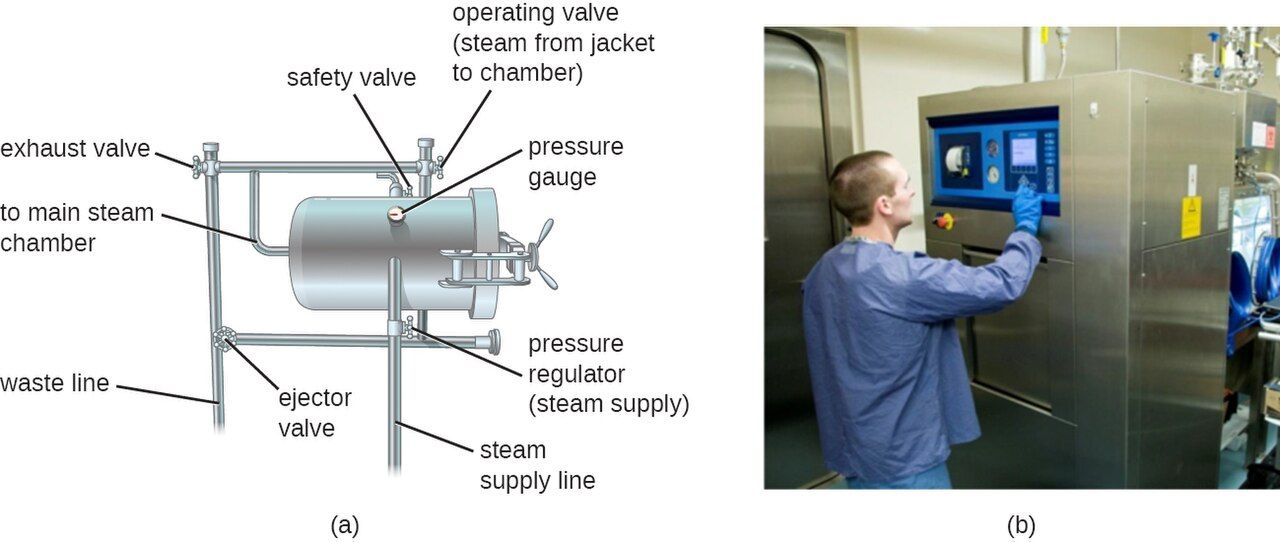
The autoclave is the single most important sterilizing device in health care, and it solves the boiling-water problem with a simple trick: raising the pressure raises the boiling point, so steam can be heated well past 100°C. A standard cycle holds saturated steam at 121°C under about 15 pounds per square inch (psi) of pressure for roughly 15–20 minutes — conditions that reliably destroy even endospores. The active ingredient is the moist heat of the steam, not the pressure itself; the pressure is only there to make the hotter steam possible. Because a load only counts as sterile if the steam actually reached every surface at temperature for long enough, autoclaving is always verified, never assumed. Chemical indicators — the striped autoclave tape and pouch dots that change color — confirm a load was exposed to heat, but the gold standard is a biological indicator: a sealed vial of Geobacillus stearothermophilus endospores run through the cycle and then incubated. If those famously heat-resistant spores are dead, everything else in the load is too.
Radiation and filtration: when heat would ruin the product
Plenty of medical items — plastic syringes, IV tubing, sutures, some fluids — would melt, warp, or degrade in an autoclave, so we sterilize them another way. Radiation splits into two types. Ionizing radiation (gamma rays, X-rays, electron beams) carries enough energy to smash DNA and generate destructive free radicals; it penetrates deeply, sterilizes in the cold, and is used industrially for prepackaged disposables and some foods. Nonionizing radiation, chiefly ultraviolet (UV) light, is weaker: it fuses adjacent thymine bases into dimers that block DNA replication, but it barely penetrates — it cannot pass through glass, plastic, or even a layer of dust — so its use is limited to disinfecting surfaces and air in biosafety cabinets and empty rooms (and it is a genuine hazard to the eyes and skin of anyone in the room). Finally, filtration physically removes microbes rather than killing them, by straining a fluid or gas through pores too small for cells to pass. A membrane filter with 0.2 µm pores sterilizes heat-sensitive liquids such as certain antibiotics, vitamins, and IV additives, and HEPA filters do the same for air, keeping operating rooms and protective-isolation rooms clean.
| Method | How it kills / removes | Sterilizes? | Typical use |
|---|---|---|---|
| Autoclave (moist heat) | Steam at 121°C, 15 psi denatures proteins | Yes (spores too) | Surgical instruments, glassware, media |
| Dry heat / flame | Oxidation & denaturation at high temp | Yes (long/hot) | Glassware, inoculating loops |
| Boiling (100°C) | Denatures proteins | No — spores survive | Home disinfection of vegetative cells |
| Ionizing radiation | Breaks DNA, forms free radicals | Yes | Disposable plastics, sutures, foods |
| UV (nonionizing) | Thymine dimers block replication | Surface only | Air & surfaces in cabinets/rooms |
| Membrane filtration | Physically strains out cells (0.2 µm) | Yes (fluids) | Heat-labile fluids; HEPA for air |
- Moist heat beats dry heat; ordinary boiling does not sterilize because endospores survive.
- The autoclave (121°C, ~15 psi, ~15 min) sterilizes with pressurized steam and is verified by a Geobacillus spore biological indicator.
- Ionizing radiation sterilizes heat-sensitive disposables; UV only disinfects surfaces and air and does not penetrate.
- Filtration (0.2 µm membranes, HEPA) removes microbes from heat-labile fluids and from air.
Section 3Chemical methods — disinfectants & antiseptics
How chemicals kill
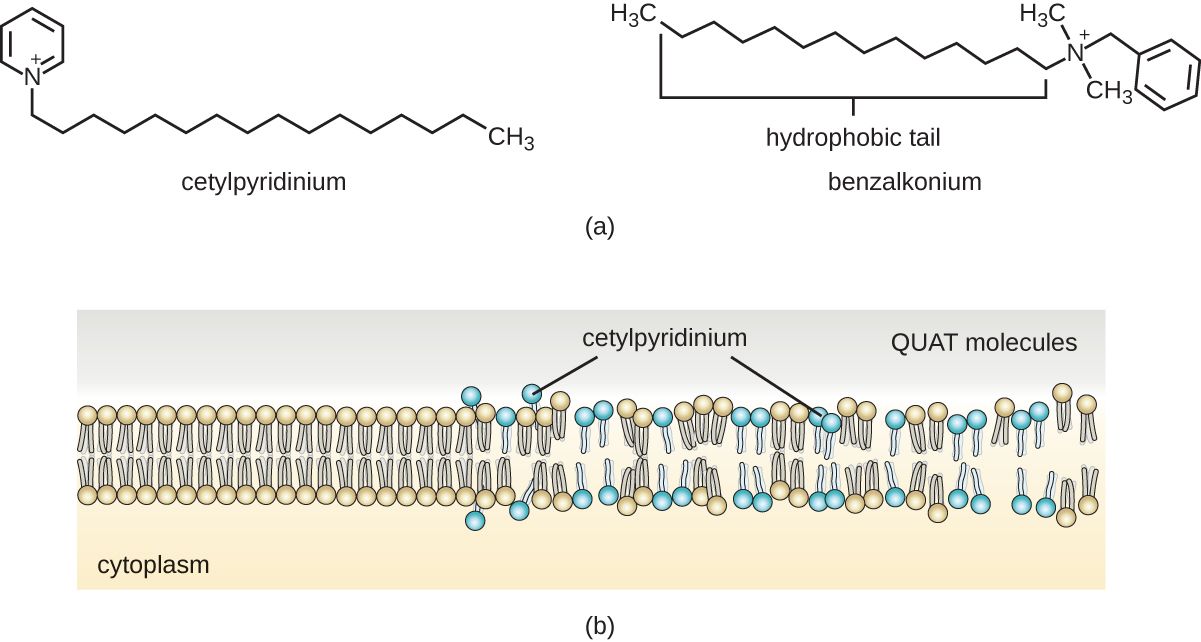
Chemical control agents work by a handful of mechanisms, and most fall into two big buckets: they denature proteins (unfolding the enzymes a microbe needs to live) or they disrupt the plasma membrane (dissolving its lipids so the cell leaks and dies). Some go further and damage nucleic acids or oxidize cell components. Whether a given chemical is called a disinfectant or an antiseptic depends on where it is used, not on the molecule itself — several agents, such as iodine and the quats, serve as both at different concentrations. Two practical properties decide whether a chemical is useful in the hospital: its use-dilution (the concentration at which it actually works, since more concentrated is not always better — 70% alcohol kills better than 100% because it needs water to denature protein) and its behavior in the presence of organic matter like blood and pus, which can neutralize many agents on contact.
The chemical families you will meet
You do not need to memorize every compound, but you should recognize the major families and where each shines. Alcohols (isopropyl and ethanol, best at 60–90%) denature proteins and dissolve membranes; they are fast, cheap skin antiseptics and surface wipes, but they evaporate quickly and do not kill spores. Chlorhexidine is a gentle, long-lasting skin antiseptic that binds to the skin and keeps working for hours — the reason it is used for surgical scrubs and central-line site care. Iodophors (iodine complexed with a carrier, e.g., povidone-iodine/Betadine) are broad-spectrum skin preps for surgery and injections. Halogens also include chlorine (household bleach, sodium hypochlorite), a powerful, cheap disinfectant that is one of the few agents that reliably kills Clostridioides difficile spores on surfaces. Hydrogen peroxide and other peroxygens oxidize cell components and are useful for surfaces and some equipment. Quaternary ammonium compounds (quats) are low-toxicity detergent-like disinfectants for everyday surface cleaning (though weak against some resistant organisms). Finally, glutaraldehyde (with a long contact time) and the gas ethylene oxide can achieve sterilization of delicate, heat-sensitive equipment — but they are toxic and demand strict handling. Ortho-phthalaldehyde (OPA) belongs beside them chemically but not in capability: it is a fast-acting high-level disinfectant with poor sporicidal activity, cleared for high-level disinfection of endoscopes, not as a sterilant.
Matching the agent to the risk
Because no single chemical does everything, hospitals classify items by how much microbial killing they need, a scheme known as the Spaulding classification. Critical items enter sterile tissue or the bloodstream (surgical instruments, catheters, implants) and must be sterilized. Semicritical items touch mucous membranes but not sterile tissue (endoscopes, respiratory equipment) and require at least high-level disinfection. Noncritical items touch only intact skin (blood-pressure cuffs, bedrails, stethoscopes) and need only low- or intermediate-level disinfection. This one framework quietly governs a huge amount of bedside and central-supply practice: it is the reason a scope gets a different reprocessing protocol than a bedrail.
| Agent family | Mechanism | Kills spores? | Typical use |
|---|---|---|---|
| Alcohols (60–90%) | Denature protein, dissolve membrane | No | Skin antiseptic, surface wipes, hand rub |
| Chlorhexidine | Disrupts membrane; persists on skin | No | Surgical scrub, line-site antisepsis |
| Iodophors (povidone-iodine) | Oxidize / halogenate cell components | No (routine use) | Pre-op skin prep, injection sites |
| Chlorine (bleach) | Strong oxidizer | Yes (surfaces) | Surface disinfection, C. diff rooms |
| Hydrogen peroxide | Oxidizes cell components | Yes (high conc.) | Surface disinfection, equipment, vaporized room decontamination |
| Quats | Detergent-like membrane disruption | No | Routine surface cleaning |
| Glutaraldehyde / ethylene oxide | Alkylate proteins & DNA | Yes (long contact) | Sterilizing heat-sensitive equipment |
| Ortho-phthalaldehyde (OPA) | Alkylates proteins | No — poor sporicide | High-level disinfection of endoscopes (not sterilization) |
- Chemical agents mostly denature proteins or disrupt membranes; the same molecule can be a disinfectant on surfaces and an antiseptic on skin.
- Alcohols and chlorhexidine are workhorse skin antiseptics; bleach handles spores on surfaces; glutaraldehyde and ethylene oxide sterilize heat-sensitive equipment, while OPA is a high-level disinfectant only.
- Use-dilution matters — 70% alcohol out-kills 100% because it needs water.
- The Spaulding classification (critical / semicritical / noncritical) matches the level of killing to how the item is used.
Section 4The microbial death curve & what changes the odds
Death is logarithmic, not all-at-once
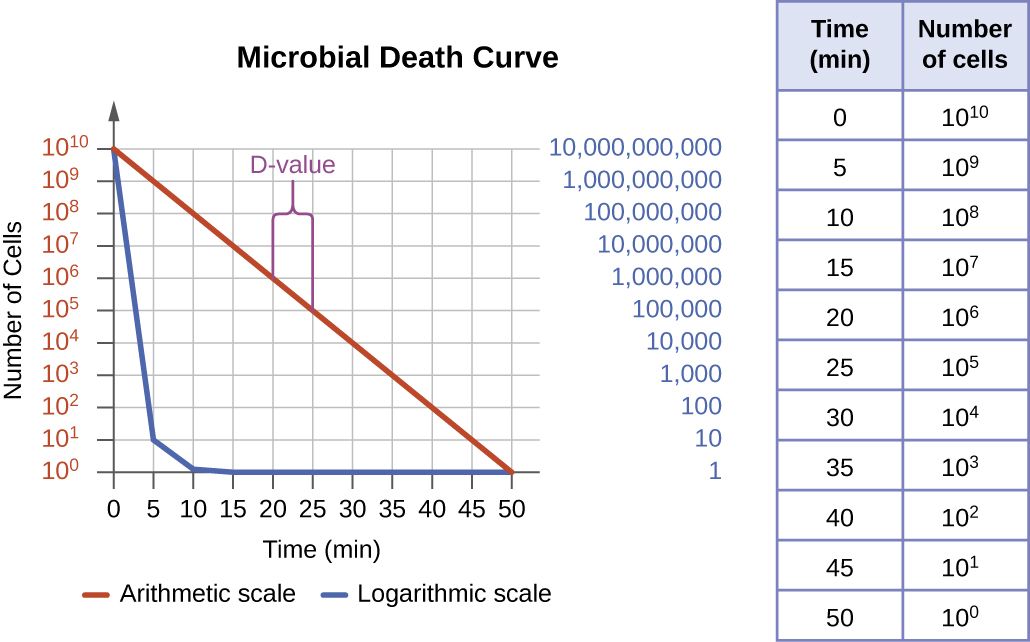
It is tempting to imagine that a disinfectant kills every microbe the instant it is applied, but that is not how killing works. Under a lethal agent, a microbial population dies logarithmically — a constant percentage dies in each equal unit of time, not a constant number. If a chemical kills 90% of the cells in the first minute, it kills 90% of the survivors in the next minute, and 90% of those in the third, and so on. Plotted on a log scale, this makes a straight downward line: the microbial death curve. The practical consequence is profound: because you are always killing a fraction and never the last stubborn cell instantly, you can drive the number vanishingly low but you can never mathematically reach absolute zero in finite time. That is why sterility is defined statistically, as a probability — a sterility assurance level of one survivor in a million (10−6) — rather than as a literal guarantee of nothing alive.
The D-value
The steepness of that line is captured by a single number, the decimal reduction time or D-value: the time required, at a given temperature or agent concentration, to kill 90% of the population — that is, to drop it by one power of ten (one "log"). A microbe or a process with a short D-value is killed quickly; a long D-value means a tough target or a weak method. The D-value is the bridge between the death curve and real protocols: if you know a starting count and the D-value, you can calculate how long a treatment must run to reach your target survival level, which is exactly how sterilization cycles and canning times are set.
What speeds up or slows down the kill
The same agent can kill in seconds or fail entirely depending on conditions, and a nurse who knows the variables can spot when a control measure is being undermined. Killing goes faster with higher temperature, higher concentration or intensity, and longer contact time — the last of which is why every disinfectant label lists a wet contact time that the surface must stay visibly wet to work. Killing goes slower, or fails, when the microbial load is enormous (more cells take longer to clear), when the microbes are inherently resistant, when a protective biofilm shields them, and — crucially at the bedside — when organic matter such as blood, pus, feces, or biofilm is present, because it physically blocks the agent and chemically inactivates many of them. Microbes themselves also fall in a predictable resistance ranking, from the nearly indestructible prions and bacterial endospores down through mycobacteria (their waxy wall makes tuberculosis hard to kill) and non-enveloped viruses, to the easiest targets of all: ordinary vegetative bacteria and fragile enveloped viruses like influenza and HIV.
| Factor | Effect on killing | Why |
|---|---|---|
| Time (contact time) | More time → more kill | Each interval removes another fraction (log) |
| Temperature / concentration | Higher → faster kill | Speeds denaturation and reaction rate |
| Number of microbes | More cells → slower to clear | Same % killed each interval — larger start, longer to finish |
| Microbe type | Spores & mycobacteria resist | Endospore coats and waxy walls block agents |
| Organic matter | Present → killing fails | Blood/pus shield and inactivate the agent |
| Biofilm | Present → strong resistance | Matrix blocks penetration; cells shielded |
- Microbes die logarithmically — a constant fraction per unit time — so absolute zero is never guaranteed and sterility is a probability (a 10−6 assurance level).
- The D-value is the time to kill 90% (one log) of a population and sets how long a process must run.
- Killing speeds up with more time, heat, and concentration; it slows with a big microbial load, resistant organisms, biofilm, and organic matter.
- Resistance ranks prions & endospores (toughest) → mycobacteria → non-enveloped viruses → vegetative bacteria & enveloped viruses (easiest).
Section 5Asepsis at the bedside — medical vs surgical
Two kinds of asepsis
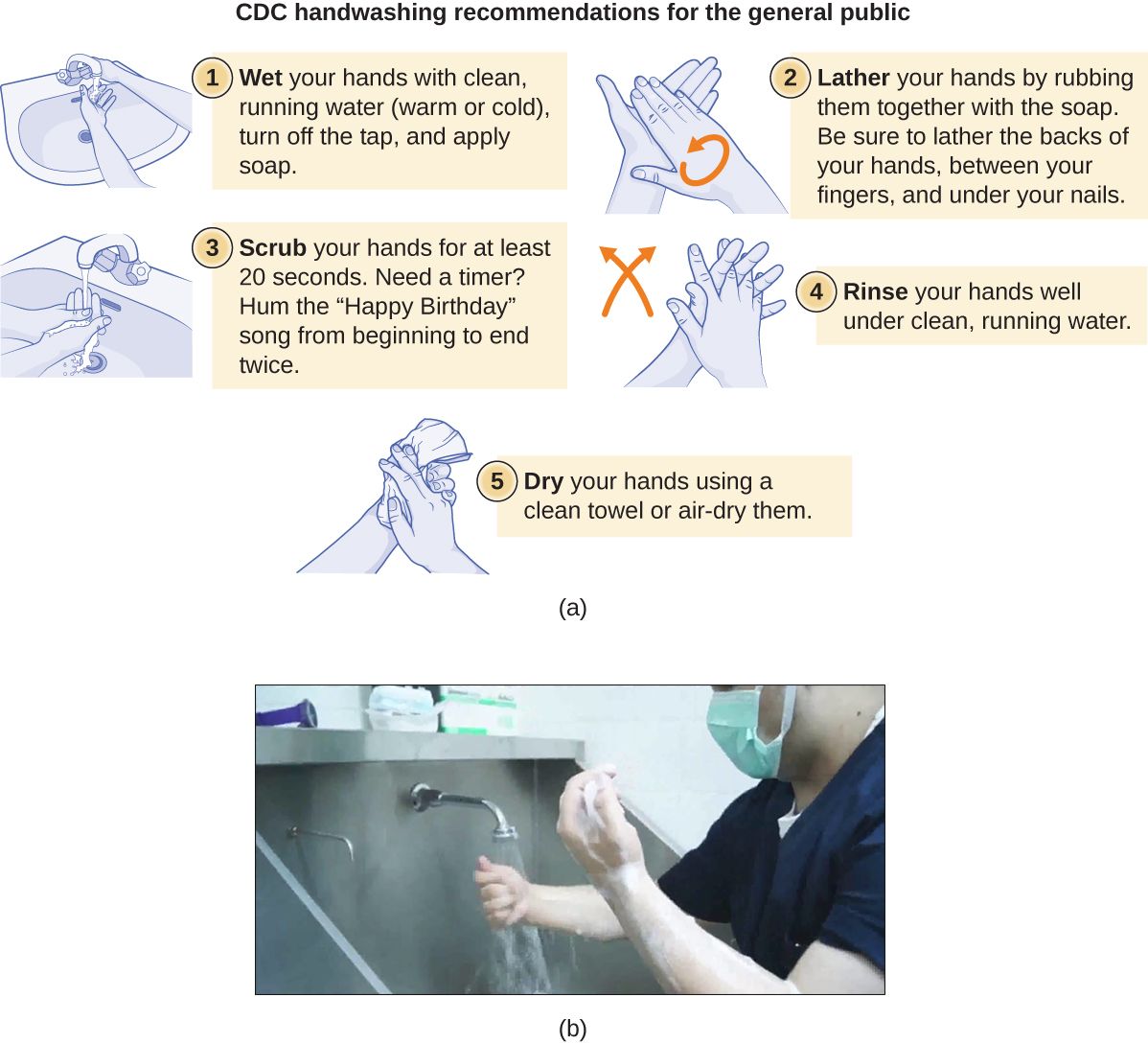
Asepsis simply means the absence of contamination by pathogens, and at the bedside it is practiced at two different levels. Medical asepsis — also called clean technique — aims to reduce the number and spread of microbes and to break the chain of transmission. It is the everyday level: hand hygiene, gloves, gowns, cleaning shared equipment, and the standard precautions you use with every patient regardless of diagnosis. It does not require sterility; it requires cleanliness and consistency. Surgical asepsis — sterile technique — aims for the total absence of microbes and is used whenever you breach the body's natural barriers: inserting a urinary or central catheter, starting a sterile dressing change on a deep wound, or assisting in the operating room. The mental shift from "clean" to "sterile" is exactly the ladder from Section 1, now applied with gloved hands.
Clean technique: the everyday defense
Medical asepsis rests on a small number of habits that, done reliably, prevent an enormous share of infections. Hand hygiene is first among them — performed before and after every patient contact, before a clean task, after body-fluid exposure, and after touching the patient's surroundings (the familiar moments of hand hygiene). Alcohol-based hand rub is the default because it is fast and effective; soap and water are reserved for visibly soiled hands and for spore-formers like C. diff. Around this core sit gloves and gowns to protect against splashes, safe handling of linens and waste, disinfection of shared devices between patients, and the transmission-based precautions layered on top of standard precautions when a patient carries a specific organism. None of this is glamorous, and all of it works.
Sterile technique: the rules of the field
Surgical asepsis is governed by a set of blunt, non-negotiable rules that exist because a sterile field is only sterile until proven otherwise. Once a sterile package is opened, a field is established, and from that moment: only sterile items may touch sterile items; a 1-inch border around the drape is considered contaminated; anything held below waist level or out of your line of sight is considered contaminated, because you cannot vouch for it; you never reach across or turn your back on the field; and any moisture that wicks through the drape (strike-through) contaminates it, because microbes travel through the wet path. Sterile gloves and gowns extend the field to your hands and front. The underlying philosophy is honest humility: when in doubt about whether something is still sterile, you treat it as contaminated and start over — a re-drape is cheap, a bloodstream infection is not.
| Feature | Medical asepsis (clean) | Surgical asepsis (sterile) |
|---|---|---|
| Goal | Reduce number & spread of microbes | Eliminate all microbes |
| Standard | Clean | Sterile |
| Typical tasks | Hand hygiene, gloves/gowns, cleaning | Catheter insertion, sterile dressings, OR |
| Hand practice | Handwash or alcohol rub | Surgical hand scrub, sterile gloves |
| If contaminated | Re-clean and continue | Discard field and restart |
- Medical asepsis (clean technique) reduces and contains microbes — hand hygiene, gloves, gowns, cleaning — and is used with every patient.
- Surgical asepsis (sterile technique) eliminates all microbes and is used whenever a natural barrier is breached.
- A sterile field is contaminated by anything nonsterile, a 1-inch border, items below the waist or out of sight, and moisture strike-through.
- The governing rule is "when in doubt, it's contaminated" — discard and restart rather than gamble.
The chapter in one breath
- Microbial control is a ladder: sterilization (all life, including spores) → disinfection (surfaces) → antisepsis (living tissue) → sanitization (safe reduction).
- -cidal agents kill; -static agents only stop multiplication and rely on the host's immune system.
- Physical methods: moist heat beats dry heat; the autoclave (121°C, 15 psi) sterilizes and is verified by a Geobacillus spore indicator; radiation and 0.2 µm filtration handle heat-sensitive items.
- Chemical methods denature proteins or disrupt membranes; alcohols and chlorhexidine prep skin, bleach kills surface spores, and the Spaulding classification matches killing level to how an item is used.
- Microbes die logarithmically; the D-value is the time to kill 90%, and sterility is a statistical assurance level, never an absolute.
- Killing is slowed by big loads, resistant organisms, biofilm, and especially organic matter — so always clean before you disinfect.
- At the bedside, medical asepsis (clean) is the everyday default and surgical asepsis (sterile) is used whenever a barrier is breached — and when in doubt, it's contaminated.
ReferenceWords worth knowing
A quick reference for the terms in this chapter — skim it now, or circle back whenever a word trips you up.
- Antisepsis
- The reduction or removal of microbes from living tissue, using an antiseptic.
- Antiseptic
- A chemical gentle enough to apply to living skin or tissue, e.g., alcohol or chlorhexidine.
- Asepsis
- The absence of contamination by pathogens; practiced as medical (clean) or surgical (sterile) technique.
- Autoclave
- A device that sterilizes with pressurized saturated steam, typically 121°C at ~15 psi for ~15 minutes.
- Bactericidal / bacteriostatic
- Agents that respectively kill bacteria (-cidal) or merely stop them multiplying (-static).
- Biological indicator
- A vial of heat-resistant spores run through a cycle to confirm true sterilization.
- D-value (decimal reduction time)
- The time needed to kill 90% (one log) of a microbial population under set conditions.
- Degerming
- The mechanical removal of microbes from skin, e.g., scrubbing before an injection.
- Disinfection
- Destruction of most pathogens on an inanimate surface; does not reliably kill endospores.
- Endospore
- A dormant, extremely resistant bacterial structure that is the toughest target of microbial control.
- Filtration
- Physical removal of microbes by straining fluid or air through pores too small for cells (e.g., 0.2 µm, HEPA).
- Medical asepsis
- "Clean technique" that reduces the number and spread of microbes; the everyday level of care.
- Microbial death curve
- The logarithmic (straight-line, on a log scale) decline of a population under a lethal agent.
- Pasteurization
- Brief mild heating that lowers pathogen and spoilage counts in liquids without sterilizing.
- Sanitization
- Reduction of microbial counts to a level judged safe for public health, e.g., dishes and food surfaces.
- Spaulding classification
- A scheme rating items critical, semicritical, or noncritical to set the required level of processing.
- Sterility assurance level (SAL)
- The statistical probability of a survivor after sterilization, conventionally one in a million (10−6).
- Sterilization
- The complete destruction or removal of all microbial life, including endospores.
- Surgical asepsis
- "Sterile technique" aiming for the total absence of microbes; used when barriers are breached.
- Use-dilution
- The working concentration at which a chemical agent is effective (more is not always better).