The High Middle Ages
Between roughly 1000 and 1300 western Europe stopped being a poor, thinly settled periphery and became a crowded, aggressive, inventive society. The population may have doubled. Forests fell, marshes drained, mills turned, towns filled with people who had walked away from the fields. Out of that surplus came institutions we still live with: chartered cities, jury trials, universities, parliaments, banks, corporate law, and a papacy that claimed authority over kings. It also produced the crusades, the persecution of Jews and heretics, and a legal machinery for defining who belonged and who did not. This chapter follows the material engine first — climate, ploughs, calories, coins — because everything else rests on it, and then traces how surplus turned into power, and power into argument. The High Middle Ages is where Europe acquired both its confidence and its cruelty, and the two grew from the same root.
By the end of this chapter you can
- Explain how the Medieval Warm Period, the heavy plough, the three-field system and animal power raised European agricultural output after 1000.
- Describe manorialism and serfdom as economic and legal arrangements, and distinguish them from slavery.
- Evaluate the scholarly debate over whether feudalism is a useful description of medieval society.
- Trace the commercial revolution through the Champagne fairs, guilds, communes and credit instruments such as the bill of exchange.
- Analyse the Investiture Controversy and explain why the Concordat of Worms settled a procedure but not a principle.
- Compare state-building in England, France and the Empire, using Domesday Book, common law, Magna Carta and the Capetian consolidation as evidence.
- Assess the causes, course and consequences of the crusades, including the Reconquista and the Albigensian Crusade.
- Explain how the university, scholasticism and the recovery of Aristotle changed European intellectual life.
- Identify the structural and symbolic features of Gothic architecture and connect them to urban wealth and civic pride.
Section 1The Great Expansion: Land, Climate and Labour
A warmer world and a wider frontier
From roughly 950 to 1250 much of the North Atlantic region ran warmer than the centuries on either side — a period climate historians call the Medieval Warm Period or, more carefully, the Medieval Climate Anomaly. In Europe the growing season lengthened by perhaps two to three weeks, the tree line and the vine line crept north, and harvests failed less often. Norse farmers settled Greenland around 985 and reached Newfoundland shortly after. English monasteries kept vineyards. None of this made anyone rich by itself, but a run of decent harvests is the difference between a society that buries its children and one that raises them.
Add to the climate a simpler fact: the raiding stopped. The Viking, Magyar and Saracen incursions that had shredded ninth- and tenth-century Europe subsided as raiders were converted, defeated, or absorbed — the Normans settled in Normandy in 911, Hungary accepted Christian kingship under Stephen I in 1000. Peace is an agricultural input. A farmer who expects to keep the crop plants more of it and invests in land that takes years to pay off: drainage ditches, fruit trees, terraces, a mill.
The result was the largest land clearance in European history before the modern era. Between about 1050 and 1250 peasants and lords together attacked forest, fen and heath. Cistercian monks specialised in marginal land. Dutch and Flemish colonists diked and drained coastal marshes and then exported the technique east. German settlers moved into Slavic-speaking lands beyond the Elbe under charters that offered lighter dues to anyone willing to break new ground. Historians call this the Ostsiedlung. It was colonisation, sometimes violent, sometimes contractual, and it permanently redrew the ethnic map of central Europe.
The tools that moved the soil
Mediterranean agriculture had used a scratch plough, or ard, which cuts a shallow furrow and works well in light dry soils. It is nearly useless on the wet, heavy clays of the northern European plain — which happen to be extraordinarily fertile once you can turn them. The heavy plough, with an iron coulter to cut vertically, a share to cut horizontally, and a mouldboard to flip the sod over, solved that problem. It also demanded a team of six or eight oxen, far more than one household owned, which pushed villagers toward cooperative ploughing and the long open strip fields that shaped the northern landscape for eight centuries.
Traction improved too. The rigid horse collar, spreading in Europe from the tenth century, transferred pull to a horse’s shoulders rather than choking its windpipe; tandem harnessing let animals be lined up in series; iron horseshoes protected hooves in wet ground. A horse eats more than an ox and costs more, but it works faster and longer, and by the twelfth century horse ploughing was common in the grain belts of northern France and England. Where horses replaced oxen, a family could work more land in the narrow window between thaw and sowing.
The third change was rotation. Under the older two-field system half the arable lay fallow each year. The three-field system divided land into a winter grain (wheat or rye), a spring crop (oats, barley, or — crucially — legumes such as peas and beans), and a fallow. The share of arable actually in crop therefore rose from a half to two-thirds — about a third more sown land every year — and the legumes fixed nitrogen while adding protein to a starch-heavy diet. Meanwhile watermills multiplied: Domesday Book, the survey Norman England compiled in 1086, records something in the order of 6,000 mills for a population of perhaps 1.5 to 2 million. Windmills appear in the sources by the 1180s. Grinding, fulling cloth, sawing wood, driving forge hammers — medieval Europe mechanised a surprising amount of drudgery.
| Innovation | Spreading widely | What it actually changed |
|---|---|---|
| Heavy mouldboard plough | 9th–12th c. | Opened wet clay soils of the north; encouraged shared ox teams and strip fields |
| Rigid horse collar and tandem harness | 10th–12th c. | Let a horse pull hard without choking (the old “fourfold power” figure is disputed); faster ploughing and carting |
| Three-field rotation | 9th–13th c. | Cut fallow from one-half to one-third; legumes added nitrogen and protein |
| Watermill and (later) windmill | 10th–13th c. | Mechanised milling, fulling, sawing; became a lucrative lordly monopoly |
| Iron in quantity (shares, horseshoes, nails) | 11th–13th c. | Durable tools; supported clearance, building and the arms trade |
| Drainage, diking, forest clearance | 1050–1250 | Expanded arable land itself — the single largest source of extra output |
More people, more mouths, more markets
Estimates of medieval population are educated reconstructions from tax rolls, manorial surveys and archaeology, and they vary. The consensus range has Europe rising from roughly 35 to 40 million people around the year 1000 to somewhere between 70 and 80 million by 1300. Italy, France and the Low Countries grew densest. England went from about 1.5 million at Domesday to somewhere between 4 and 6 million before the fourteenth-century crisis, a range historians still argue over.
Growth of that scale changes everything downstream. A farm family that produces a surplus can sell it; a village that sells needs a market; a market needs a road, a mint, a measure, and someone to enforce a contract. Lords who wanted cash rather than eggs began commuting labour dues into money rents. Younger sons with no land walked to the towns. And by about 1270 the frontier had closed: the good land was taken, marginal plots were being ploughed that should never have been, holdings were subdividing, and real wages were falling. The expansion carried its own limit inside it, and the fourteenth century would collect the debt.
A favourable climate, the end of the raids, and a package of ordinary technologies — plough, collar, rotation, mill — produced the food surplus that made every other achievement of the High Middle Ages possible.
Section 2Lords, Peasants and the Return of the Town
What we mean — and do not mean — by feudalism
Textbooks used to present a tidy pyramid: king grants land to great lords, lords to lesser lords, lesser lords to knights, knights ride out to fight, peasants at the bottom feed everyone. The core relationship in that picture is vassalage: a free man does homage to a lord, swears fealty, and receives a fief — usually land, sometimes an office or a revenue — in return for military service and counsel.
Those words are real and appear in medieval documents. The tidy system is not. Elizabeth A. R. Brown, in a 1974 article memorably titled “The Tyranny of a Construct,” and Susan Reynolds, in Fiefs and Vassals (1994), argued that historians had built “feudalism” largely out of sixteenth- and seventeenth-century lawyers reading a twelfth-century Italian legal compilation, the Libri Feudorum, and generalising it across five centuries and a continent. Reynolds showed that in many regions most land was held as heritable property, not conditional fief, and that the vocabulary of homage varied wildly from Normandy to Catalonia to Saxony. Not everyone accepts the full demolition; medievalists still argue about how much of the old model survives. But the honest position is that “feudalism” is a useful shorthand for a world of personal, negotiated, overlapping obligations, and a bad description of a system, because there was no system.
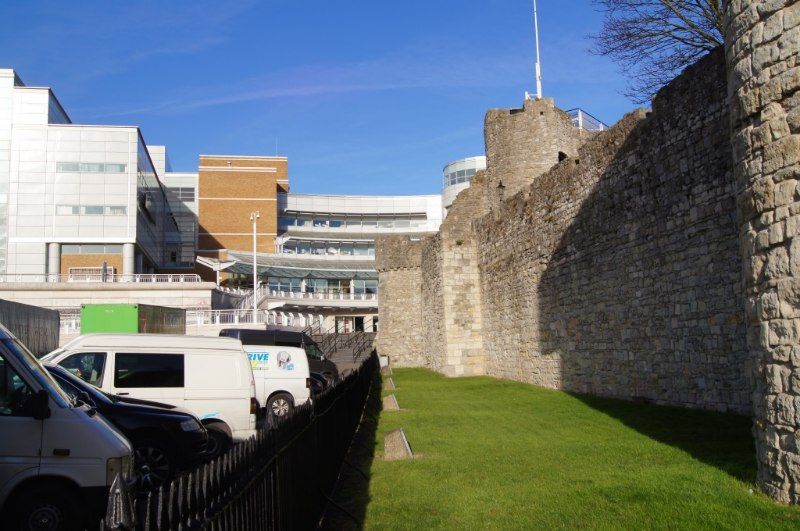
What did exist everywhere was the castle and the mounted warrior. Between about 950 and 1050, as royal power fragmented in France, local strongmen built earthwork-and-timber castles and used the men inside them to extract dues from everyone within riding distance. Historians call this the “castellan revolution” or, more contentiously, the “feudal revolution” — a genuine scholarly quarrel about whether the change around the year 1000 was a sharp rupture or a slow drift. Either way, the practical unit of medieval power was a fortified point with armed men in it and peasants around it.
Life on the manor
The manor was an estate, not a village, though the two often overlapped. Its arable was split between the lord’s demesne, farmed for him, and tenant holdings farmed by peasant families. Tenants paid in labour (so many days a week ploughing, more at harvest), in kind (hens at Christmas, eggs at Easter), and increasingly in cash. Beyond that lay the banalités: monopolies obliging tenants to grind grain at the lord’s mill, bake at his oven and press at his winepress, each for a cut. The mill was often the single most profitable asset on the manor, which is why unauthorised handmills were confiscated and smashed.
Custom governed all of it. The manorial court, whose rolls survive in the tens of thousands and are one of the best sources we have for ordinary medieval life, recorded transfers of holdings, fines for stray pigs, disputes over boundaries and the occasional scandal. Custom protected the peasant as well as bound him: a lord who demanded more than “the custom of the manor” risked flight, foot-dragging and, occasionally, litigation. Peasants were not passive. They bargained, sued, absconded to towns, and in 1358 and 1381 they revolted.
Peasant life was also brutally physical and short. Bad years came — the Great Famine of 1315 to 1317 killed perhaps a tenth of northern Europe. Housing was one or two rooms with animals often sharing the space. Bread supplied most calories; meat was occasional; ale was the safe drink. Yet by the thirteenth century the peasantry of England and France was better fed and more numerous than in 900, and a growing minority held their land by rent alone, legally free.
Towns, guilds and the commercial revolution
Roman urban life had never entirely vanished in Italy, but north of the Alps towns were small and often shrivelled by 900. From the eleventh century they exploded. Merchants clustered outside monastery or castle walls in settlements called faubourgs or portus; the settlement outgrew the fortress; the merchants bought or bullied a charter from lord or king guaranteeing personal freedom, the right to hold a market, their own court and their own taxes. The German proverb Stadtluft macht frei — town air makes you free — referred to a real legal rule in many places: a serf who lived a year and a day in a chartered town without being reclaimed became free.
Inside the walls, work was organised by guilds: associations of merchants or craftsmen that fixed prices and quality standards, restricted entry through apprenticeship, buried their dead, endowed chantries and quarrelled endlessly with each other for civic office. Guilds were monopolies with a religious face, and they were also the first mass institutions of urban self-government. In northern Italy and Flanders the towns went further and became communes — sworn associations of citizens that in practice governed themselves, so that Milan, Florence, Genoa and Pisa were functioning republics while nominally imperial. The Lombard cities in particular, Milan, Cremona, Brescia, Bergamo and Verona among them, formed the Lombard League, defeated the emperor Frederick I Barbarossa at Legnano in 1176, and extracted the Peace of Constance in 1183 confirming their self-rule.
Long-distance trade knitted the regions together. Northern Italian ships carried eastern spices, silk and alum; Flanders and Brabant made the finest woollen cloth in Europe from English wool; the Hanseatic League, a confederation of north German towns crystallising in the thirteenth century, controlled Baltic grain, timber, wax, furs and above all fish. Between north and south lay the Champagne fairs, six great fairs a year rotating among Troyes, Provins, Lagny and Bar-sur-Aube under the protection of the counts of Champagne, where an Italian could buy Flemish cloth, settle accounts by paper rather than coin, and go home. When the fairs declined around 1300 — partly because the French crown absorbed Champagne, partly because Genoese galleys began sailing directly to Bruges — the credit techniques survived them.
| Instrument or institution | What it did | Why it mattered |
|---|---|---|
| Bill of exchange | Written order to pay a sum in another city and currency | Moved value without moving coin; dodged bandits and, legally, the usury ban |
| Commenda partnership | Investor funds a voyage, travelling partner runs it, profits split | Pooled capital and shared risk; the ancestor of the joint-stock company |
| Double-entry bookkeeping | Every transaction recorded twice, debit and credit | Emerges in Italian ledgers around 1300; made large firms auditable |
| Merchant and craft guilds | Regulated entry, quality, price; provided welfare | Trained labour and enforced contracts where the state could not |
| Town charter / commune | Legal freedom, own court, own taxes | Created a self-governing corporate body inside a lordly world |
| Gold coinage revived | Florin (Florence, 1252), genovino, ducat (Venice, 1284) | Gave Europe a high-value currency for international settlement again |
Rural surplus fed a commercial revolution that produced a genuinely new social actor — the self-governing, credit-using, legally free townsman — whose institutions did not fit the older world of lords and peasants at all.
Section 3Popes, Kings and the Invention of the State
Reform and the Investiture Controversy
The reform movement began in the monasteries. The abbey of Cluny, founded about 910 and answerable directly to the pope rather than to any local lord, became the centre of a network of hundreds of houses committed to strict observance and freedom from lay interference. The idea spread: if a monastery should be free of the local count, why should a bishopric be the private gift of a king?
By the mid-eleventh century a party of reformers around the papacy had a programme. They attacked simony (buying church office), nicolaitism (clerical marriage and concubinage), and above all lay investiture — the practice by which a secular ruler handed a new bishop the ring and staff of his office. In 1059 a papal decree moved papal elections into the hands of the cardinals, cutting out the Roman nobility and the emperor. In 1075 twenty-seven blunt propositions known as the Dictatus Papae were entered in the register of Pope Gregory VII: that the pope alone may depose emperors, that he may be judged by no one, that all princes should kiss his feet.
The emperor Henry IV, whose government in Germany and Italy depended on bishops he appointed and could trust, refused. Gregory excommunicated and deposed him in 1076. German nobles, delighted, announced they would elect another king if Henry were not absolved within a year. In January 1077 Henry crossed the Alps in winter and stood in the snow outside the castle of Canossa for three days as a penitent until Gregory, who as a priest could hardly refuse absolution to a penitent, readmitted him. The fighting resumed almost immediately; Henry later drove Gregory from Rome, and Gregory died in exile at Salerno in 1085. The formal settlement came only in 1122 at the Concordat of Worms: the emperor renounced investiture with ring and staff and allowed free canonical election; the pope conceded that elections in Germany could take place in the emperor’s presence and that the bishop would receive his secular lands and rights from the ruler.
England: conquest, common law and Magna Carta
In 1066 Duke William of Normandy defeated Harold Godwinson at Hastings and took England by force. What followed was one of the most thorough elite replacements in European history: within twenty years virtually the entire English landholding aristocracy had been dispossessed in favour of perhaps 200 Norman and French families, castles were planted in every shire, and the language of government became Latin and French. In 1085–86 William ordered a survey of who held what, worth how much, then and in King Edward’s day. Domesday Book is the most detailed administrative document produced anywhere in eleventh-century Europe and it exists because a conquering king wanted to tax precisely.
The decisive legal turn came under Henry II (1154–89). Faced with a kingdom exhausted by civil war, he sent royal justices on regular circuits, offered standardised written writs that let a free man move a land dispute out of a lord’s court into the king’s, and used sworn panels of neighbours — the ancestor of the jury — to answer questions of fact. Royal justice was faster, more predictable and less bloody than trial by battle or ordeal, so litigants chose it, and choosing it made it customary. That accumulated custom is the common law: judge-made, precedent-driven, and today the legal foundation of England, Ireland, the United States, Canada, Australia, India and much else. Henry’s attempt to extend the same jurisdiction over criminous clerks brought him into collision with Archbishop Thomas Becket, murdered in Canterbury Cathedral in December 1170 by four knights who took the king’s rage literally.
Strong government invites resistance. Henry’s son John lost Normandy to Philip II of France in 1204, taxed savagely to try to get it back, and then watched the allied army meant to recover it destroyed at Bouvines in 1214. In June 1215 rebel barons forced him to seal Magna Carta at Runnymede. Most of its sixty-three clauses concern baronial grievances about wardship, forests and fish weirs. But clauses 39 and 40 — that no free man shall be seized, imprisoned or dispossessed except by the lawful judgement of his equals or by the law of the land, and that justice shall not be sold, denied or delayed — established in writing that the king was under the law. The charter was annulled by the pope within ten weeks and reissued repeatedly thereafter. Its long career as a constitutional icon owes as much to seventeenth-century lawyers as to 1215, but the principle was genuinely there.
France, the Empire and the papal monarchy
The Capetians, elected in 987 in the person of Hugh Capet, began as kings whose effective authority barely reached beyond the Île-de-France. They had two advantages: an unbroken run of male heirs for over three centuries, and the habit of crowning the son during the father’s lifetime. Slowly they turned dynastic luck into administration. Philip II Augustus (1180–1223) multiplied royal revenue several times over, installed salaried officials called baillis and sénéchaux to govern in the king’s name instead of hereditary counts, confiscated Normandy, Anjou and Maine from King John in 1204, and confirmed it all at Bouvines. His grandson Louis IX (1226–70) added moral prestige: he heard petitions personally, led two crusades, died at Tunis in 1270 and was canonised in 1297. His grandson Philip IV, by contrast, showed what a bureaucratic monarchy could do when it stopped being pious, summoning the Estates General in 1302, humiliating Pope Boniface VIII at Anagni in 1303, and destroying the Knights Templar to seize their assets.
The Holy Roman Empire moved the other way. Its kings were elected, its magnates entrenched, and its Italian ambitions ruinous. Frederick I Barbarossa (1152–90) fought six Italian campaigns and lost the decisive one at Legnano. His grandson Frederick II (1194–1250) — raised in Palermo, fluent in Arabic, an obsessive falconer, called by contemporaries stupor mundi, the wonder of the world — built a genuinely modern administration in his Sicilian kingdom with the Constitutions of Melfi in 1231, while conceding away royal rights in Germany to buy princely support. He spent his life at war with the papacy and was excommunicated four times. After his death the Empire never regained a strong central monarchy; real power settled with princes, bishops and free cities, and German political fragmentation lasted until unification in 1871.
The papacy meanwhile became a monarchy in its own right. Innocent III (1198–1216) claimed to stand “below God but above man,” arbitrated a disputed imperial election, laid England under interdict until John accepted his candidate for Canterbury and held the kingdom as a papal fief, and launched both the Fourth and the Albigensian crusades. The Fourth Lateran Council of 1215, which he convened, is the most consequential church council of the Middle Ages: it defined transubstantiation, required every Christian to confess and receive communion at least annually, forbade clergy to participate in trials by ordeal (effectively killing the ordeal and accelerating the turn to juries and inquisitorial procedure), and ordered Jews and Muslims to wear distinguishing dress.
| England | France | Holy Roman Empire | |
|---|---|---|---|
| Succession | Hereditary, often disputed | Hereditary; direct male line 987–1328 | Elective; princes choose the king |
| Key instrument | Royal writs, itinerant justices, juries | Salaried baillis; territorial confiscation | Bishops and ministerials; Italian revenues |
| Landmark | Domesday 1086; Magna Carta 1215 | Bouvines 1214; Louis IX’s courts | Concordat of Worms 1122; Melfi 1231 |
| Relations with papacy | Becket crisis 1170; John submits 1213 | Cooperative, then hostile under Philip IV | Continuous conflict, four Frederick II bans |
| Outcome by 1300 | Centralised law, taxation by consent | Strongest monarchy in Europe | Fragmented into princely territories |
The struggle between popes and rulers permanently divided authority in the West — no medieval European ruler ever fully controlled the Church, and that unresolved split left room for law, corporate rights and eventually constitutional government.
Section 4Frontiers and Crusades: Europe Turns Outward
Clermont and the First Crusade
In 1071 the Seljuk Turks destroyed a Byzantine army at Manzikert and overran most of Anatolia. Twenty-four years later the emperor Alexios I Komnenos asked the West for mercenaries. What he got instead was something new. At the Council of Clermont in November 1095, Pope Urban II preached an armed pilgrimage to recover Jerusalem and offered participants an unprecedented spiritual reward: remission of the penance due for confessed sins. No text of the sermon survives; five later accounts disagree about what he said, which is a useful reminder of how much of this history is reconstruction.
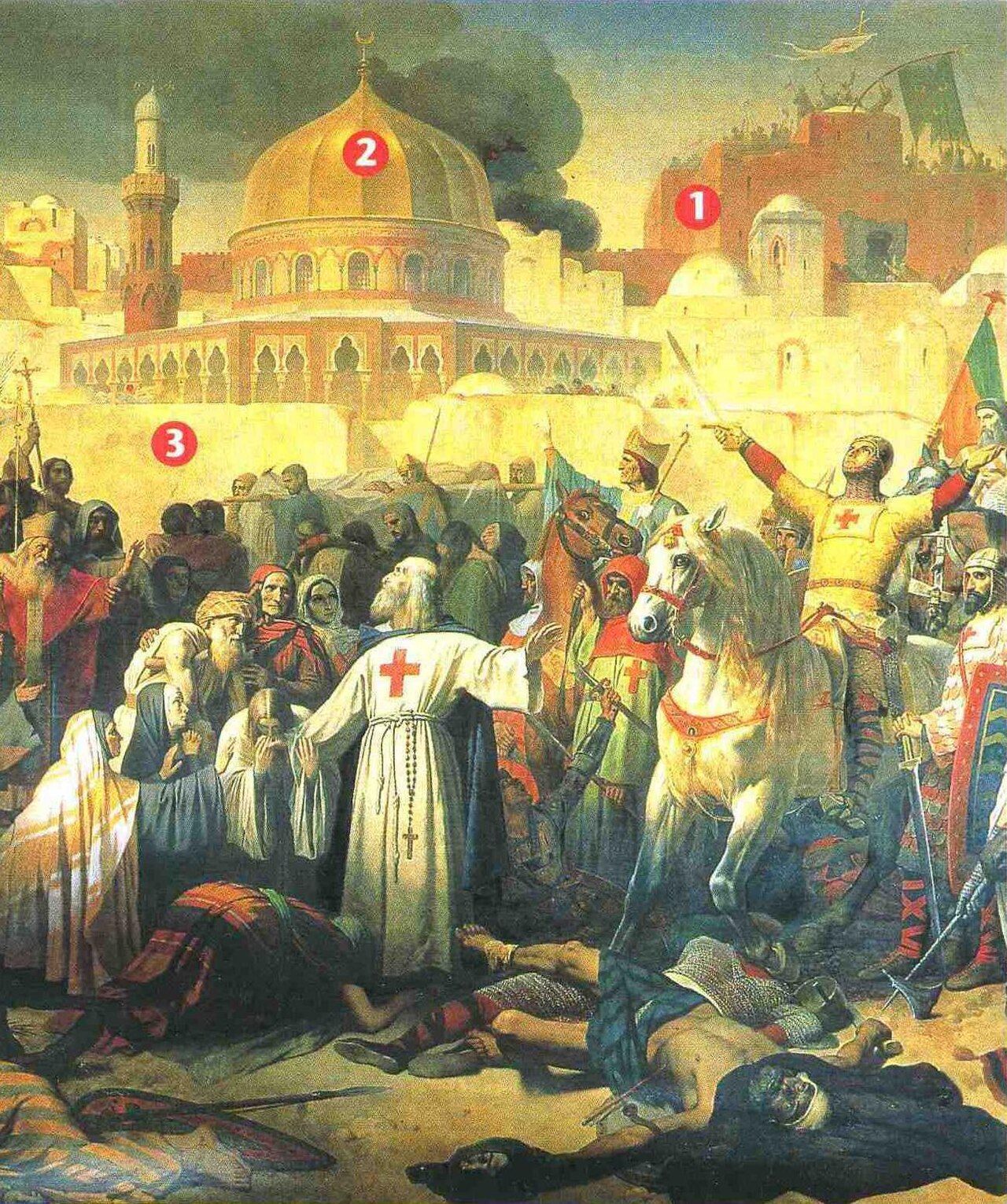
The response was enormous and largely unplanned. A popular movement led by the preacher Peter the Hermit set out early, and in the spring of 1096 bands from the same wave, above all the followers of Count Emicho of Flonheim, massacred the Jewish communities of the Rhineland — Speyer, Worms, Mainz, Cologne — in the first large-scale pogroms in western European history, often over the objections of local bishops who tried to shelter them. The princely armies that followed took Nicaea in 1097, endured a horrific siege at Antioch, and on 15 July 1099 stormed Jerusalem and slaughtered much of its Muslim and Jewish population. Latin chroniclers described the massacre with satisfaction; it is not a modern invention. Four crusader states resulted: the County of Edessa, the Principality of Antioch, the County of Tripoli and the Kingdom of Jerusalem.
Why did people go? Motives were mixed and provable case by case from charters: genuine terror of damnation and hope of remission, loyalty to a lord who had taken the cross, family tradition, the prestige of the journey, and yes, land and plunder for some. But the majority of crusaders mortgaged or sold property to finance a ruinously expensive trip, and most who survived came home. Crusading was, for most participants, a devotional act with a catastrophic cost–benefit ratio.
Saladin, Constantinople and the crusading habit
The crusader states survived because their Muslim neighbours were divided. When the Zengid and then Ayyubid rulers unified Egypt and Syria, the arithmetic changed. Edessa fell in 1144, prompting the Second Crusade (1147–49), preached by Bernard of Clairvaux and a total failure. In 1187 Saladin destroyed the army of the Kingdom of Jerusalem at the Horns of Hattin and retook Jerusalem in October, permitting most inhabitants to ransom themselves — a contrast with 1099 that impressed even his enemies.
The Third Crusade (1189–92) drew the three greatest rulers of Europe. Frederick Barbarossa drowned crossing a river in Anatolia and his army dissolved. Philip II went home early. Richard I of England took Acre and Jaffa, twice came within sight of Jerusalem without attacking it, and negotiated a truce guaranteeing Christian pilgrims access to the city. The Fourth Crusade (1202–04) is the darkest chapter: unable to pay the Venetians for transport, the army first sacked the Christian city of Zara for them, then intervened in a Byzantine succession dispute, and in April 1204 stormed and pillaged Constantinople itself, carrying off relics and bronze horses and installing a Latin emperor. Innocent III had forbidden it and then accepted the result. The wound to relations between Latin and Greek Christianity never healed; the Byzantine Empire, restored in 1261, never recovered its strength. Acre, the last mainland crusader stronghold, fell in 1291.
Consequences are easy to overstate. Europe did not learn algebra or acquire spices because of the crusades — Italian merchants were already trading with Egypt and Syria, and the great intellectual transmission ran through Spain and Sicily, not Palestine. What the crusades did produce was durable: the military orders (Templars, Hospitallers, Teutonic Knights) which became international banking and landholding corporations; a papal machinery for taxing the clergy and issuing indulgences that would eventually help detonate the Reformation; and an ideological template in which holy war against an external enemy could be turned inward against anyone defined as an enemy of Christendom.
| Crusade | Dates | Trigger | Result |
|---|---|---|---|
| First | 1096–99 | Byzantine appeal; Urban II at Clermont | Jerusalem taken and its people massacred; four Latin states founded |
| Second | 1147–49 | Fall of Edessa, 1144 | Failed before Damascus; damaged crusading prestige |
| Third | 1189–92 | Saladin’s victory at Hattin, 1187 | Coastal strip recovered; Jerusalem stayed Muslim; pilgrim access secured |
| Fourth | 1202–04 | Innocent III; Venetian debt | Sack of Constantinople; Latin Empire; permanent Greek–Latin rupture |
| Albigensian | 1209–29 | Cathar heresy in Languedoc | Heresy suppressed; the south annexed to the French crown |
| Baltic / Northern | 1147–15th c. | Conversion of pagan Slavs, Prussians, Balts | Teutonic Order state in Prussia and Livonia |
Iberia, the Baltic and the enemy within
The Iberian Reconquista was longer, closer to home and more consequential for Europe than anything in Syria. Toledo fell to Alfonso VI of Castile in 1085, bringing with it a mass of Arabic manuscripts and a mixed population of Arabic-speaking Christians, Muslims and Jews. The decisive battle came at Las Navas de Tolosa in 1212, where a combined Christian army broke the Almohads. Córdoba fell in 1236, Valencia in 1238, Seville in 1248. Only the emirate of Granada survived, paying tribute, until 1492. Iberian society for two centuries after each conquest was one of pragmatic and unequal coexistence — the arrangement historians call convivencia, a term now used with caution because it can romanticise what was legally subordinate status for religious minorities, punctuated by real violence.
In the north-east the crusading idea was applied to pagan Slavs, Prussians and Balts. The Teutonic Knights, redeployed from the Holy Land, conquered Prussia between 1230 and 1283 and built a monastic state with brick castles and chartered German towns. Conversion, colonisation and conquest were, in practice, the same operation.
Most disturbing is the turn inward. After his legate was murdered in Languedoc, Innocent III proclaimed in 1208 a crusade against the Cathars, dualists who rejected the material world, the sacraments and the Church’s authority; the army marched the next year. Twenty years of war — the sack of Béziers in 1209, the sieges of Carcassonne and Toulouse — broke the movement, wrecked the culture of the troubadours and delivered the south to the French crown by the Treaty of Paris in 1229. Montségur, the last Cathar stronghold, held out until 1244. To finish the job the papacy from the early 1230s appointed standing inquisitors, mostly Dominicans, using written records, systematic interrogation and (after 1252) torture. Jews meanwhile went from a protected if precarious minority to a targeted one: badge requirements after 1215, the ritual-murder libel first recorded at Norwich in 1144, the massacre at York in 1190, expulsion from England in 1290 and from royal France in 1306. R. I. Moore called the pattern a “persecuting society” — the argument that the same administrative sophistication that produced universities and common law also produced the capacity to define, register and eliminate deviance. The claim is debated, but the chronology is not.
Crusading expressed a confident, expanding Europe, and the same expansion that pushed outward into Syria, Iberia and the Baltic turned inward to define and persecute heretics and Jews at home.
Section 5Schools, Cathedrals and the Life of the Mind
From cathedral school to university
Learning in the early Middle Ages lived in monasteries, and its purpose was prayer and preservation. In the eleventh century the centre of gravity shifted to cathedral schools in the growing towns — Chartres, Laon, Reims, Paris — where masters taught the seven liberal arts to clerics who intended careers in administration. Demand outran supply. Where students and masters gathered in numbers they did what everyone else in a twelfth-century town did: they formed a guild. The Latin for such a corporation was universitas, and that is all the word originally meant — not a campus, a corporation of persons.
The two prototypes differed instructively. At Bologna, where students were often adult professionals studying Roman and canon law, the students formed the guild and hired, fined and disciplined the professors, docking pay for skipping difficult passages. At Paris, where the arts and theology dominated and students were younger, the masters formed the guild; Philip II granted privileges in 1200 after a lethal town-and-gown riot, and papal statutes of 1215 and 1231 confirmed its autonomy from the local bishop. Oxford grew from an English migration out of Paris, Cambridge from a migration out of Oxford after a hanging in 1209. Salerno and later Montpellier led in medicine.
The structure the universities invented is still recognisable: a fixed curriculum, examinations, a licence to teach (licentia docendi), which at the greatest schools carried the right to teach anywhere in Christendom, the degrees of bachelor, master and doctor, faculties of arts, law, medicine and theology, academic dress, and a jealously guarded legal immunity from the local courts. It is one of the very few institutions to survive from the twelfth century to the present without a break in function.
| Studium | Emerges | Specialty | Governing guild |
|---|---|---|---|
| Bologna | c. 1088–1150 | Roman and canon law | Students hire and fine the masters |
| Paris | c. 1150–1200 | Arts and theology | Masters; chartered 1200, statutes 1215 |
| Oxford | c. 1167–1200 | Arts, theology, natural philosophy | Masters, under a chancellor |
| Salerno | 11th c. | Medicine (Arabic and Greek texts) | Loose association of practitioners |
| Montpellier | c. 1180–1220 | Medicine and law | Masters, with papal privileges |
Aristotle returns: scholasticism and its limits
For centuries the Latin West knew Aristotle only through two logical works. Between about 1120 and 1250 nearly the entire corpus arrived — physics, metaphysics, ethics, biology, meteorology — along with Euclid, Ptolemy’s Almagest, Galen, and the commentaries of the Persian Ibn Sina (Avicenna) and the Andalusian Ibn Rushd (Averroes). The route ran through Toledo, where Gerard of Cremona (died 1187) alone translated some seventy works from Arabic, and through Sicily and Constantinople for translations straight from the Greek. Europe received its own classical inheritance back, enlarged, from Muslim and Jewish scholars who had preserved and extended it.
The method that digested it is scholasticism. Its engine is the disputed question: state the problem, marshal the authorities that say yes, marshal those that say no, then resolve the contradiction by distinction. Peter Abelard’s Sic et Non (around 1120) lined up 158 theological questions with conflicting patristic quotations on each side and left the reconciling to the reader — deliberately, to train students in analysis. Gratian did the same for church law in his Decretum (about 1140), creating the discipline of canon law; Peter Lombard’s Sentences (about 1150) became the standard theology textbook for four hundred years.
The synthesis belongs to Thomas Aquinas (about 1225–1274), a Dominican who taught at Paris and Naples and whose unfinished Summa Theologiae argues that reason and revelation cannot ultimately conflict because both come from God, that philosophy is therefore legitimate on its own terms, and that grace perfects nature rather than replacing it. Not everyone agreed. In 1277 the bishop of Paris, Étienne Tempier, condemned 219 propositions circulating in the arts faculty, several of them close to Aquinas’s own positions. Some historians, following Pierre Duhem, argued that this condemnation freed natural philosophy from Aristotle’s authority and helped make later science possible; others think the claim is far too neat. What is not in doubt is that the medieval university institutionalised the practice of arguing systematically about first principles.
Reform, friars and lay devotion
Monastic life kept reinventing itself. The Cistercians, founded at Cîteaux in 1098 and driven by the ferocious energy of Bernard of Clairvaux from 1115, rejected Cluniac wealth for austerity, manual labour, plain unadorned churches and remote sites — and, through the labour of lay brothers, became the most efficient agricultural operation in Europe, which made them rich and started the cycle again. Their standardised architecture and their wool business ran from Yorkshire to Poland.
The thirteenth century’s innovation was to bring religious life into the streets. Francis of Assisi (about 1181–1226), a cloth merchant’s son, renounced his inheritance, embraced absolute poverty and preached to anyone who would listen; Innocent III gave his brotherhood verbal approval in 1209–10 and a written rule followed in 1223. Dominic de Guzmán, confronting the Cathars in Languedoc, concluded that preachers could not credibly denounce wealth while travelling in it, and founded an order of trained preachers approved in 1216. The friars were mobile, urban and highly educated — Aquinas was a Dominican, Bonaventure a Franciscan — and they staffed the universities and, less happily, the inquisition. Lay movements multiplied too: the beguines of the Low Countries, women who lived communally in poverty and service without taking permanent vows, were admired, then suspected, then in 1310 saw one of their number, Marguerite Porete, burned in Paris for a book of mystical theology. Earlier, Hildegard of Bingen (1098–1179) had written on visions, medicine and music and corresponded with popes and emperors.
Stone, light and the vernacular voice
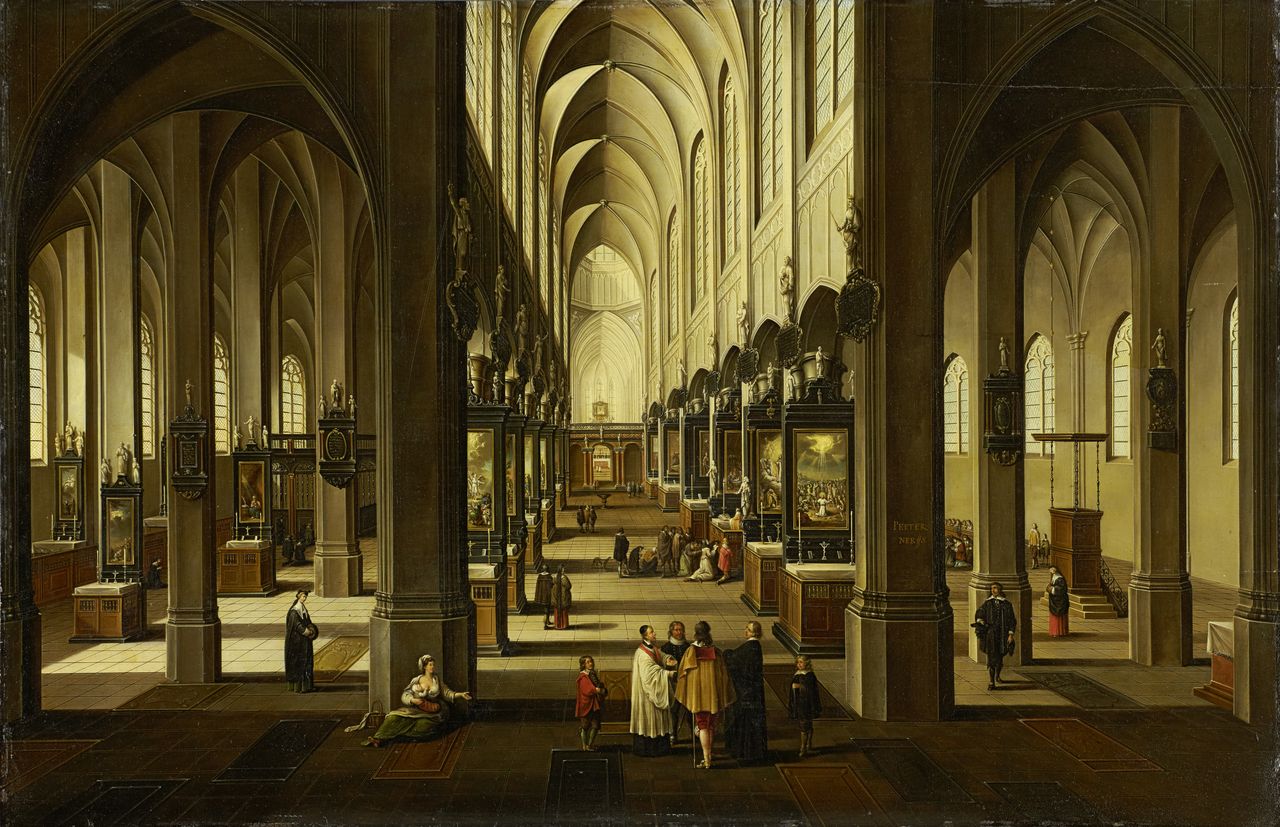
Eleventh-century Romanesque churches were solid: round arches, barrel vaults, thick walls, small windows, dim interiors, and sculpture concentrated on the doorway. The Gothic alternative is usually dated to the rebuilt choir of the abbey of Saint-Denis outside Paris, consecrated in 1144 under Abbot Suger, who wrote that material light lifted the mind toward immaterial truth. Three devices made it work together: the pointed arch, which directs thrust downward and allows vaults of different spans to meet at the same height; the ribbed vault, which channels weight to points rather than along a whole wall; and the flying buttress, which braces those points from outside. Take the load off the wall and the wall can become glass.
The results were competitive and sometimes reckless. Notre-Dame de Paris was begun in 1163; Chartres was rebuilt after a fire in 1194 with the finest surviving programme of twelfth- and thirteenth-century stained glass; Amiens raised its vault to about 42 metres; Beauvais tried 48 and the choir vault collapsed in 1284. These were civic projects as much as religious ones, funded by bishops, guilds, kings and pilgrims, employing hundreds over generations, and they announced a town’s wealth as loudly as its piety.
Language changed with the buildings. Latin remained the tongue of law, liturgy and learning, but from about 1100 literature in the spoken languages of Europe found an audience: the Song of Roland in Old French, the troubadour lyrics of Occitania that invented the conventions of romantic love, Chrétien de Troyes’s Arthurian romances with Lancelot and the Grail, the German Nibelungenlied and the poems of Walther von der Vogelweide. The line runs directly to Dante Alighieri (1265–1321), who argued in De vulgari eloquentia that the vernacular could carry the highest matter and then proved it in the Commedia. A literate lay public, with money and leisure, now wanted to read in its own language — and that public is the precondition for everything Chapter 7 describes.
Urban wealth and a recovered classical inheritance produced two lasting institutions — the university and the Gothic cathedral — that together made systematic argument and monumental civic ambition normal features of European life.
The chapter in one breath
Three centuries of good weather, better ploughs and the end of the raids let Europe grow more food and more people than it had since Rome. That surplus paid for towns, and towns bought charters, formed guilds, invented credit and produced a class of free people who owed nothing to any lord. Rulers taxed the new wealth and used it to build administrations — Domesday and the common law in England, salaried officials and confiscated provinces in France, a reformed and increasingly monarchical papacy in Rome. When pope and emperor collided over who appointed bishops, neither won outright, and the permanent division of authority they left behind became one of the West’s most distinctive political inheritances. The same confident society sent armies to Jerusalem, Iberia and the Baltic, and then turned the machinery of holy war on Cathars and Jews at home. Its schools became universities; its recovered Aristotle became scholasticism; its money and pride became cathedrals of glass. By 1300 the good land was gone, the population was pressing its limits, and the whole structure was one bad decade away from catastrophe.
Words worth knowing
| Term | What it means |
|---|---|
| Medieval Warm Period | A regionally warmer interval roughly 950–1250 that lengthened growing seasons in the North Atlantic world. |
| Three-field system | Rotation of winter grain, spring crop and fallow, reducing idle land from one-half to one-third. |
| Manorialism | The economic organisation of an estate into lord’s demesne and tenant holdings, with labour, kind and cash dues. |
| Serf | An unfree tenant bound to the land and owing services, but holding property and protected by manorial custom. |
| Fief | Land, office or revenue granted in return for service, usually military; the core of what later writers called feudalism. |
| Banalités | Lordly monopolies compelling tenants to use the lord’s mill, oven or winepress for a fee. |
| Commune | A sworn association of townspeople governing their own city, especially in Italy and Flanders. |
| Guild | A licensed association of merchants or craftsmen regulating entry, quality, price and mutual welfare. |
| Bill of exchange | A written order to pay a sum in another city and currency; the foundation of medieval international finance. |
| Simony | The buying or selling of church office, a central target of eleventh-century reformers. |
| Lay investiture | A secular ruler conferring the symbols of episcopal office, the flashpoint of the Gregorian conflict. |
| Concordat of Worms | The 1122 compromise separating a bishop’s spiritual office from his secular lands and rights. |
| Domesday Book | The 1086 English survey of landholding and value, made so that a conquering king could tax accurately. |
| Common law | Judge-made English law built from royal writs, itinerant justices and juries under Henry II. |
| Magna Carta | The 1215 charter forced on King John, asserting that the king is bound by the law of the land. |
| Crusade | A papally authorised armed pilgrimage carrying a spiritual reward, directed at Muslims, pagans, heretics or political enemies. |
| Reconquista | The centuries-long Christian conquest of Muslim Iberia, decisively advanced after Las Navas de Tolosa in 1212. |
| Scholasticism | The university method of resolving contradictions between authorities through logical distinction and disputed questions. |
| Universitas | Originally a guild or corporation of persons; applied to associations of masters or students, hence “university.” |
| Gothic | The architectural style using pointed arch, ribbed vault and flying buttress to replace load-bearing wall with glass. |