The Lymphatic & Immune System
Every day, trillions of bacteria, viruses, and fungi test your borders — and most days you never notice, because a layered defense force turns them away before they can take hold. This chapter follows that force from its plumbing to its most precise weapons. First you will meet the lymphatic system, the quiet network that drains your tissues, ferries fat from your meals, and houses your immune army. Then you will watch immunity itself unfold in three lines of defense — from the skin on the outside, through the fast fury of inflammation, to the slow, specific, unforgettable power of T cells and B cells. By the end you will understand not just how you fight infection, but why a vaccine protects you and a snakebite antivenom does not last.
By the end of this chapter you can
- Describe the three functions of the lymphatic system and trace the path of lymph from a tissue back to the bloodstream.
- Distinguish the primary and secondary lymphoid organs and state what each one does.
- Contrast innate and adaptive immunity and place the body's defenses into the correct line of defense.
- Explain the inflammatory response, name its four cardinal signs, and connect each sign to the event that causes it.
- Compare the roles of helper and cytotoxic T cells and explain why T cells require antigen presentation.
- Describe how a B cell becomes a plasma cell, the structure of an antibody, and how antibodies disable a pathogen.
- Distinguish a primary from a secondary immune response and explain why memory cells make vaccines work.
- Classify immunity as active or passive and natural or artificial, and give a real example of each of the four types.
Section 1The lymphatic system
A drainage network with three jobs
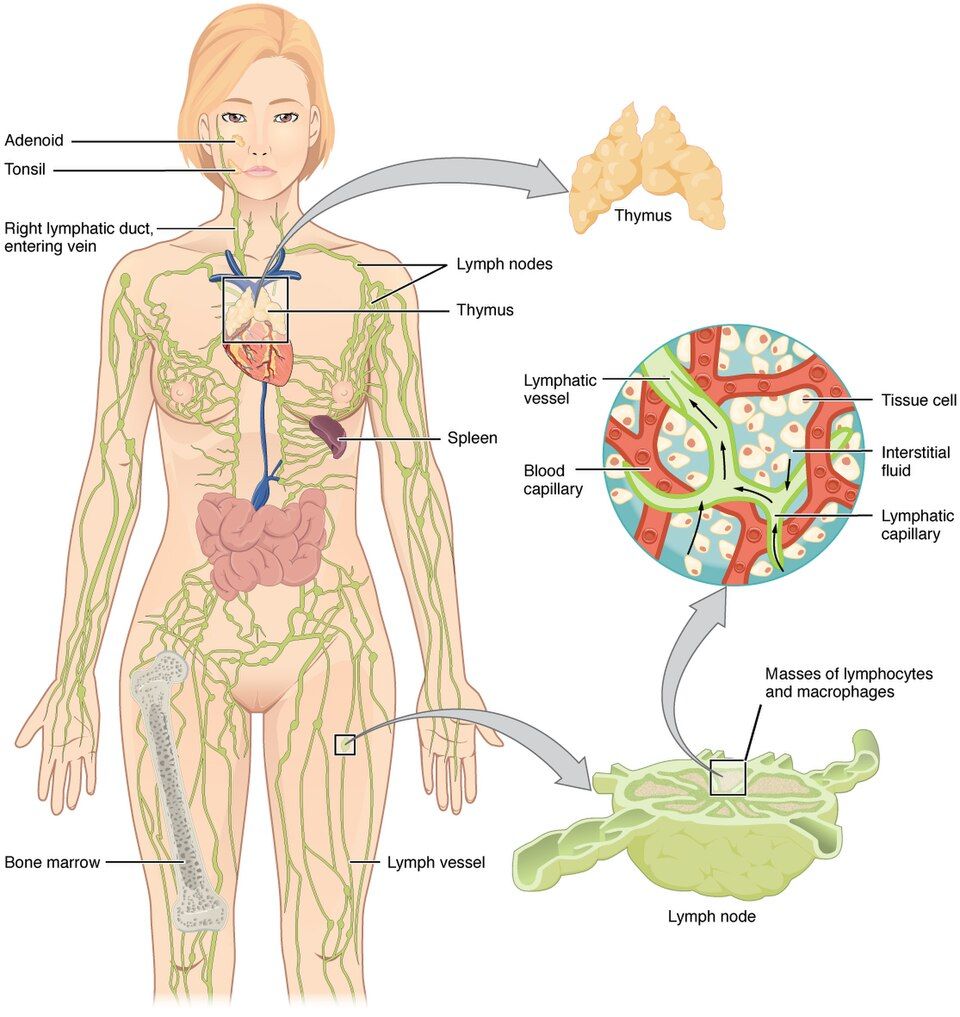
Your bloodstream is not perfectly sealed. As blood pushes through the tiniest capillaries, a little fluid is squeezed out into the spaces between cells — roughly three liters a day more leaves than comes back. If that fluid simply pooled, you would swell up and your blood volume would crash within hours. The lymphatic system is the return line that prevents this. It is a one-way network of vessels that collects the leaked interstitial fluid, renames it lymph once it is inside a lymphatic vessel, and hands it back to the bloodstream near the heart. That is its first and most basic job: fluid balance.
It also does two more things. In the lining of the small intestine, specialized lymphatic capillaries called lacteals absorb dietary fats and fat-soluble vitamins that are too large to enter the blood capillaries directly — the milky fat-laden lymph they carry is called chyle. And, most importantly for the rest of this chapter, the lymphatic system is the home and highway of the immune system: it houses the lymphocytes and macrophages that fight infection and it filters lymph through checkpoints where those cells can catch invaders in the act.
| Function | What happens | Where |
|---|---|---|
| Fluid balance | Returns ~3 L/day of leaked interstitial fluid to the blood | Lymphatic capillaries throughout the body |
| Fat absorption | Takes up dietary fats and fat-soluble vitamins as chyle | Lacteals in the small intestine |
| Immune defense | Houses and transports lymphocytes; filters lymph for pathogens | Lymph nodes, spleen, and other lymphoid organs |
How lymph flows — with no pump
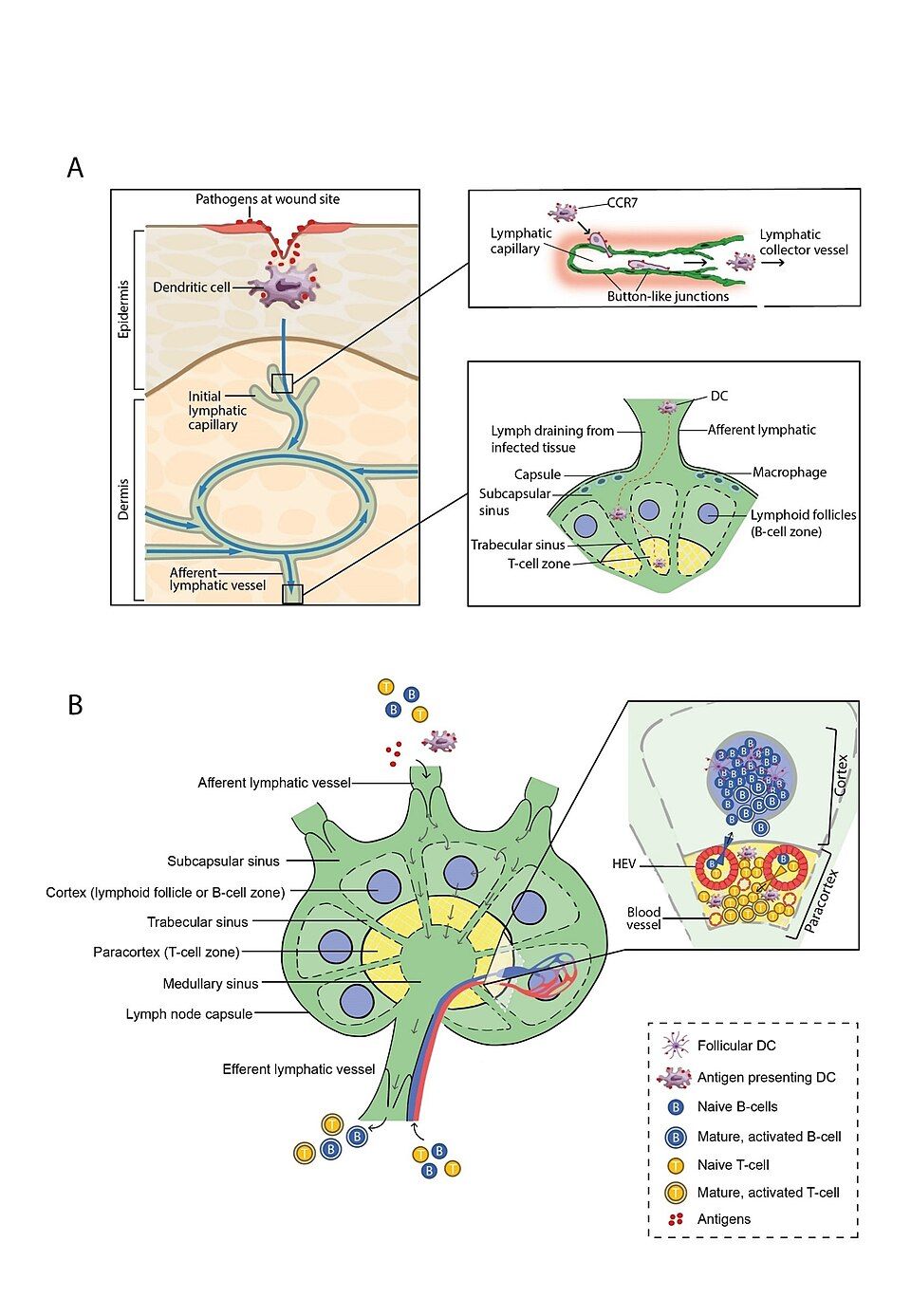
Lymph starts its journey in lymphatic capillaries, blind-ended tubes whose overlapping endothelial cells act like tiny one-way flap valves: interstitial fluid pushes them open to get in, but cannot push them back out. From there lymph flows into larger lymphatic vessels, which look and behave much like veins — thin-walled, with internal valves to stop backflow. The vessels pass their lymph through bean-shaped lymph nodes, then merge into large lymphatic trunks and finally two collecting ducts: the small right lymphatic duct (which drains the right arm and the right side of the head and chest) and the large thoracic duct (which drains everything else). Both empty into the subclavian veins at the base of the neck, and the fluid is blood again.
Here is the catch: the lymphatic system has no heart of its own. It moves lymph the same way veins move blood back uphill — by the skeletal muscle pump (contracting muscles squeeze the vessels), the respiratory pump (pressure changes with each breath), and rhythmic contraction of smooth muscle in the vessel walls, all made one-directional by those valves. This is why gentle movement reduces swelling and why a limb that cannot move tends to puff up.
The lymphoid organs
The organs of the immune system are sorted into two groups by what they do. Primary lymphoid organs are where lymphocytes are born and mature: the red bone marrow, where all blood cells originate and where B lymphocytes mature, and the thymus, a bilobed organ in the chest where T lymphocytes finish maturing and learn not to attack the body's own tissues. The thymus is largest in childhood and slowly shrinks (involutes) after puberty. Secondary lymphoid organs are where mature lymphocytes actually meet antigens and launch responses: the lymph nodes that filter lymph, the spleen that filters blood (removing worn-out red blood cells in its red pulp and screening blood for pathogens in its white pulp), plus the tonsils, Peyer's patches of the intestine, and the diffuse MALT (mucosa-associated lymphoid tissue) that guards every wet surface.
- The lymphatic system does three jobs: fluid balance (returns leaked fluid), fat absorption (lacteals make chyle), and immune defense.
- Lymph flows one way — capillaries → vessels → nodes → ducts → subclavian veins — driven by muscle and breathing, not a pump, and kept one-directional by valves.
- Primary lymphoid organs (bone marrow, thymus) make lymphocytes; secondary organs (lymph nodes, spleen, tonsils, MALT) are where they fight.
Section 2The three lines of defense
Two kinds of immunity, three layers of defense
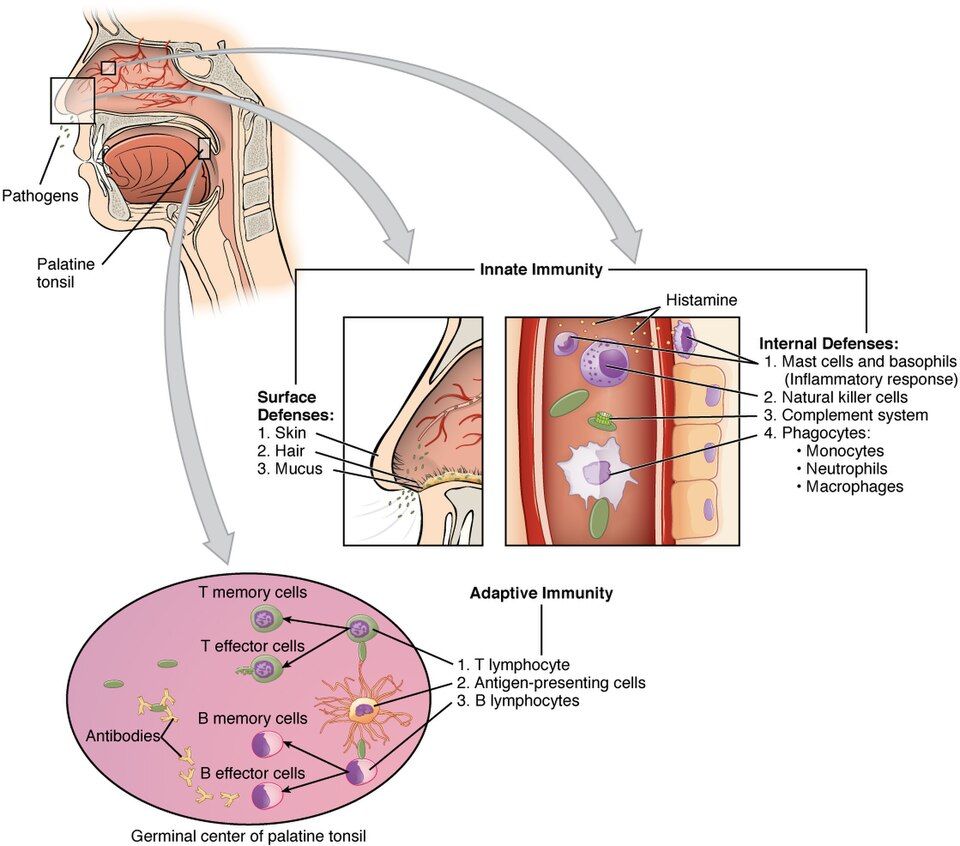
Immunity comes in two broad styles. Innate (nonspecific) immunity is the defense you are born with: it treats every intruder the same way, responds within minutes to hours, and keeps no memory of past attackers. Adaptive (specific) immunity is the defense you develop over a lifetime: it targets one particular pathogen with exquisite precision, takes days to gear up the first time, and — crucially — remembers. These two styles are organized into three lines of defense, each one taking over if the one before it is breached.
The first line is the body's outer wall: the skin and mucous membranes and their secretions. Intact skin is a dry, tough, keratinized barrier that few microbes can cross. Mucous membranes trap invaders in sticky mucus, then cilia sweep them out. Chemical defenses back up the wall: the acid mantle of sweat and sebum, the enzyme lysozyme in tears and saliva that digests bacterial walls, harsh stomach acid, and the normal flora of harmless bacteria that crowd out dangerous ones. Nothing here is aimed at a specific microbe — it is a barrier against all of them.
When the wall is breached
If a pathogen gets past the barrier — through a cut, a burn, an inhaled droplet — the second line meets it inside the body. This is still innate and still nonspecific, but now it is cellular and chemical warfare: phagocytes (neutrophils and macrophages) that engulf and digest invaders, natural killer (NK) cells that destroy virus-infected and tumor cells on sight, the inflammatory response, fever, and antimicrobial proteins such as interferons (which warn neighboring cells about viruses) and complement (a cascade of blood proteins that punches holes in microbes and tags them for destruction). The second line does not care which microbe it is fighting — only that something does not belong.
The third line is adaptive immunity: the lymphocytes — T cells and B cells — and the antibodies the B cells produce. This line is slow to start but devastatingly specific, and it leaves behind memory cells so the next encounter is faster and stronger. The rest of this chapter is mostly about the second and third lines.
| Line | Type | Defenses |
|---|---|---|
| First line | Innate — surface barriers | Skin, mucous membranes, secretions (acid, lysozyme, mucus, normal flora) |
| Second line | Innate — internal | Phagocytes, NK cells, inflammation, fever, interferons, complement |
| Third line | Adaptive — specific | T lymphocytes, B lymphocytes, antibodies, memory cells |
- Innate immunity is fast, general, and memoryless; adaptive immunity is slow at first, specific, and remembers.
- First line = surface barriers; second line = internal innate defenses (phagocytes, NK cells, inflammation, fever, complement); third line = lymphocytes and antibodies.
- Only the third line has memory — the basis of lifelong immunity and vaccination.
Section 3The inflammatory response
Four signs you already know
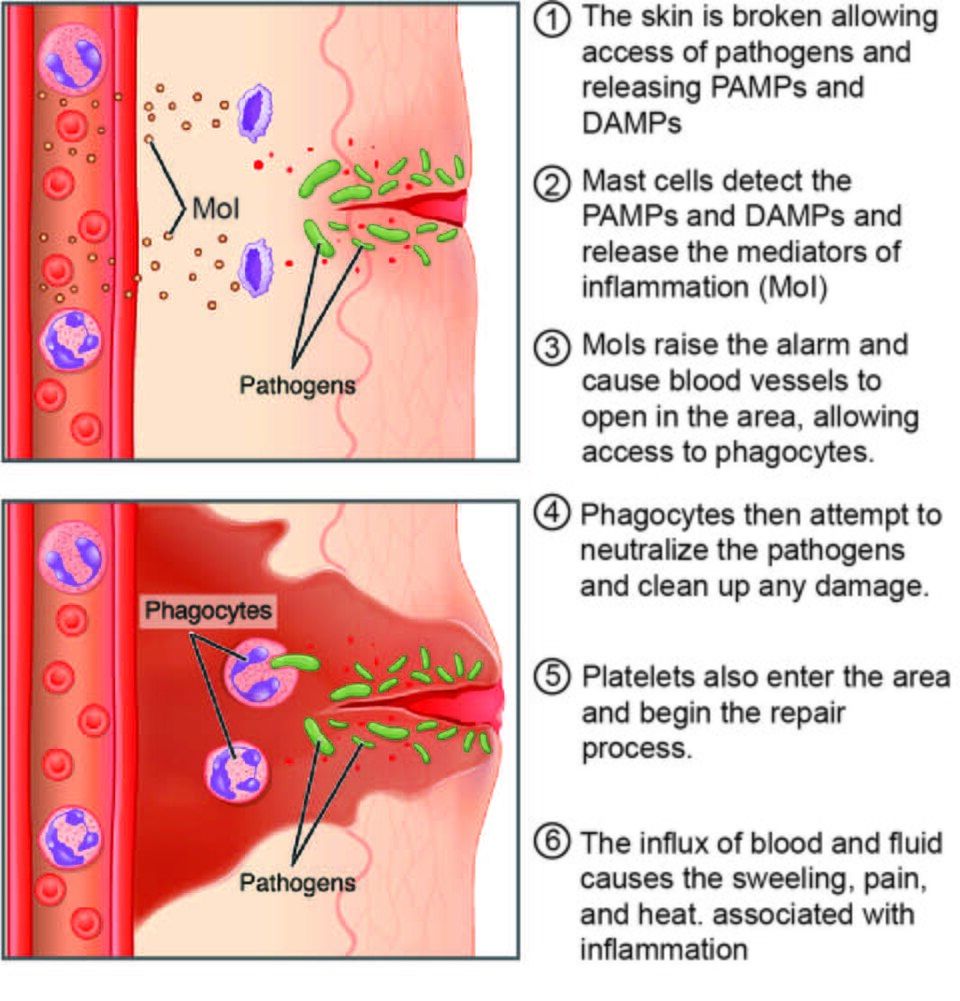
Cut your finger and within minutes it turns red, warm, swollen, and sore. Those four cardinal signs — the Latin rubor, calor, tumor, and dolor — are not the infection; they are your body's inflammatory response, a central weapon of the second line of defense. Inflammation is triggered whenever tissue is damaged or invaded, and although it feels like something going wrong, it is a tightly choreographed rescue operation. Its goals are to dispose of debris and pathogens, wall off the injured area so infection cannot spread, and set the stage for repair.
What actually happens
The moment tissue is injured, damaged cells and resident mast cells release a flood of chemical alarm signals — most famously histamine, along with prostaglandins and other mediators. These chemicals do two things at once. They cause vasodilation, widening local blood vessels so more blood floods the area — that is the redness and the heat. And they make the capillary walls more permeable, so fluid, clotting proteins, and defensive cells leak out into the tissue — that is the swelling (edema), and the pressure of that swelling plus the mediators themselves cause the pain.
Now the cleanup crew arrives. Chemical signals from the injury draw phagocytes toward it, a process called chemotaxis. Neutrophils come first, squeezing out of the bloodstream through the vessel wall (diapedesis) and engulfing microbes; longer-lived macrophages follow to devour pathogens and dead cells. The creamy pus that may collect is simply the debris of this battle — dead neutrophils, broken tissue, and destroyed microbes. Once the threat is cleared, the same site becomes the workshop where repair begins.
| Cardinal sign | Latin | What causes it |
|---|---|---|
| Redness | Rubor | Vasodilation brings more blood to the area |
| Heat | Calor | Increased blood flow warms the tissue |
| Swelling | Tumor | Increased capillary permeability lets fluid leak into tissue |
| Pain | Dolor | Pressure of edema plus chemical mediators on nerve endings |
Inflammation can also go systemic. When infection is widespread, chemicals called pyrogens raise the hypothalamic set point, producing fever. A moderate fever is protective — it slows the reproduction of many microbes and speeds up the body's repair reactions. The bone marrow also ramps up white-cell production (leukocytosis), which is why a high white-cell count on a blood test suggests infection.
- The four cardinal signs — redness, heat, swelling, pain — come from vasodilation and increased capillary permeability.
- Histamine from mast cells starts it; neutrophils then macrophages arrive by chemotaxis and diapedesis to phagocytose debris and pathogens.
- Inflammation disposes of threats, walls off the area, and prepares repair; systemically it can produce protective fever and leukocytosis.
Section 4T cells & cell-mediated immunity
Immunity that acts cell-to-cell
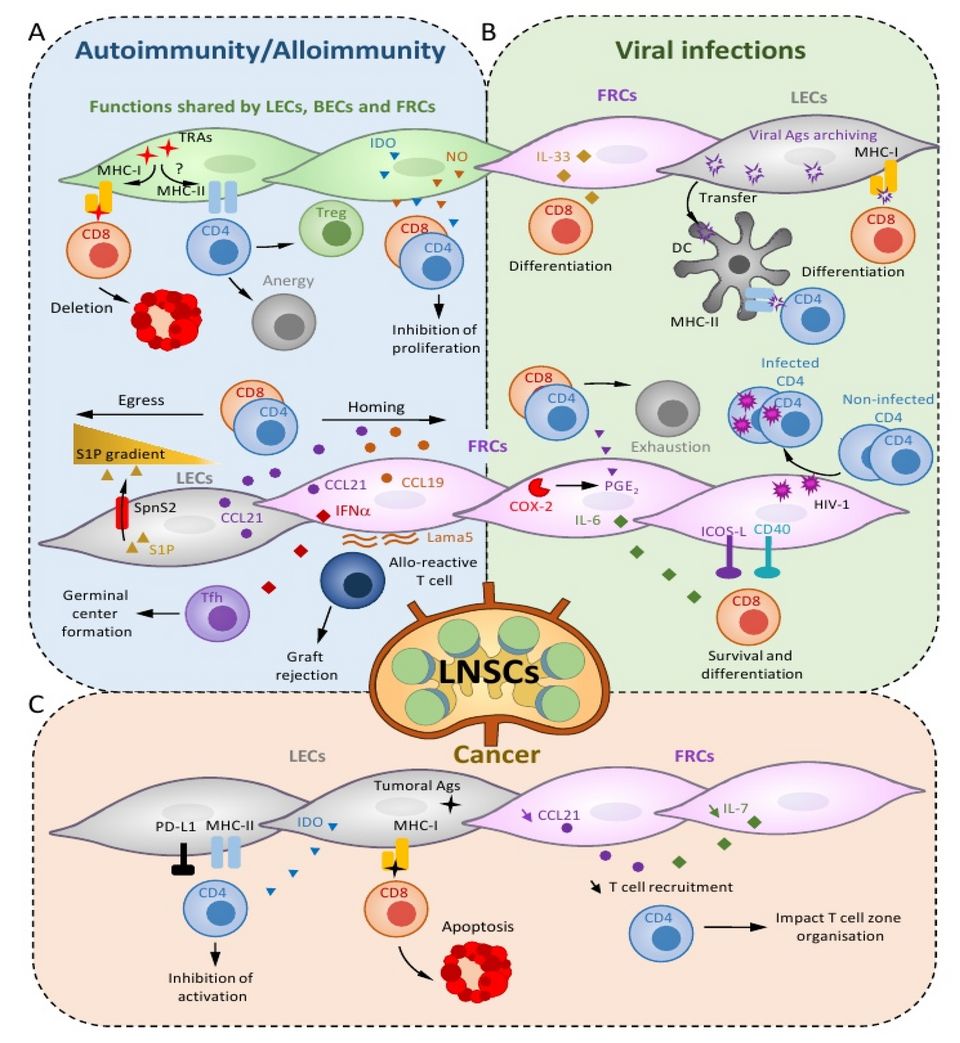
The third line splits into two branches. Cell-mediated immunity, run by T lymphocytes, deals with threats that hide inside your cells — viruses, some bacteria, and cancerous cells — and it does its work by direct cell-to-cell contact rather than by releasing antibodies. T cells are born in the bone marrow but mature in the thymus (the "T" is for thymus), where they are screened so that only cells which ignore your own tissues are allowed to graduate.
Here is the defining rule of T cells: they are blind to free-floating antigen. A T cell can only recognize an antigen when it is presented to it, held up on the surface of another cell in a special display molecule called an MHC (major histocompatibility complex). Every nucleated cell carries MHC class I, on which it displays samples of the proteins being made inside it — a healthy cell shows self-peptides, but a virus-infected cell displays viral fragments, in effect raising a flag that says "I am infected." Antigen-presenting cells (APCs) — dendritic cells, macrophages, and B cells — also carry MHC class II, on which they display bits of pathogens they have engulfed. This presentation requirement is the safety switch that keeps the powerful T-cell response from firing at random.
The T-cell lineup
When a T cell whose receptor happens to match the presented antigen finds it, that one cell is selected to multiply into an army of identical clones — a process called clonal selection. Those clones mature into several specialized types:
| T cell type | Marker | Job |
|---|---|---|
| Helper T cell | CD4 | The coordinator — reads antigen on MHC II and releases cytokines that activate cytotoxic T cells, B cells, and macrophages |
| Cytotoxic T cell | CD8 | The killer — reads antigen on MHC I and destroys infected or cancerous cells with perforin and granzymes |
| Regulatory T cell | CD4 | The brake — dampens and shuts down the response, preventing autoimmunity |
| Memory T cell | — | The archive — persists for years to mount a fast response on re-exposure |
The helper T cell is the quarterback of the entire adaptive response: without its cytokine signals, neither the cytotoxic T cells nor the B cells switch fully on. The cytotoxic T cell is the assassin: when it recognizes an infected cell, it releases perforin to punch a pore in the target and granzymes that trigger the cell to self-destruct by apoptosis, killing the pathogen along with its hiding place.
- T cells mature in the thymus and run cell-mediated immunity by direct contact, not antibodies.
- T cells act only when antigen is presented on an MHC molecule — MHC I shows what is inside any cell, MHC II is used by APCs.
- Helper (CD4) cells coordinate the whole response; cytotoxic (CD8) cells kill infected cells; regulatory cells brake it; memory cells remember.
Section 5B cells & antibodies
The antibody factories
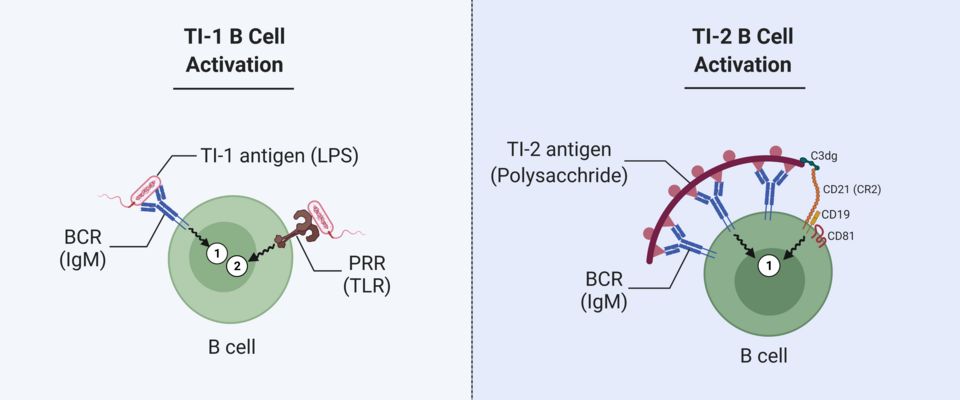
The other branch of adaptive immunity is humoral immunity (from humor, meaning body fluid), and it is the job of B lymphocytes. Where T cells attack threats hidden inside cells, B cells fight pathogens floating free in the blood, lymph, and tissue fluid — and they do it not by direct combat but by manufacturing antibodies. B cells mature in the red bone marrow (a handy memory hook: B for bone marrow) and then wait in the lymph nodes and spleen for their matching antigen.
When a B cell's surface receptor binds its specific antigen — usually with a confirming cytokine push from a helper T cell — that B cell is activated and undergoes clonal selection, dividing rapidly into two products. Most become plasma cells, short-lived but astonishing antibody factories that can pump out thousands of identical antibodies every second. The rest become memory B cells that linger for years, primed to respond instantly if the same pathogen ever returns.
What an antibody is and how it fights
An antibody (also called an immunoglobulin, Ig) is a Y-shaped protein built from four chains — two heavy and two light. The two tips of the Y form the variable region, a custom-shaped antigen-binding site that fits one specific antigen like a lock and key; the stem is the constant region that determines the antibody's class. Antibodies do not usually kill a pathogen outright. Instead they tag and disable it: they neutralize toxins and viruses by covering the part that would bind your cells, agglutinate (clump) many pathogens together for easy disposal, activate complement to lyse the invader, and opsonize — coat the target so phagocytes grab it more readily.
| Class | Where / when | Notable job |
|---|---|---|
| IgG | Most abundant; the secondary response | Long-term immunity; the only class that crosses the placenta |
| IgM | First antibody made in a new infection | Large pentamer; powerful complement activator |
| IgA | Secretions — saliva, tears, mucus, breast milk | Guards mucous membranes and passes immunity in milk |
| IgE | Bound to mast cells and basophils | Drives allergies and fights parasitic worms |
| IgD | On the B-cell surface | Acts as an antigen receptor that helps activate the B cell |
Why the second exposure is different
The first time you meet a pathogen, the primary response is slow: it takes several days for the right B cell to be found, multiply, and start producing antibody (mostly IgM at first, then IgG), and you may get sick in the meantime. But the encounter leaves behind memory B cells. If that same pathogen returns, the secondary response is far faster and stronger — memory cells launch a flood of high-quality IgG within a day or two, often clearing the invader before you ever feel ill. That difference is the entire logic of vaccination: safely create the memory now, so the real infection meets a secondary response.
- B cells mature in bone marrow and run humoral immunity, becoming plasma cells that mass-produce antibodies and memory B cells that remember.
- An antibody is a Y-shaped protein with a variable antigen-binding region; it disables pathogens by neutralization, agglutination, complement activation, and opsonization.
- The secondary response is fast and strong because of memory cells — the principle behind every vaccine.
Section 6The four types of immunity
Two questions sort every kind of immunity
Acquired immunity is classified by asking two simple questions. First: who made the antibodies? If your own immune system made them, the immunity is active — it is slow to develop but long-lasting, because it comes with memory cells. If you received ready-made antibodies from someone else, the immunity is passive — it protects you immediately but temporarily, because when those borrowed antibodies break down there are no memory cells to replace them. Second: how did the exposure happen? If it came through the ordinary course of life, it is natural; if it came through medicine, it is artificial. Cross the two questions and you get four categories.
| Active (you make it) | Passive (you receive it) | |
|---|---|---|
| Natural | Catch an infection, recover, and make your own antibodies and memory | Antibodies passed mother → child across the placenta (IgG) or in breast milk (IgA) |
| Artificial | A vaccine exposes you to a harmless form of the antigen so you build antibodies and memory | An injection of ready-made antibodies (antiserum) — antivenom, rabies or tetanus immunoglobulin |
When each one is used
Active immunity is the goal of prevention. Whether you earn it the hard way by surviving an illness (naturally acquired active) or the safe way through a vaccine (artificially acquired active), the payoff is the same: a durable supply of memory cells ready to crush the pathogen on any future encounter. This is why childhood vaccines can protect for decades.
Passive immunity is the tool of emergencies. A fetus cannot wait to build its own defenses, so it borrows its mother's antibodies (naturally acquired passive); a person already bitten by a venomous snake or an animal with rabies cannot wait the weeks a vaccine would take, so they are given an injection of pre-formed antibodies for instant protection (artificially acquired passive). The trade-off is always the same: passive immunity works right now but fades in weeks to months and never leaves memory behind.
- Active immunity = your body makes the antibodies (slow, lasting, has memory); passive = you receive antibodies from another source (instant, temporary, no memory).
- Natural exposure happens through life; artificial exposure happens through medicine — giving four types in all.
- Vaccines give artificially acquired active immunity; antivenom and mother-to-baby antibodies are passive.
The chapter in one breath
- The lymphatic system returns leaked fluid to the blood, absorbs dietary fat as chyle, and houses the immune cells — moving lymph one way with no pump, using valves and muscle.
- Primary lymphoid organs (bone marrow, thymus) build lymphocytes; secondary organs (lymph nodes, spleen, tonsils, MALT) are where they fight.
- Defense is layered into three lines: surface barriers, then internal innate defenses, then specific adaptive immunity — and only the last has memory.
- Inflammation (redness, heat, swelling, pain) is the second line at work: vasodilation and leaky capillaries bring phagocytes to dispose of threats and start repair.
- T cells run cell-mediated immunity and act only on presented antigen — helpers coordinate, cytotoxic cells kill infected cells.
- B cells run humoral immunity, becoming plasma cells that make antibodies and memory cells that make the secondary response fast — the basis of vaccines.
- Immunity is active or passive and natural or artificial; active is slow and lasting with memory, passive is instant and temporary without it.
ReferenceWords worth knowing
A quick reference for the terms in this chapter — skim it now, or circle back whenever a word trips you up.
- Active immunity
- Long-lasting immunity in which your own body produces the antibodies and memory cells, acquired naturally through infection or artificially through a vaccine.
- Antibody (immunoglobulin)
- A Y-shaped protein made by plasma cells that binds one specific antigen and tags it for destruction by neutralization, agglutination, complement, or opsonization.
- Antigen
- Any molecule the immune system recognizes as foreign and can respond to, usually a fragment of a pathogen.
- Antigen-presenting cell (APC)
- A cell — dendritic cell, macrophage, or B cell — that displays engulfed antigen on MHC class II to activate helper T cells.
- B lymphocyte (B cell)
- A lymphocyte that matures in bone marrow and runs humoral immunity by differentiating into antibody-producing plasma cells and memory cells.
- Complement
- A cascade of blood proteins of the innate second line that lyses microbes, promotes inflammation, and opsonizes pathogens for phagocytosis.
- Cytotoxic T cell (CD8)
- A T lymphocyte that recognizes antigen on MHC I and kills infected or cancerous cells using perforin and granzymes.
- Helper T cell (CD4)
- A T lymphocyte that recognizes antigen on MHC II and coordinates the adaptive response by releasing cytokines; the main target of HIV.
- Humoral immunity
- Adaptive immunity carried out by antibodies in the body fluids, run by B cells; effective against free-floating (extracellular) pathogens.
- Inflammation
- An innate response to injury or infection marked by redness, heat, swelling, and pain that disposes of threats and prepares tissue repair.
- Innate immunity
- The nonspecific defenses present from birth — the first and second lines — that respond fast to any threat and keep no memory.
- Lymph
- The interstitial fluid once it has entered a lymphatic vessel, on its way back to the bloodstream.
- Lymph node
- A small, bean-shaped secondary lymphoid organ that filters lymph and houses lymphocytes and macrophages.
- Lymphocyte
- A white blood cell of the lymphoid line: the T cells and B cells, which carry out adaptive immunity, plus the natural killer (NK) cells, which act in innate immunity.
- Macrophage
- A large, long-lived phagocyte that engulfs pathogens and debris and can present antigen to T cells.
- Memory cell
- A long-lived T or B cell left behind after an infection that enables a fast, strong secondary response on re-exposure.
- MHC (major histocompatibility complex)
- Surface molecules that display antigen for T cells — MHC I on all nucleated cells, MHC II on antigen-presenting cells.
- Passive immunity
- Temporary immunity from ready-made antibodies received from another source (placenta, breast milk, or injection); immediate but leaves no memory.
- Plasma cell
- An activated B cell that mass-produces and secretes antibodies, thousands per second.
- Thymus
- A primary lymphoid organ in the chest where T lymphocytes mature and are screened against attacking the body's own tissues.
- Vaccine
- A preparation of harmless antigen that triggers artificially acquired active immunity, building antibodies and memory without causing disease.