Virtue Ethics and Character
Consequentialism asks what an act produces. Deontology asks what a rule requires. Virtue ethics asks a stranger question: what kind of person is doing the acting, and what kind of person will they become by doing it? That shift — from the deed to the doer — is old, roughly twenty-four centuries old, and it came back into professional life for a very practical reason. Health systems discovered that staff who could recite every rule still left patients unwashed and unfed. Something other than rule-knowledge was failing. This chapter works through Aristotle’s machinery of habit, practical wisdom and the mean; it takes seriously the parallel traditions in China, Rome, medieval Europe and southern Africa; it confronts the psychological evidence that character may be far weaker than the theory needs; and it lands where you work, on wards and in offices, where institutions either grow good practitioners or quietly grind them down.
By the end of this chapter you can
- Explain how virtue ethics differs from act-centred theories by asking about the agent rather than the action alone.
- Define eudaimonia, arete, hexis and the function argument, and show how Aristotle links them.
- Apply the doctrine of the mean to real cases, and state its limits.
- Distinguish phronesis (practical wisdom) from technical skill and from rule-following, and explain akrasia.
- Compare Aristotelian, Stoic, Confucian, Thomist and ubuntu accounts of character on at least three points of substance.
- Summarise the situationist challenge from Milgram, Darley and Batson, and Isen and Levin, and evaluate the main replies.
- Use MacIntyre’s distinction between internal goods, external goods, practices and institutions to diagnose an organisational failure.
- Identify moral distress and moral injury in clinical narratives and explain why they are structural, not merely personal.
- Construct a defensible virtue-based argument about a professional case, naming the virtues at stake and the reasoning that connects them to action.
Section 1From the Act to the Agent
A question the other theories do not ask
Imagine two nurses who both stay late to sit with a dying patient. The first stays because the unit policy on end-of-life presence says someone must; she watches the clock and leaves at the earliest defensible moment. The second stays because she cannot imagine doing otherwise, notices that the daughter has not eaten since morning, and quietly arranges a sandwich. On a strict act-description, they did the same thing. Most people feel, immediately and stubbornly, that they did not.
Virtue ethics takes that intuition seriously and builds a theory on it. Its central claim is that the primary object of moral evaluation is not the isolated act but the character of the agent — the settled dispositions from which acts flow. A right action, on this view, is what a person of good character would characteristically do in the circumstances. The theory is agent-centred rather than act-centred, and it is aretaic (from arete, excellence) rather than deontic (from deon, duty).
This is not a way of dodging hard questions. It is a claim about explanatory order. Utilitarians and Kantians can, of course, praise good character — but for them character is derivative, valuable because it reliably produces good outcomes or dutiful choices. The virtue ethicist reverses the dependence: we understand what a good outcome is, and what a duty amounts to in a messy particular case, partly by asking what a wise and decent person would see and do.
Anscombe’s detonation
The modern revival has a precise starting point. In 1958 G. E. M. Anscombe, then at Oxford and later professor of philosophy at Cambridge, published a short, aggressive paper called “Modern Moral Philosophy” in the journal Philosophy. She argued three things. First, moral philosophy should be laid aside until we have an adequate philosophy of psychology — until we can say clearly what intention, wanting and pleasure actually are. Second, the concepts of moral obligation and moral “ought” are survivals from an earlier law-based conception of ethics, and outside that framework they survive as the notion “criminal” would survive after criminal law and criminal courts had both been abolished and forgotten: the word remains, the framework that gave it sense does not. Third, the differences between the major English moral philosophers from Sidgwick onward were, she said, of no great importance.
Anscombe also coined the word consequentialism in that paper, and she used it as an insult. Whatever one makes of her polemic — many philosophers think the second thesis overreaches badly — the effect was real. Philippa Foot’s Virtues and Vices (1978), Alasdair MacIntyre’s After Virtue (1981), Rosalind Hursthouse’s On Virtue Ethics (1999), Christine Swanton’s pluralist account (2003) and Julia Annas’s Intelligent Virtue (2011) built a live third option out of the wreckage.
Common misconception. Virtue ethics is often described as “the theory with no rules.” That is not right. Hursthouse points out that every virtue and vice term generates what she calls a v-rule: do what is honest, do not do what is cruel, do what is loyal. These are genuinely action-guiding. What virtue ethics denies is that such rules can be applied mechanically, by someone who lacks the perception to see when a situation calls for honesty rather than kindness.
What the three families actually disagree about
The differences are not merely verbal. They generate different answers, different failure modes, and different kinds of training.
| Question | Consequentialism | Deontology | Virtue ethics |
|---|---|---|---|
| Primary bearer of value | States of affairs (welfare, preference satisfaction) | Acts, as instances of maxims or duties | Persons and their settled dispositions |
| What makes an act right | It produces the best available outcome | It conforms to a binding duty — for Kant, one that survives universalisation | A person of practical wisdom would do it here |
| Role of motive | Strictly irrelevant to rightness | Central to moral worth, separate from rightness | Internal to the act’s description; not separable |
| Handling of emotion | Data about welfare; not itself virtue | Suspect; inclination can contaminate duty | Feeling rightly is part of acting rightly |
| Characteristic failure | Justifies too much; permits using people | Rigid in tragic conflicts; ignores context | Vague; risks circularity and cultural parochialism |
| Implied moral education | Teach calculation and impartiality | Teach principles and consistency | Teach habituation, perception and exemplars |
Note the last row. A theory implies a pedagogy. If you believe ethics is calculation, you run students through trolley variants. If you believe it is character, you put them beside a superb clinician for a year and make them talk about what they saw. Most professional programmes quietly do both, without saying so.
Virtue ethics relocates the primary question from “what should be done?” to “what would a person of good character do, and how does one become such a person?”
Section 2Aristotle’s Machinery: Habit, Mean, Wisdom
Eudaimonia and the function argument
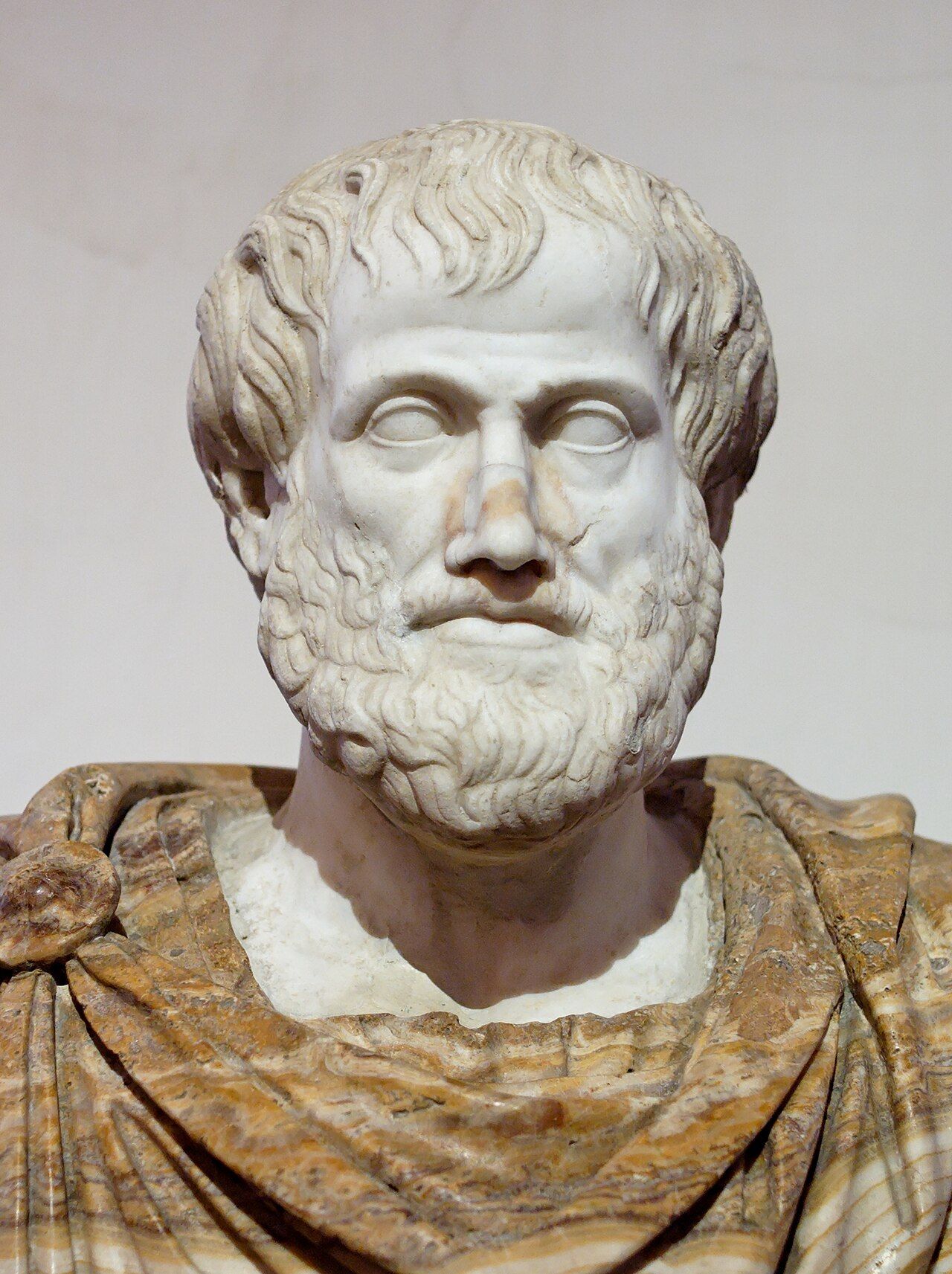
Aristotle (384–322 BCE) opens the Nicomachean Ethics — lecture material from his Lyceum years, roughly 335–322 BCE, traditionally connected to his son Nicomachus as editor or dedicatee, though the connection is not secure — by asking what all human striving aims at. His answer is eudaimonia. The word is conventionally translated “happiness,” which is misleading; “flourishing” or “living well and doing well” is closer. Eudaimonia is not a feeling you can have on a Tuesday afternoon. It is an assessment of a whole life, which is why Aristotle writes that one swallow does not make a summer, and neither does one day (1098a18).
How do we work out what flourishing consists of? Aristotle uses the function argument (ergon argument, 1097b–1098a). A flute-player is good if she plays well; an eye is good if it sees well. Things have characteristic activities, and excellence is performing that activity well. What is the characteristic activity of a human being? Not mere life, which plants share; not perception, which animals share; but activity of the soul in accordance with reason. So the human good is activity of the soul in accordance with virtue, over a complete life.
Philosophers disagree sharply about whether this argument works. Critics say it slides from a descriptive claim about what humans distinctively do to a normative claim about what they should do; humans distinctively wage organised war too. Defenders, including Martha Nussbaum and Philippa Foot, reconstruct it as a claim about the form of life characteristic of a social, language-using, long-dependent species — a claim continuous with how we evaluate a good oak or a good wolf. You should know that this is contested ground rather than settled doctrine.
Habituation: how virtue is acquired
Aristotle divides excellences into intellectual virtues, which come chiefly through teaching and time, and virtues of character (moral virtues), which come through habit — ethos, from which Aristotle derives êthos, character, and so our word ethics (1103a17). His formula in Book II is deliberately provocative: we become just by doing just acts, temperate by doing temperate acts, brave by doing brave acts (1103a34–b1). You cannot read your way into courage.
A virtue, once formed, is a hexis — a stable state or disposition, not a passing feeling and not a raw capacity. Three conditions distinguish genuinely virtuous action from action that merely looks right (1105a30–33). The agent must (1) know what she is doing, (2) choose the act for its own sake, and (3) act from a firm and unchanging character. A student who happens to tell the truth because she has not yet thought of a lie is not honest. Honesty is what shows up under pressure, reliably, without an audience.
So development matters. The young cannot be held to account exactly as adults are, and character education is not a soft extra bolted onto the real curriculum. Aristotle is candid that some people, badly habituated, are effectively unreachable by argument — a bleak conclusion that his admirers usually soften and that the evidence on entrenched antisocial behaviour does not obviously refute.
The mean, and what it is not
The doctrine of the mean holds that each virtue of character lies between an excess and a deficiency in feeling and action. Courage sits between cowardice and rashness; generosity between meanness and prodigality. Crucially, the mean is relative to us, not an arithmetic midpoint: the right amount of food for an Olympic wrestler is not the right amount for a beginner (1106a36–b7). And the mean is not mediocrity. Aristotle says that with respect to being best, virtue is an extreme.
| Sphere of experience | Deficiency (vice) | Virtue (mean) | Excess (vice) |
|---|---|---|---|
| Fear and confidence | Cowardice | Courage | Rashness |
| Bodily pleasure | Insensibility | Temperance | Self-indulgence |
| Giving money | Meanness | Generosity | Prodigality |
| Anger | Inirascibility (never angry at injustice) | Good temper (praotes) | Irascibility |
| Self-presentation | Self-deprecation | Truthfulness | Boastfulness |
| Social conduct | Surliness | Friendliness | Obsequiousness, flattery |
| Others’ fortune | Spite | Righteous indignation | Envy |
Aristotle immediately blocks the obvious abuse. Some things admit of no mean at all: spite, shamelessness, envy, and among actions adultery, theft and murder (1107a9–17). There is no correct amount of murder. The doctrine is a heuristic about emotional calibration, not a licence to split every difference. Read those two passages together and you will notice a genuine inconsistency in Aristotle: the last row of the table above comes from his own list at 1108a35–b6, where spite and envy flank righteous indignation as extremes, while a page earlier he says both admit of no mean. He drops that triad in the detailed treatment of Book IV, and most editors treat it as unfinished rather than doctrine.
Clinical translation. The mean explains a pattern every preceptor recognises. The new graduate who escalates nothing is not calm, she is deficient in appropriate concern. The one who escalates everything is not vigilant, she is deficient in judgement. Competence is the calibrated middle, and it is learned by repeated corrected exposure — which is exactly Aristotle’s habituation, running under a different name.
Phronesis and akrasia
Phronesis, practical wisdom, is the master virtue that makes the rest work. It is the capacity to perceive what a particular situation calls for and to deliberate well about how to achieve a good end. Aristotle distinguishes it sharply from techne, craft knowledge, and from sophia, theoretical wisdom. A craft has a product separate from the making; practical wisdom’s “product” is acting well itself. Phronesis cannot be codified, because the particulars outrun any rule — which is why Aristotle says the decision rests with perception (1109b23).
Aristotle also holds a strong version of the unity of the virtues: you cannot fully possess one virtue without possessing practical wisdom, and practical wisdom brings the others with it. This is intuitively hard — we all know the brave coward, the honest bully — and most contemporary virtue ethicists retreat to a weaker “limited unity” thesis, holding only that the virtues constrain and inform one another.
Finally, Book VII treats akrasia, weakness of will: acting against one’s own better judgement. Socrates had denied it was possible, arguing that no one knowingly does wrong. Aristotle disagrees, and explains it partly through the way a person under the pull of appetite fails to bring the relevant knowledge to bear at the moment of action — knowledge possessed but not used, like a sleeping man’s. Anyone who has watched a smoking cardiologist light up outside the cath lab has watched akrasia. The concept matters professionally because it separates ignorance (fix with teaching) from weakness (fix with structures, defaults, accountability and habit).
For Aristotle, character is built by habituated action, calibrated as a mean relative to the person and situation, and governed by practical wisdom that no rule can replace.
Section 3Character Beyond Athens
Confucian ethics: character as relational
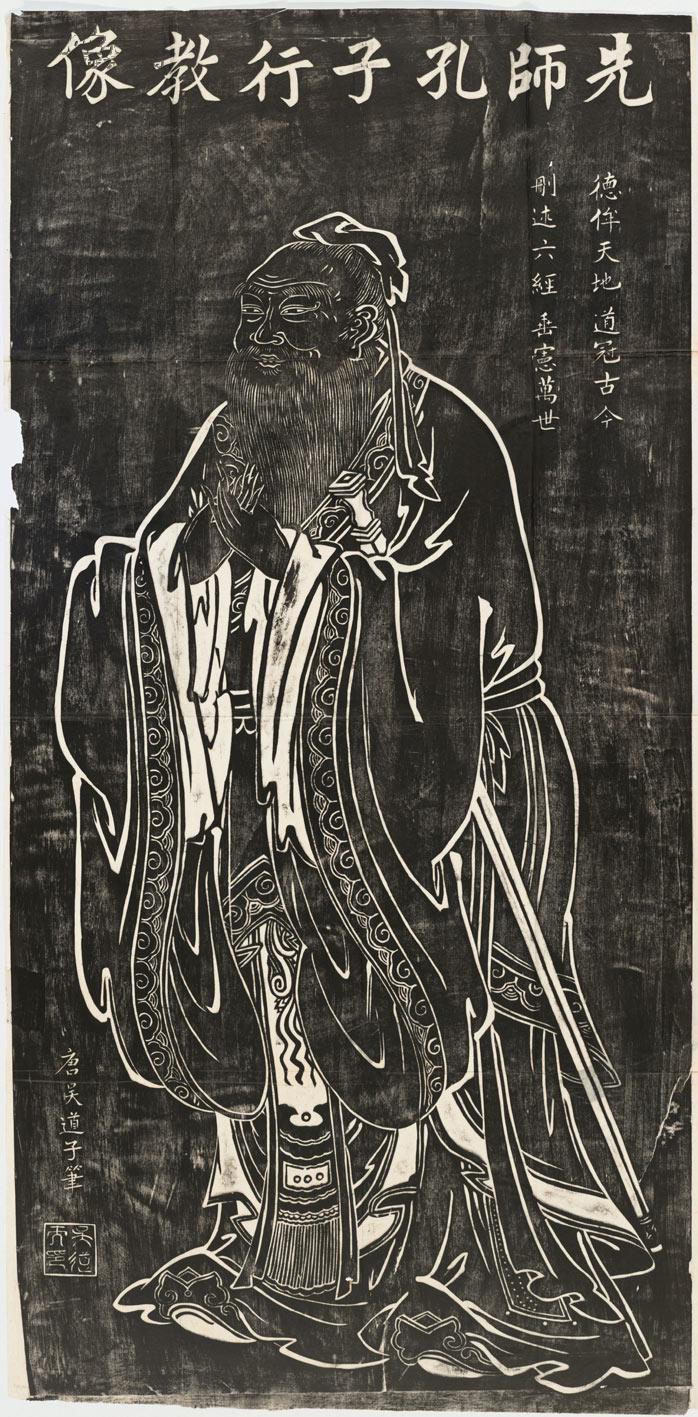
Kongzi (551–479 BCE), latinised as Confucius, taught in the turbulence of the late Spring and Autumn period; the Analects is a compilation by later students. The central excellence is ren, variously rendered benevolence, humaneness or co-humanity — the character written with the graphs for “person” and “two.” That etymology is doing philosophical work. For Confucius, one becomes a person through relationships, not prior to them.
Ren is cultivated through li, ritual propriety: the whole apparatus of manners, ceremony, mourning, greeting and deference by which a community makes decency habitual and visible. To a modern reader this looks like mere etiquette; the Confucian claim is that form shapes feeling, that how you bow trains what you value. Add yi (rightness or appropriateness), xiao (filial devotion) and zhi (wisdom), and the goal is the junzi, the exemplary person — a term Confucius deliberately reappropriated from “son of a lord” to mean someone noble by cultivation rather than birth.
The tradition then argues with itself, which is the interesting part. Mengzi (Mencius, c. 372–289 BCE) held that human nature is good, containing four “sprouts” that need only cultivation; his famous thought experiment is that anyone seeing a child about to fall into a well feels an immediate alarm and compassion, with no thought of reward. Xunzi (c. 310–235 BCE) flatly denied it: human nature is crooked, and virtue is the product of deliberate effort and ritual training, as a warped board is straightened by a press. That disagreement — is character grown or manufactured? — recurs in every moral education debate since.
Stoicism, Aquinas, and the Islamic refinement of character
The Stoics, founded by Zeno of Citium around 300 BCE and best preserved in Epictetus (c. 50–135 CE), Seneca and the emperor Marcus Aurelius (121–180), inherited the four cardinal virtues — wisdom, justice, courage and temperance — but made a radical addition: virtue is the only good. Health, reputation and wealth are “preferred indifferents,” worth pursuing but incapable of touching your flourishing. Epictetus, born enslaved, grounds this in the dichotomy of control: some things are up to us (judgement, impulse, desire) and some are not (body, property, reputation), and misery comes from confusing the two. Stoic practice — premeditation of adversity, the evening review of one’s day — is the direct ancestor of cognitive behavioural techniques, a lineage Aaron Beck and Albert Ellis both acknowledged.
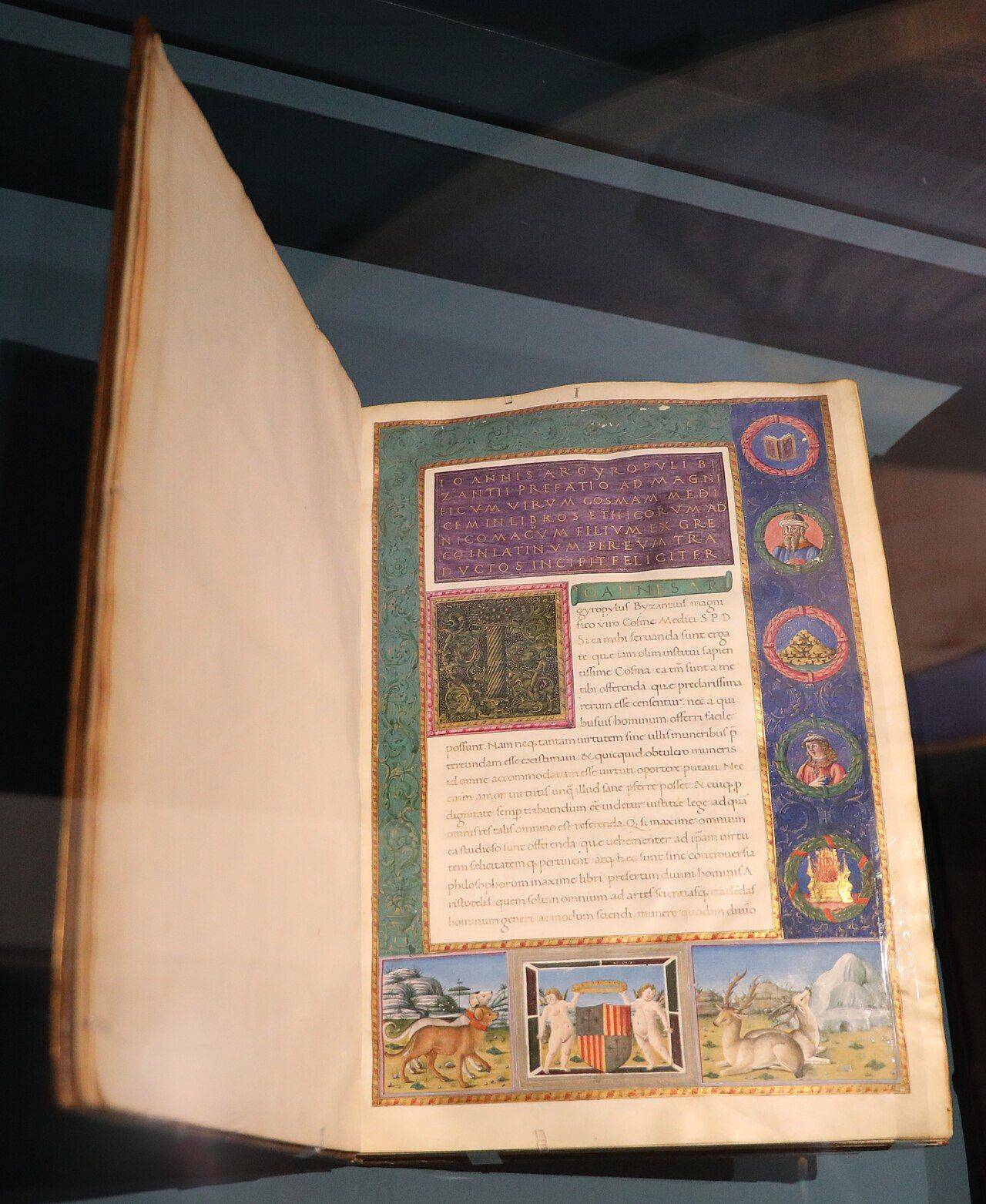
Thomas Aquinas (1225–1274) absorbed the Aristotle newly available in Latin translation into Christian theology in the Summa Theologiae. He kept the four cardinal virtues as acquired by habituation, though he allows infused counterparts of them as well, and added three theological virtues — faith, hope and charity (caritas) — which he held are infused by grace rather than earned by practice. Charity, for Aquinas, orders all the rest. In the Islamic world the same Greek inheritance produced Miskawayh’s Tahdhib al-Akhlaq (The Refinement of Character, c. 1000 CE), written in the Buyid courts of Iraq and Iran, which treats the soul’s diseases on a medical analogy and prescribes regimens of habit. Baghdad worked the Aristotelian argument out some two centuries before Paris did, and the Arabic commentators were one of the channels through which Aristotle returned to the Latin West.
Ubuntu and the critique of the Greek inheritance
Southern African moral thought is often summarised by the Nguni maxim umuntu ngumuntu ngabantu — a person is a person through other persons. Ubuntu names a family of views, not a single doctrine, and philosophers such as Thaddeus Metz have worked to state it rigorously rather than sentimentally: roughly, an action is right insofar as it honours relationships of identity and solidarity with others. Archbishop Desmond Tutu drew on it explicitly as chair of the South African Truth and Reconciliation Commission (established 1995, public hearings from 1996, main report 1998), arguing for restorative rather than retributive justice. Notice that ubuntu and Confucianism converge on something Aristotle assumes but rarely defends: that the self is constituted by its relations.
Honesty requires naming the tradition’s failures. Aristotle held that women are deficient in authoritative reason and defended natural slavery in the Politics; his account of the magnanimous man is unbearably self-satisfied. Confucian role ethics has historically underwritten patriarchal hierarchy. These are not incidental blemishes to be waved away. The best contemporary response, made by Nussbaum in “Non-Relative Virtues” (1988), is that the framework can be separated from its author’s prejudices: every human community faces the same spheres of experience — fear, appetite, distribution, speech — and each names an excellence for it, which gives virtue ethics a route to cross-cultural criticism rather than relativism. Chapter 7 returns to whether that route holds.
| Tradition | Central excellence | Source of virtue | Goal | Distinctive move |
|---|---|---|---|---|
| Aristotelian | Phronesis | Habituation in a good polis | Eudaimonia over a complete life | The mean, relative to the agent |
| Stoic | Virtue as the sole good | Reason aligned with nature | Apatheia, freedom from disturbance | Dichotomy of control |
| Confucian | Ren (humaneness) | Ritual practice and role fulfilment | Becoming a junzi; harmonious society | Form shapes feeling |
| Thomist | Caritas (charity) | Habit plus infused grace | Beatitude, union with God | Acquired and infused virtues distinguished |
| Ubuntu | Solidarity and identity with others | Community and relationship | Personhood realised through others | Restorative rather than retributive justice |
| Care ethics (Ch. 6) | Caring attentiveness | Responsive relationships | Maintained webs of care | Rejects the impartial standpoint as primary |
Character ethics arose independently in several civilisations, converging on habituation and exemplars while disagreeing about human nature, the role of ritual, and whether the self is primarily individual or relational.
Section 4The Situationist Challenge
The evidence that character may not exist
Virtue ethics needs character traits to be real, cross-situationally consistent and reasonably stable. Beginning in the 1960s, a body of social psychology suggested they might be none of those things. The philosophers Gilbert Harman (“Moral Philosophy Meets Social Psychology,” 1999) and John Doris (Lack of Character, 2002) pressed the case hardest. Harman went furthest, suggesting we should abandon talk of character traits altogether; Doris argued for the milder but still damaging conclusion that traits are narrow and situation-specific rather than global.
| Study | Design | Headline result | Caveat you must know |
|---|---|---|---|
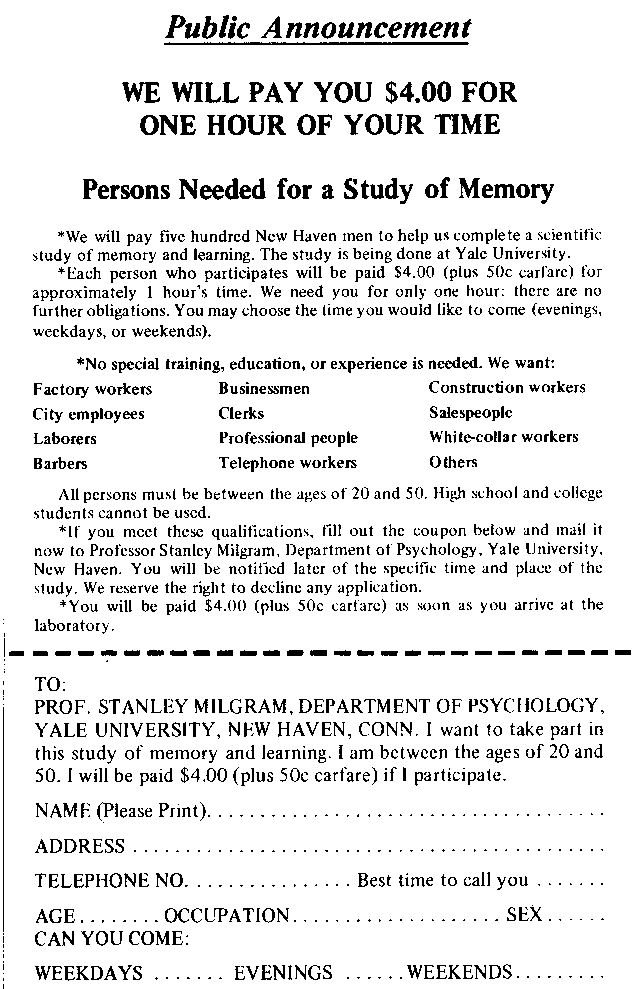
| Milgram, Yale, 1961–62 (pub. 1963) | Participants told to deliver escalating “shocks” to a confederate | 26 of 40 (65%) went to the maximum 450 volts in the first published condition | Compliance varied hugely across 20+ variants; Gina Perry’s archival work (2012) shows deviations from protocol and prodding beyond the script |
| Isen & Levin, 1972 | Dime planted in a payphone coin return; confederate then drops papers | 14 of 16 who found a dime helped; 1 of 25 who did not | Very small samples; later replications inconsistent, and the effect size is almost certainly inflated |
| Darley & Batson, Princeton, 1973 | Seminarians sent to give a talk, some on the Good Samaritan, in varying hurry | 63% helped a slumped stranger when unhurried, 10% when in high hurry | Talk topic had no effect; but “helping” was coded coarsely and n per cell was small |
| Zimbardo, Stanford, 1971 | Students assigned guard or prisoner roles in a mock prison | Widely reported as roles rapidly producing cruelty | Not a controlled experiment; Thibault Le Texier’s 2019 archival study documents that guards were coached, and the BBC Prison Study run by Reicher and Haslam in 2001 (broadcast 2002, published 2006) found quite different dynamics |
Add Walter Mischel’s earlier finding (1968) that personality-trait measures typically correlate with behaviour at around r = 0.3 — the so-called personality coefficient — and the picture is uncomfortable. The honest student is not reliably honest across settings; she is honest in the settings where honesty is cued and cheap.
Four replies, and what survives
The debate has since matured. Four replies deserve attention.
First, the empirical caution. Much of the situationist canon comes from an era of small samples and flexible analysis, and it has fared unevenly in the replication crisis of the 2010s. Ego depletion, a related pillar, failed a large multi-lab replication (Hagger and colleagues, 2016). This does not rescue global traits, but it should stop anyone from treating a 1972 study of 41 people as settled physics.
Second, the target is wrong. Rachana Kamtekar (2004) argued that situationists attack a folk conception of character — a bundle of independent behavioural habits — that Aristotle never held. Aristotelian virtue is unified by practical wisdom and is defined partly by how the agent sees the situation. Milgram’s participants were not failing to apply a courage-habit; they were misperceiving what was happening, exactly the failure phronesis is supposed to prevent.
Third, virtue is rare and hard. Aristotle says as much. If full virtue is an achievement of a lifetime, the finding that most undergraduates lack it is not a refutation; it is the premise. Gopal Sreenivasan (2002) additionally noted that the studies measure single behaviours in single situations, which is statistically the wrong instrument for detecting a stable disposition.
Fourth, the interactionist settlement. Mischel and Yuichi Shoda’s CAPS model (1995) proposes that people have stable if…then signatures: not “Ravi is aggressive” but “Ravi is aggressive when publicly criticised by a peer, and unusually forbearing when a frightened patient shouts at him.” Traits are real, but indexed to conditions. Most philosophers now work with something like this.
The practical upshot is the opposite of cynicism. If situations are powerful, then a serious person designs her situations: she does not rely on willpower at 3 a.m., she builds checklists, pre-commits, arranges to be observed, and avoids the hurry that Darley and Batson showed can turn a seminarian on his way to preach about the Good Samaritan straight past a man in a doorway. Character work becomes environmental engineering as much as self-improvement.
What this means for you on a ward
Take hand hygiene. Decades of education campaigns based on knowledge and attitude produced modest, decaying gains; the interventions that worked combined visible dispensers at the point of care, real-time feedback, and senior clinicians modelling compliance publicly — situation plus exemplar. Take speaking up about a wrong-site marking: individual courage predicts less than whether the team has a rehearsed script, an explicit escalation ladder, and a consultant who has visibly thanked someone for stopping the line. None of this shows courage is fictional. It shows courage is expensive, and that ethical institutions lower its price.
Situationist evidence undermines a crude picture of global, context-free traits but not the Aristotelian claim itself; the mature position is that character is real, conditional, hard-won, and heavily shaped by the environments we build.
Section 5Virtue in Professional Practice
MacIntyre: practices, internal goods, and institutions
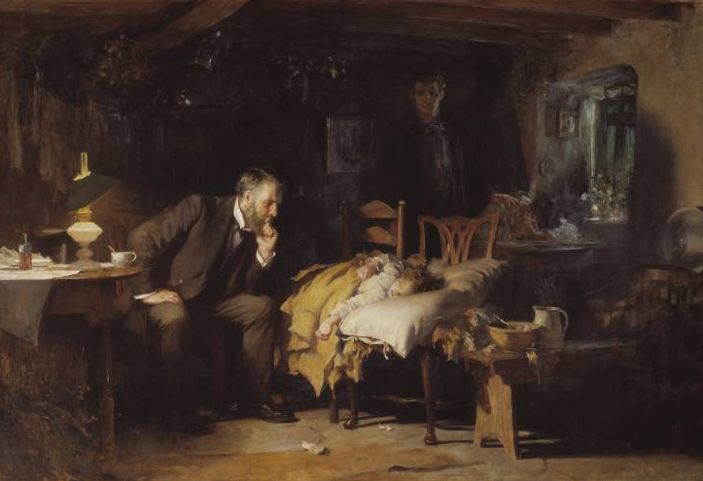
Alasdair MacIntyre’s After Virtue (1981) supplies the most useful vocabulary in this chapter for anyone who works inside an organisation. A practice, in his technical sense, is a coherent, complex, socially established cooperative activity with standards of excellence internal to it — medicine, teaching, architecture, farming, chess. Practices generate internal goods: goods you can only get by engaging in the practice well, and which enrich everyone in it. Making a genuinely accurate diagnosis is an internal good of medicine. External goods — money, status, ratings, throughput targets — can be obtained many ways and are competitive by nature: more for me is less for you.
Virtues, on this account, are the qualities that let us achieve internal goods. And here is MacIntyre’s sting: practices cannot survive without institutions to house them, but institutions deal necessarily in external goods, so “the ideals and the creativity of the practice are always vulnerable to the acquisitiveness of the institution.” The relationship is not accidental corruption. It is structural, permanent, and requires justice, courage and truthfulness in the institution’s members to hold the line.
Two British inquiries make the abstraction concrete. The Bristol Royal Infirmary Inquiry, reporting in 2001 under Ian Kennedy, examined paediatric cardiac surgery deaths between 1984 and 1995 and found a “club culture” in which concerns raised by the anaesthetist Stephen Bolsin were absorbed and neutralised for years. The Mid Staffordshire NHS Foundation Trust Public Inquiry, reporting in February 2013 under Robert Francis QC, described patients left unwashed and without water while managers pursued foundation-trust status and financial targets; it made 290 recommendations and led to a statutory duty of candour. Worth noting for accuracy: widely circulated estimates of 400 to 1,200 excess deaths at Mid Staffordshire were derived from mortality statistics that Francis himself declined to endorse as a body count. The failure was one of culture and character rather than of arithmetic, and it is no less serious for that.
The virtues a health professional actually needs
Edmund Pellegrino and David Thomasma, in The Virtues in Medical Practice (1993), argued that clinical relationships have features — the patient’s vulnerability, the inequality of knowledge, the necessity of trust — that make character indispensable rather than ornamental. You cannot verify your surgeon’s honesty in the moment; you rely on it. The following table maps virtues onto the failure modes you will actually see.
| Virtue | What it looks like in practice | Deficiency | Excess or counterfeit |
|---|---|---|---|
| Fidelity to trust | Doing what you said you would do when no one checks | Quiet abandonment of the difficult patient | Boundary loss; over-involvement |
| Truthfulness | Disclosing an error to the patient before being asked | Concealment, vague euphemism | Brutal candour that ignores readiness |
| Courage | Stopping the line; escalating over a senior’s objection | Silence rationalised as respect for hierarchy | Reflexive confrontation that burns credibility |
| Compassion | Noticing the daughter who has not eaten | Detachment, depersonalisation, gallows contempt | Emotional flooding that disables judgement |
| Justice | Triaging by need, not by charm or familiarity | Unexamined bias in analgesia or referral | Rigid proceduralism blind to particular need |
| Practical wisdom | Knowing which of the above governs, here, now | Rule-following without perception | “Judgement” used to excuse unaccountable deviation |
Codes of conduct encode some of this. The American Nurses Association’s Code of Ethics for Nurses with Interpretive Statements (2015 revision) sets out nine provisions, and Provision 5 — the nurse owes the same duties to self as to others, including preservation of integrity — is unmistakably a virtue provision rather than a rule about acts. A code, however, is a floor. Aristotle’s point is that a floor cannot teach you to see.
The hidden curriculum. Frederic Hafferty and Ronald Franks (1994) named the phenomenon that formal ethics teaching is routinely overwhelmed by what students absorb from observed behaviour: how the attending speaks about the patient in the corridor, who gets thanked, what gets rewarded. If Aristotle is right that character comes from habituation, the hidden curriculum is not a nuisance alongside the real curriculum. It is the real curriculum.
Moral distress, moral injury, and the limits of individual virtue
Andrew Jameton coined moral distress in Nursing Practice: The Ethical Issues (1984) for a specific and important experience: you know the ethically right action, and institutional constraints prevent you from taking it. This is not uncertainty and it is not burnout. Its signature is powerlessness, and its residue accumulates — what Webster and Baylis (2000) named moral residue, and what Epstein and Hamric (2009) described as its crescendo effect, each episode leaving a higher baseline.
The related concept of moral injury comes from Jonathan Shay’s work with Vietnam veterans (Achilles in Vietnam, 1994) and was formalised by Brett Litz and colleagues in 2009: lasting psychological harm from perpetrating, failing to prevent, or witnessing acts that transgress deeply held moral beliefs. Wendy Dean and Simon Talbot argued in 2018 that much of what is labelled clinician burnout is better described as moral injury — a claim that shifts the remedy from resilience training for individuals to repair of the systems that force the transgression.
This is the honest closing note for a chapter on virtue. A theory centred on character can be weaponised: if the problem is your character, the solution is your resilience, and the rota stays broken. MacIntyre’s framework blocks that move. Where an institution systematically requires its members to act against the internal goods of their practice, the vice is the institution’s. Virtue ethics correctly assigns the virtue of justice to the organisation and the virtue of courage to those who name the failure — and it insists that the two are related, because unjust institutions are precisely the ones that make courage expensive. Chapter 14 takes up what to do about it.
Professional character is sustained or destroyed by institutions; virtue ethics is only honest when it holds organisations, not just individuals, to account for the conditions under which good practice is possible.
The chapter in one breath
Virtue ethics asks about the agent rather than the act, and it does so because motive, perception and habit look inseparable from what a person actually does. Aristotle grounds it in eudaimonia — flourishing over a complete life — reached through habituated action calibrated as a mean relative to the person and situation, and governed by phronesis, a practical wisdom no rulebook can supply. Anscombe’s 1958 attack revived the tradition, and Foot, MacIntyre, Hursthouse and Annas built it into a live third option. The same insight arose independently elsewhere: Confucian ren cultivated through ritual, Stoic virtue as the sole good, Thomist charity, ubuntu’s personhood through others — traditions that disagree productively about whether human nature is good and whether the self is prior to its relations. Situationist psychology — Milgram, Darley and Batson, Isen and Levin — showed that context predicts behaviour better than trait labels, and the mature reply is that character is real but conditional, rare, and heavily dependent on the environments we build. That last point is the professional payoff: MacIntyre’s practices, internal goods and predatory institutions explain Bristol and Mid Staffordshire better than any tally of broken rules, and they explain moral distress as a structural injury rather than a personal failing.
Words worth knowing
| Term | What it means |
|---|---|
| Akrasia | Weakness of will: acting against one’s own better judgement. Aristotle affirms it is possible; Socrates denied it. |
| Arete | Excellence or virtue — performing a characteristic function well. Applies to knives and horses as well as people. |
| Cardinal virtues | Wisdom, justice, courage and temperance; inherited from Plato and the Stoics and retained by Aquinas. |
| Doctrine of the mean | Each virtue of character lies between excess and deficiency in feeling and action, relative to the agent — not an arithmetic midpoint, and not applicable to acts like murder. |
| Eudaimonia | Flourishing or living well; the final end of human action, assessed over a complete life rather than moment to moment. |
| Function argument | Aristotle’s inference from a thing’s characteristic activity to what counts as its excellence; contested as a move from fact to value. |
| Hexis | A stable disposition or settled state of character, as opposed to a passing feeling or a bare capacity. |
| Hidden curriculum | What learners absorb from observed institutional behaviour rather than from formal teaching (Hafferty and Franks, 1994). |
| Internal goods | Goods obtainable only by engaging well in a practice, such as an accurate diagnosis; contrasted with external goods like money and status. |
| Junzi | The Confucian exemplary person; nobility earned by cultivation rather than inherited by birth. |
| Moral distress | Knowing the right action but being prevented from taking it by institutional constraint (Jameton, 1984); leaves accumulating moral residue. |
| Moral injury | Lasting harm from perpetrating, failing to prevent or witnessing acts that violate deeply held moral beliefs (Shay, 1994; Litz et al., 2009). |
| Phronesis | Practical wisdom: perceiving what a particular situation requires and deliberating well about it; distinct from craft skill and theoretical wisdom. |
| Practice (MacIntyre) | A complex cooperative activity with standards of excellence internal to it, housed — and endangered — by institutions. |
| Ren | Confucian humaneness or co-humanity, cultivated through ritual propriety (li) and realised in relationships. |
| Situationism | The view that behaviour is driven far more by situational features than by stable character traits. |
| Ubuntu | Southern African relational ethics: a person is a person through other persons; associated with restorative justice. |
| Unity of the virtues | The thesis that one cannot fully possess a single virtue without practical wisdom and hence the others; most modern writers hold a weakened version. |
| V-rule | Hursthouse’s action-guiding rule derived from a virtue term, such as “do what is honest, avoid what is cruel.” |