Care Ethics, Rights and Justice
Three of the most powerful ideas in modern moral life sit uneasily together. Care ethics says morality begins in the particular — this person, in front of me, who needs something only I can give right now. Rights say morality begins in the universal — there are things owed to every human being whether anyone feels like giving them or not. Justice asks a third question entirely: given that there is never enough of anything, who gets what, and on what defensible basis? A nurse holding a dying stranger’s hand is doing care ethics. The same nurse insisting that a confused patient still gets to refuse a treatment is doing rights. The same nurse’s hospital deciding which of eleven patients gets the last ICU bed is doing justice. This chapter takes each seriously on its own terms, shows where they genuinely conflict, and gives you tools for the moments when you cannot satisfy all three.
By the end of this chapter you can
- Explain care ethics as developed by Carol Gilligan, Nel Noddings, Joan Tronto and Eva Kittay, and state what it adds to the theories in Chapters 3–5.
- Apply Tronto’s four phases of care — caring about, taking care of, care-giving and care-receiving — and their moral elements of attentiveness, responsibility, competence and responsiveness to a real caregiving failure.
- Distinguish the four Hohfeldian incidents (claim, liberty, power, immunity) and identify the correlative duty attached to any claim-right.
- Contrast negative and positive rights, and explain why the 1966 human rights covenants were split into two documents.
- Compare the interest theory and will theory of rights and say what each explains better.
- Reconstruct John Rawls’s original position, veil of ignorance and difference principle, and state Robert Nozick’s entitlement theory objection.
- Explain the capability approach of Amartya Sen and Martha Nussbaum and why it challenges resource-based measures of equality.
- Evaluate real allocation systems — the Oregon Health Plan, MELD-based liver allocation, pandemic crisis standards — against competing criteria of urgency, utility, equity and lottery.
- Analyse a case in which care, rights and justice pull in different directions, and defend a resolution without pretending the conflict vanished.
Section 1The Ethics of Care
A different voice, and what it actually claimed
In 1982 the Harvard psychologist Carol Gilligan published In a Different Voice, a book that began as a complaint about a research method and ended as a moral theory. Her target was the developmental scale of her colleague Lawrence Kohlberg, who had ranked moral reasoning on six stages, with the highest stages reserved for people who reasoned from abstract, universalisable principles. The longitudinal study on which the stages were built, begun with his 1958 doctoral research on boys in Chicago and followed for two decades, was all male — 84 boys, in the figure Gilligan cited. When girls and women were scored on the resulting scale, they tended to land lower.
Gilligan looked at the transcripts rather than the scores. In Kohlberg’s famous Heinz dilemma — a man cannot afford a drug that would save his wife, should he steal it? — an eleven-year-old boy she called Jake treated the problem as arithmetic: life outranks property, so steal, and a judge would see that. A girl she called Amy refused the frame. She asked whether Heinz could talk to the druggist, worried about what happens to the wife if Heinz goes to jail, and treated the dilemma as a failure of relationship rather than a conflict of principles. On Kohlberg’s scale Amy looked immature. Gilligan argued she was reasoning in a different register, one oriented to responsibility in relationships rather than to rights among strangers.
It matters what Gilligan did and did not establish. The empirical claim that women and men differ systematically in moral orientation has fared poorly: Lawrence Walker’s meta-analyses in the 1980s found gender differences in Kohlbergian scoring to be very small and largely explained by education and occupation. Gilligan herself moved toward saying the two voices are two ways of framing any moral problem, available to anyone, rather than two sexes. The durable contribution is the philosophical one: a theory that only scores abstract impartial reasoning as mature will systematically undervalue the moral work of people who spend their lives keeping particular others alive.
Noddings, engrossment and the limits of caring
Two years later the philosopher of education Nel Noddings published Caring: A Feminine Approach to Ethics and Moral Education (1984), which turned the insight into a systematic ethic. Noddings analysed the caring relation as a pairing of the one-caring and the cared-for. The one-caring practises engrossment — receiving the other’s reality rather than projecting onto it — and motivational displacement, in which the other’s project temporarily becomes one’s own. Crucially, the relation is not complete until the cared-for responds: care that is offered and not received is, on this account, not yet care.
Noddings was frank about the consequence, which is also the standard objection. Caring in her strong sense requires proximity and reciprocity, so it thins rapidly with distance. She was reluctant to say we have caring obligations to starving children in distant countries in the same sense we have them to the child on our doorstep. Critics — including many who are sympathetic to care ethics — read this as a fatal parochialism: an ethic that cannot generate obligations to strangers has abandoned much of what ethics is for. Defenders reply that care ethics never claimed to replace justice, only to name a moral domain that justice-based theories had rendered invisible.
A second objection cuts deeper. Claudia Card and Sarah Hoagland warned in the late 1980s and early 1990s that an ethic elevating self-effacing attentiveness could ratify the exploitation of the very people who already do most of the world’s caring — disproportionately women, disproportionately poor, disproportionately immigrants and women of colour. If caring is a virtue and caring is what you are already forced to do, the theory can become a chain. Later care ethicists took this seriously; it is the reason Tronto and Kittay pushed the theory toward politics.
Tronto’s four phases and Kittay’s dependency
The political scientist Joan Tronto, working with Berenice Fisher, gave care ethics its most usable structure in Moral Boundaries (1993). She defined care broadly as everything we do to maintain, continue and repair our world so we can live in it as well as possible, and then broke the process into four phases, each with its own moral element. In Caring Democracy (2013) she added a fifth, caring with, the solidarity and trust that let a whole society sustain care rather than dumping it on households.
| Phase | What it involves | Moral element | Typical failure |
|---|---|---|---|
| Caring about | Noticing that a need exists at all | Attentiveness | The confused patient whose pain nobody registers because he cannot name it |
| Taking care of | Assuming that something must be done, by us | Responsibility | Everyone agrees the discharge plan is unsafe; nobody owns it |
| Care-giving | The hands-on work itself | Competence | Good intentions, wrong technique, pressure injury |
| Care-receiving | The cared-for’s response to what was done | Responsiveness | Nobody asks whether the intervention actually helped |
| Caring with | Sustaining care as a shared public undertaking | Solidarity, trust | Care privatised onto unpaid family, mostly women |
Eva Feder Kittay supplied the missing political principle in Love’s Labor (1999), a book informed by her life with her daughter Sesha, who has severe cognitive and physical disabilities. Kittay pointed out that the contractarian theories of justice, Rawls’s above all, start with citizens imagined as free, equal and fully cooperating — and that none of us is that, at the beginning or usually at the end, of our lives. Dependency is not an exception to the human condition; it is a phase of it. The person who does dependency work becomes dependent in turn, on a society willing to support her. Kittay named the obligation doulia, after the doula who cares for the mother so the mother can care for the infant: just as we require care to survive, we require that care be given to those who care for us.
The numbers are not small. AARP and the National Alliance for Caregiving estimated in their 2020 report that roughly 53 million adults in the United States had provided unpaid care to an adult or child with special needs in the prior year, the majority of them women. AARP’s 2023 Valuing the Invaluable report, working from a narrower count of caregivers, valued unpaid family caregiving at about 600 billion dollars for 2021 — well above what Medicaid spent that year on long-term services and supports. None of it appears in gross domestic product. Care ethics says that is not an accounting quirk. It is a moral choice about whose labour counts.
Care ethics relocates the moral centre from the impartial rule to the concrete relationship, and its mature political form — Tronto’s phases, Kittay’s doulia — demands that societies, not just individuals, take responsibility for dependency.
Section 2What a Right Actually Is
Hohfeld’s four incidents
“I have a right to that” is one of the most-used and least-analysed sentences in English. The Yale jurist Wesley Newcomb Hohfeld, in two articles in the Yale Law Journal in 1913 and 1917, showed that the word is doing four different jobs. Learning to separate them will resolve a surprising share of the arguments you will have at work.
| Incident | Meaning | Correlative in someone else | Health-care example |
|---|---|---|---|
| Claim (right in the strict sense) | X is owed something by Y | Y has a duty | A patient’s claim that you not touch her without consent |
| Liberty (privilege) | X has no duty not to do something | Y has no claim against X | A competent adult’s liberty to smoke, refuse dialysis, or eat badly |
| Power | X can alter legal or moral relations | Y has a liability to that change | Naming a health care proxy; withdrawing consent |
| Immunity | X cannot have her position altered by Y | Y has a disability | A patient’s immunity from having her advance directive overridden by a relative |
The practical payoff is the correlativity test. A genuine claim-right always names a duty-bearer. If you cannot say who owes the duty and what exactly they must do, you may be asserting something worth wanting rather than a right. “I have a right to a private room” is often a liberty (nobody may stop you paying for one) dressed up as a claim (the hospital must supply one). Conversely, notice how much of clinical ethics is about powers: consent is not primarily a claim to receive treatment but a power to change what others may permissibly do to your body.
Negative and positive, and why the split had a Cold War
Rights are also sorted by what they require of others. A negative right requires forbearance: do not kill me, do not search my home, do not treat me without consent. A positive right requires provision: give me an education, primary health care, a minimum income. Isaiah Berlin’s 1958 Oxford lecture Two Concepts of Liberty drew a parallel-looking distinction between freedom from interference and freedom to govern oneself, and the two debates have been entangled ever since — though Berlin’s positive liberty is self-mastery, not an entitlement to goods, and running the two pairs together causes a good deal of confusion.
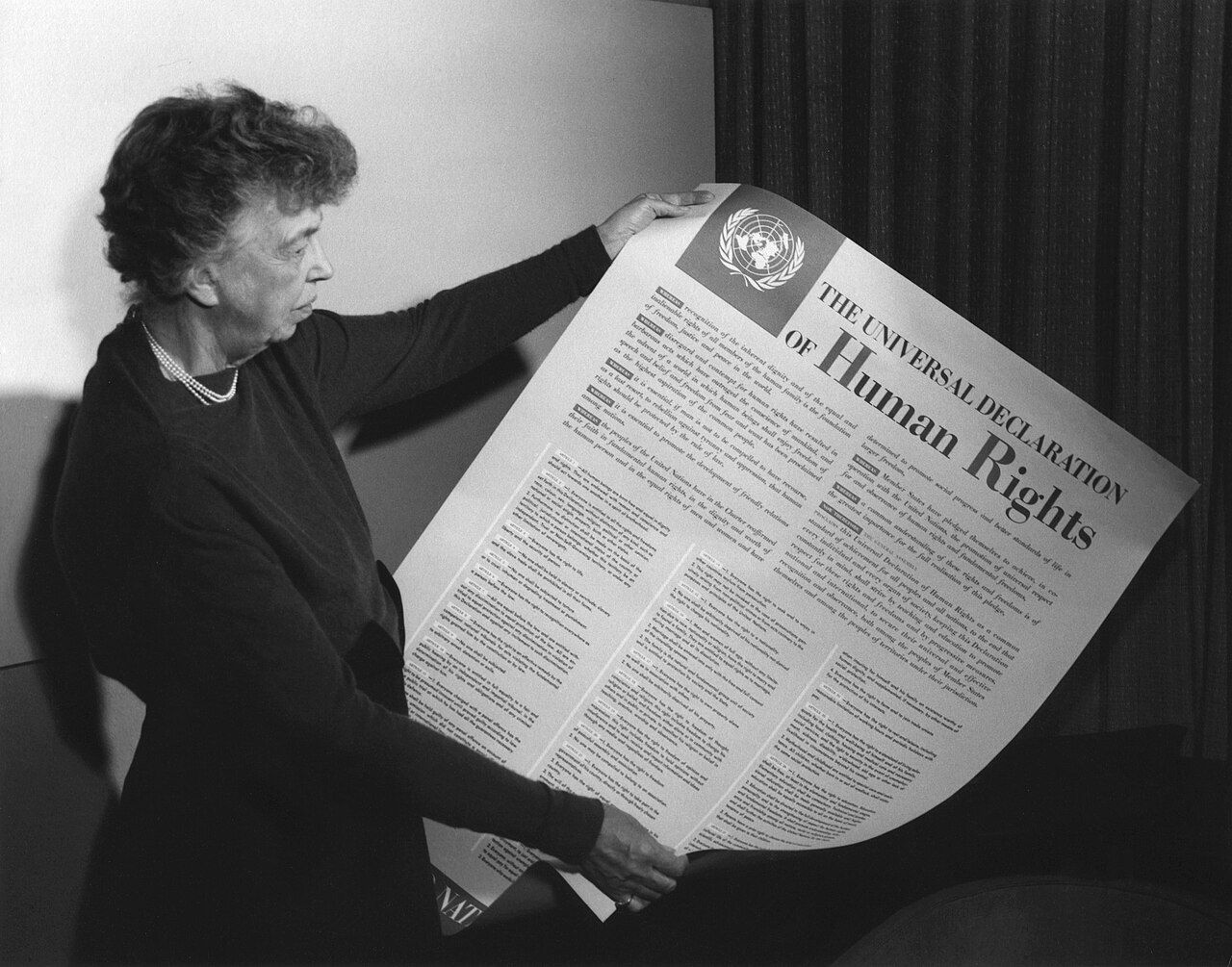
The Universal Declaration of Human Rights, adopted in Paris on 10 December 1948 by 48 votes with 8 abstentions, contains both kinds. Its drafting committee was chaired by Eleanor Roosevelt and included René Cassin of France, Charles Malik of Lebanon, and P. C. Chang of China; the Canadian John Humphrey, who ran the UN Secretariat’s human rights division, produced the working first draft. Article 3 protects life, liberty and security of person. Article 25 asserts a right to a standard of living adequate for health and well-being, including medical care. When the Declaration was converted into binding treaty law, however, the two families were split into separate instruments: the International Covenant on Civil and Political Rights and the International Covenant on Economic, Social and Cultural Rights, both adopted in 1966 and in force in 1976. The split was not philosophical tidiness. Western states insisted that civil and political rights were immediately enforceable while economic rights were aspirational and resource-dependent; Soviet-bloc states pressed the opposite emphasis. The ICESCR’s language of “progressive realisation” is the fossil of that argument.
Is the distinction as clean as it looks? Increasingly, scholars say no. Henry Shue, in Basic Rights (1980), argued that every right generates three kinds of duty — to avoid depriving, to protect from deprivation, and to aid the deprived — so that even a paradigmatically negative right such as the right not to be assaulted requires courts, police and payroll. A right to a fair trial is expensive. The honest statement is that rights differ in how much provision they require, not in whether they require any.
Where rights come from, and who can hold them
Two rival accounts dominate. The will theory (or choice theory), associated with H. L. A. Hart, holds that to have a right is to have a kind of sovereignty: control over another person’s duty, including the power to waive it. The interest theory, developed by Joseph Raz and others, holds that X has a right when an aspect of X’s well-being is a sufficient reason to hold others under a duty. Each explains something the other struggles with. The will theory makes elegant sense of consent, waiver and the right to sue. But it implies that infants, people in comas and people with profound cognitive disability cannot hold rights at all, since they cannot waive duties — a conclusion most people find unacceptable, and one that Kittay attacked directly. The interest theory covers those cases easily, but has trouble explaining why my strong interest in your friendship does not put you under a duty.
Scepticism about rights has a long pedigree. Jeremy Bentham, in his critique of the French Declaration of 1789, dismissed natural rights as “nonsense upon stilts” and insisted that rights are the children of law. Karl Marx, in On the Jewish Question (1843), argued that the rights of man protect the isolated, self-interested individual and leave the structure of exploitation intact. More recently, some scholars have argued that human rights doctrine emerged from a specific European legal history and can flatten other moral traditions; others reply that the 1948 drafting was genuinely multicultural, pointing to Malik and Chang, and that the appeal to rights has been taken up most fiercely by anticolonial movements. This is a live disagreement, and you should not pretend otherwise.
Rights also collide with each other, which is why the language of absolute versus prima facie rights matters. Almost no legal system treats rights as unlimited. In Jacobson v. Massachusetts (1905) the United States Supreme Court upheld a five-dollar fine for refusing smallpox vaccination during an outbreak in Cambridge, holding that individual liberty is not an absolute exemption from reasonable public health regulation. Very few rights survive as true absolutes; the prohibition on torture is the usual candidate, and even that is contested at the margins by people arguing about definitions rather than about the principle.
A right is not a strong preference: it is a structured relation that names a holder, a duty-bearer and a specific duty, and the serious work in rights talk is done by distinguishing claims from liberties and powers, and negative duties from positive ones.
Section 3Justice: The Formal Idea and Its Rivals

The empty box, and the fight to fill it
Aristotle, in Book V of the Nicomachean Ethics, stated the formal principle of justice: equals should be treated equally and unequals unequally, in proportion to the relevant difference. He also separated distributive justice (how goods, offices and burdens are shared out) from corrective justice (how wrongs between parties are put right). The formal principle is correct and almost empty. It tells you to be consistent; it does not tell you which differences count. Skin colour is a difference. So is need, effort, contribution, seniority, prognosis and the ability to pay. Every serious theory of justice is an argument about which of these are morally relevant and why.
Note also a third category that the modern literature has revived: procedural justice, the fairness of the process rather than the outcome. Research by Tom Tyler and colleagues since the 1980s has repeatedly found that people’s judgements about the legitimacy of institutions depend heavily on whether they were treated with voice, neutrality and respect — sometimes more than on whether they won. That is not merely a psychological curiosity. When an allocation must produce losers, as allocation always does, procedure carries much of the moral weight.
Rawls, Nozick and the argument of the century
John Rawls’s A Theory of Justice (1971) reset the field. Rawls asked what principles free and rational people would choose to govern the basic structure of their society if they had to choose from the original position, behind a veil of ignorance that hid their own race, sex, class, talents, health and conception of the good. Not knowing whether you will be the surgeon or the person with cerebral palsy in a group home, what rules would you accept? Rawls argued you would reason cautiously — a maximin strategy, maximising the minimum — and select two principles in strict priority order: first, equal basic liberties for all; second, that social and economic inequalities attach to positions open under fair equality of opportunity, and that they work to the greatest benefit of the least advantaged. That second clause is the famous difference principle. Inequality is permitted, but only when it lifts the floor. Rawls measured advantage in primary goods: rights, liberties, opportunities, income, wealth and the social bases of self-respect.
Robert Nozick, Rawls’s Harvard colleague, answered three years later in Anarchy, State, and Utopia (1974). Justice, he argued, is historical, not patterned: a distribution is just if it arose by just steps, whatever shape it happens to have. His entitlement theory had three parts — justice in original acquisition, justice in voluntary transfer, and rectification when the first two were violated. His Wilt Chamberlain argument is the pivot. Start from whatever distribution you consider perfectly just. Now let a million basketball fans, over a season, each freely drop a separate twenty-five cents of their admission price into a box with Chamberlain’s name on it. The pattern is destroyed and Chamberlain is a quarter of a million dollars richer, yet every step was voluntary. So maintaining any pattern requires continuous interference with people’s free choices. Nozick’s conclusion, that redistributive taxation of earnings is on a par with forced labour, is deliberately provocative and widely rejected, but the structural point — that outcome-patterns and liberty are in permanent tension — is not easily dismissed.
A third position reframes the question. Amartya Sen, in his 1979 Tanner Lecture “Equality of What?” and later in Inequality Reexamined (1992) and The Idea of Justice (2009), argued that both Rawls and the utilitarians measure the wrong thing. Resources are inputs; what matters is what a person can actually do and be with them — her capabilities. Two people with identical incomes are not equally well off if one uses a wheelchair in a city of stairs, or is pregnant, or lives where malaria is endemic. Sen called these conversion factors. Martha Nussbaum pushed the approach further in Women and Human Development (2000) and Creating Capabilities (2011) by specifying ten central capabilities — life, bodily health, bodily integrity, senses and thought, emotions, practical reason, affiliation, other species, play, and control over one’s environment — that any decent political order must secure above a threshold. Sen has resisted fixing such a list, holding that it should emerge from public reasoning in each society. That disagreement between them is real and instructive.
| Rawls (1971) | Nozick (1974) | Sen / Nussbaum | |
|---|---|---|---|
| Central question | What would we choose behind the veil? | How did this holding arise? | What is this person actually able to do and be? |
| Metric of advantage | Primary goods | Holdings, justly acquired | Capabilities and functionings |
| View of inequality | Permissible if it benefits the worst-off | Permissible if it arose from just steps | Judge by the capability shortfall, not the income gap |
| Role of the state | Design the basic structure fairly | Minimal: protection, enforcement, redress | Secure a threshold of central capabilities |
| Signature objection | Ignores desert, and treats talents as a common asset | Original acquisition is historically filthy; ignores need | Which capabilities, chosen by whom, and how weighted? |
What the contract left out
A powerful line of criticism says the whole social contract framing smuggles in an idealised citizen. Carole Pateman’s The Sexual Contract (1988) argued that the classic contract theories presupposed a sexual division of labour that placed women outside the contracting public. Charles Mills’s The Racial Contract (1997) argued that the actual historical contract was among white Europeans and that its exclusions were not accidental noise but part of the design. Kittay pressed the disability version of the same complaint: parties in the original position are described as normal, fully cooperating members of society over a complete life, which quietly writes out both the profoundly dependent and those who care for them.
Iris Marion Young supplied the most useful reconstruction. In Justice and the Politics of Difference (1990) she argued that distribution is not the whole of justice: oppression also operates through exploitation, marginalisation, powerlessness, cultural imperialism and violence, none of which reduces neatly to who has how much. In Responsibility for Justice (2011, published after her death) she proposed the social connection model: when injustice is produced by the ordinary functioning of institutions in which many people participate, responsibility is not a matter of finding the guilty party but of shared, forward-looking political obligation to change the structure. That is exactly the shape of most health inequities, and it is why “nobody here did anything wrong” is a poor defence of a bad system.
Aristotle’s formal principle only demands consistency; the substantive theories — Rawls’s fair terms, Nozick’s just history, Sen and Nussbaum’s capabilities, Young’s structural account — disagree about which differences between people justify different treatment.
Section 4Justice Under Scarcity: How Real Systems Decide

The menu of allocation criteria
When a good is scarce and indivisible — a liver, an ICU bed, the first hundred thousand doses of a vaccine — the choice is not between allocating and not allocating. Refusing to decide is a decision, usually in favour of whoever is loudest, nearest or best connected. The available criteria are few, and each carries a characteristic objection.
| Criterion | Rule | Strength | Standard objection |
|---|---|---|---|
| Sickest first (urgency) | Highest immediate need wins | Matches the rescue intuition and clinical instinct | May waste the resource on those least likely to benefit |
| Best outcome (utility) | Maximise lives or life-years saved | Transparent, defensible under scarcity | Prognosis correlates with prior disadvantage, so it can launder inequity |
| Life-cycle / youngest first | Priority to those with fewer life-years lived | Everyone passes through every age | Frank age discrimination; devalues the old |
| First come, first served | Queue order | Simple, resists manipulation | Rewards proximity, information and transport — a wealth proxy |
| Lottery | Random selection among the eligible | Expresses equal moral worth; incorruptible | Ignores real differences in need and benefit |
| Instrumental value | Priority to those needed to save others | Multiplier effect in a pandemic | Slides easily into ranking people by social worth |
| Reciprocity | Priority to those who took risks for others | Recognises sacrifice | Hard to bound; who counts as having served? |
Most defensible real-world systems combine several. The influential framework by Govind Persad, Alan Wertheimer and Ezekiel Emanuel in The Lancet in 2009 argued exactly this: no single principle is sufficient, and a “complete lives” system should blend youngest-first, prognosis, lottery and instrumental value while explicitly rejecting allocation by social worth or ability to pay.
Three systems, three lessons
Oregon. In 1989 Oregon passed the Basic Health Services Act, designed by the emergency physician and later governor John Kitzhaber. Rather than cover everything for fewer people, Oregon would cover a ranked list of condition–treatment pairs for everyone below the poverty line, drawing the funding line wherever the legislature stopped. The first list, built partly from telephone surveys asking Oregonians to rate quality of life in various health states, was rejected in 1992 by Health and Human Services Secretary Louis Sullivan on the ground that it violated the Americans with Disabilities Act: the surveys systematically rated life with a disability as worth less, so treatments for disabled people fell down the list. Oregon rebuilt the methodology, received a waiver in 1993 and implemented the plan in February 1994. The lesson is not that rationing is wrong. It is that any measure of “benefit” embeds a judgement about whose life goes well, and that judgement can be discriminatory even when everyone involved is acting in good faith.
Transplantation. The United States National Organ Transplant Act of 1984 created the Organ Procurement and Transplantation Network, run under federal contract — for most of its history by UNOS, though the contract has since been broken into pieces. For years, liver allocation leaned heavily on waiting time and on where the patient was hospitalised, which rewarded early listing and good insurance. In February 2002 the system switched to the MELD score (and PELD for children) — a formula using bilirubin, INR and creatinine that predicts three-month mortality without a transplant. Allocation moved from “who has waited longest” toward “who will die soonest without it,” and waiting-list deaths fell. Lung transplantation adopted an allocation score in 2005 that explicitly balances urgency against expected post-transplant survival, and the 2014 kidney allocation system introduced longevity matching so that the longest-lasting kidneys go to recipients expected to use them longest. Each change traded one conception of fairness for another, in public, with data.
Pandemic crisis standards. In March 2020 the Italian anaesthesia society SIAARTI published guidance suggesting that, if ventilators ran out, an age limit might be needed — and provoked international argument. New York State had prepared ventilator allocation guidelines in 2015 using SOFA organ-failure scores with periodic reassessment and reallocation. In the United States in spring 2020, disability advocates filed complaints with the HHS Office for Civil Rights against several state plans, including Alabama’s, whose older guidance had contemplated deprioritising people with severe intellectual disability; Alabama withdrew the plan. Several states also revised protocols after evidence emerged that SOFA scores could disadvantage Black patients. Vaccine allocation raised the same questions globally: by the start of 2022, roughly one in ten people in low-income countries had received at least one dose, against something over 70 percent in many high-income countries, despite the COVAX mechanism created precisely to prevent that gap.
Cost, QALYs, and the thing Americans will not say out loud
The quality-adjusted life year (QALY) values a year of life multiplied by a health-state weight from 0 to 1. England’s National Institute for Health and Care Excellence, set up in 1999 as the National Institute for Clinical Excellence, has long used a reference range of roughly £20,000 to £30,000 per QALY as the zone above which a treatment needs special justification, with higher ceilings for end-of-life and highly specialised treatments. This is explicit, published rationing, and it is regularly and loudly criticised in the British press.
The United States does the same thing implicitly. The Affordable Care Act (2010) added section 1182 to the Social Security Act, which forbids the Patient-Centered Outcomes Research Institute from using a dollars-per-QALY figure as a threshold for what counts as cost-effective, and bars the Secretary from using such thresholds in Medicare coverage and reimbursement decisions. The rationing does not stop; it moves to formulary tiers, prior authorisation, network design, deductibles and the sheer unaffordability of care. Disability-rights organisations have long objected that QALYs devalue life with a disability by construction — if a year in a wheelchair is scored at 0.7, saving that year is worth less, which is precisely the Oregon problem in algebraic form. Health economists have proposed alternatives such as the equal-value-of-life-years-gained measure. There is no consensus, and you should be suspicious of anyone who tells you there is.
Every health system rations; the ethical question is not whether to allocate but whether the criteria are explicit, publicly defensible, revisable in light of evidence, and free of hidden judgements about whose life is worth less.
Section 5When Care, Rights and Justice Collide
The characteristic conflicts
The three frameworks do not merely emphasise different things; they can generate opposite verdicts. Consider four recurring shapes of conflict.
Care against justice. You spend forty minutes with a frightened patient whose daughter has flown in from out of state. Those forty minutes come out of the hour you have for eleven other patients. Care ethics licenses partiality toward the person in front of you; distributive justice asks why your attention should follow the loudest family. Both are right, which is why the resolution is not a formula but a defensible allocation of your own scarce attention — and, more importantly, a staffing structure that does not force the trade every shift.
Rights against care. A seventy-eight-year-old with early dementia but intact decisional capacity is going home to an apartment with stairs and no railings. You are certain she will fall. Her right to refuse and to choose where she lives is a claim-right and a power; your caring response wants to override it. Respecting the right may mean watching harm you could have prevented. The care-ethical answer is not to override but to work the relationship: negotiate, arrange, revisit, and stay present when she does fall.
Rights against rights. A patient claims a right to a treatment the system will not fund. Another patient’s right to a share of the same budget is invisible because she has no name and no lawyer. As the philosopher Norman Daniels has argued in his work on accountability for reasonableness (with James Sabin, from the late 1990s), when reasonable people disagree about limits, legitimacy has to come from the process: reasons that are public, relevant, revisable, and enforced.
Justice against care work itself. The people who do the most caring are frequently the worst placed in the distribution. Direct care workers in the United States — home health aides, personal care aides, nursing assistants — are disproportionately women, disproportionately Black and immigrant, and among the lowest paid workers in the economy, with median wages that leave a substantial share on public assistance. Kittay’s doulia and Young’s structural analysis converge here: this is not the result of anyone’s malice, and it is still an injustice that someone is obligated to fix.
Olmstead: a case where all three lined up
The clearest legal illustration is Olmstead v. L.C., decided by the United States Supreme Court on 22 June 1999. Lois Curtis and Elaine Wilson, two women with intellectual disability and mental illness, had been voluntarily admitted to a Georgia state psychiatric hospital. Their treating professionals concluded they could be served appropriately in the community. They remained institutionalised anyway, for years, because the community placements were not funded. The Court held 6–3, in an opinion by Justice Ruth Bader Ginsburg whose remedial section spoke only for a plurality, that unjustified institutional isolation of people with disabilities is a form of discrimination under Title II of the Americans with Disabilities Act, subject to a reasonable-modifications standard and the state’s available resources.
Read the case through all three lenses. Rights: the ADA claim-right against discrimination, held by Curtis and Wilson, with the state of Georgia as duty-bearer. Justice: a distributive question about whether states may prefer congregate settings for budgetary convenience, and the Court’s explicit acknowledgement of resource limits and the needs of others on the waiting list. Care: the finding turned on the professional judgement of the clinicians who actually knew these two women, and the remedy was about where and how care would be given — Tronto’s responsiveness written into law. The decision reshaped American long-term care policy and drove the growth of Medicaid home and community-based services. And the unfinished business is equally instructive: hundreds of thousands of people remain on state waiting lists for those services, which is exactly what “progressive realisation” looks like from the inside.
Working the three together
Practically, you can run any hard case through a short sequence. First, rights screen: is anyone’s claim-right, liberty or power being violated? If so, that usually settles it, because rights function as constraints rather than as weights. Second, justice check: if the good is scarce, are the criteria explicit and publicly defensible, do they track morally relevant differences, and would you accept them from behind the veil, not knowing who you would be? Third, care audit, using Tronto: was the need noticed, was responsibility taken, was the work competent, and did anyone check what the cared-for actually experienced? Fourth, name the residue. In genuine conflicts, doing the right thing still leaves damage. Bernard Williams argued that genuine moral conflict leaves a residue even when you choose correctly, and the literature calls that trace moral remainder; Andrew Jameton, writing about nursing in 1984, named the specific experience of knowing the right action and being institutionally blocked from taking it moral distress.
That last step is not a therapeutic afterthought. Persistent moral distress is a measurable driver of burnout and of nurses leaving the profession, and its causes are usually structural: staffing, throughput targets, futile treatment continued at family insistence. California’s AB 394, signed in 1999, made it the first state to mandate minimum nurse-to-patient ratios by unit; the regulations took effect in January 2004 at one nurse to six patients on medical–surgical units and tightened to one to five a year later. Research by Linda Aiken and colleagues, including a widely cited 2002 study in JAMA, found each additional surgical patient per nurse associated with roughly a seven percent increase in the odds of thirty-day mortality. Debate continues about the cost and the mechanism, and about whether fixed ratios are the best instrument. But the underlying claim is one that care ethics, rights and justice all endorse from different directions: the conditions of care are themselves an ethical object, not the neutral background against which ethics happens.
Rights set the floor, justice designs the middle distance, and care governs the last metre — and when they conflict, the honest move is to choose, justify, and name what was lost rather than pretend a formula dissolved the problem.
The chapter in one breath
Care ethics began as a challenge to a psychologist’s scoring sheet and became a full moral theory: Gilligan named a voice organised around responsibility in relationships, Noddings analysed the caring relation into engrossment and response, Tronto broke care into caring about, taking care of, care-giving, care-receiving and caring with, matched to attentiveness, responsibility, competence, responsiveness and solidarity, and Kittay showed that dependency is not an exception to the human condition but a phase of it — which is why the duty of doulia falls on societies, not only on households. Rights work differently. Hohfeld showed that the word conceals four distinct relations, and the useful discipline is always to name the holder, the duty-bearer and the duty; the 1948 Declaration and the split 1966 covenants show how contested the negative–positive divide has been. Justice supplies the third question. Aristotle’s formal principle is empty until you say which differences count, and Rawls, Nozick, Sen, Nussbaum and Young give sharply different answers. Real systems — Oregon’s ranked list, MELD-based liver allocation, pandemic crisis standards, NICE’s QALY threshold — are those arguments made operational. The three frameworks are not rivals to be ranked. They cover different levels: the floor, the structure and the room.
Words worth knowing
| Term | What it means |
|---|---|
| Care ethics | A normative theory taking the concrete relationship between a person with needs and a person who responds as the basic moral fact. |
| Engrossment | Noddings’s term for receiving another person’s reality as it is, rather than as you assume it to be. |
| Motivational displacement | Temporarily adopting the cared-for’s project as your own motive for action. |
| Tronto’s phases | Caring about, taking care of, care-giving, care-receiving and caring with — matched to attentiveness, responsibility, competence, responsiveness and solidarity. |
| Doulia | Kittay’s principle that society owes support to those who do dependency work, mirroring the care they give. |
| Claim-right | A right in the strict sense: X is owed something, and some identifiable Y has a correlative duty. |
| Liberty (privilege) | The absence of a duty not to act; nobody has a claim against you doing it, but nobody must help either. |
| Hohfeldian power | The ability to change moral or legal relations — consenting, refusing, appointing a proxy, waiving a right. |
| Negative / positive right | A right requiring others to refrain, versus one requiring others to provide. |
| Will theory / interest theory | Rival accounts of rights: control over another’s duty, versus an interest weighty enough to ground a duty. |
| Formal principle of justice | Aristotle’s requirement that like cases be treated alike and unlike cases in proportion to relevant differences. |
| Original position / veil of ignorance | Rawls’s thought experiment for choosing principles without knowing your own place in society. |
| Difference principle | Rawls’s rule that inequalities are just only if they benefit the least advantaged. |
| Entitlement theory | Nozick’s historical account: a distribution is just if it arose by just acquisition and voluntary transfer. |
| Capability approach | Sen and Nussbaum’s view that advantage should be measured by what a person can actually do and be, not by resources held. |
| Conversion factor | A personal, social or environmental feature that changes how much functioning a given resource yields. |
| Social connection model | Young’s account of shared, forward-looking responsibility for injustice produced by ordinary institutional processes. |
| QALY | A quality-adjusted life year: one year of life weighted by health state, used to compare interventions. |
| Accountability for reasonableness | Daniels and Sabin’s standard for legitimate limit-setting: public, relevant, revisable and enforced reasons. |
| Moral distress | Jameton’s term for knowing the right action and being institutionally prevented from taking it. |