The Cold War and the Contemporary World
In 1945 Europe lay in ruins and two powers on its edges — neither of them fully European in self-image — picked up the pieces. For the next forty-four years the world was organized around their rivalry: two military alliances, two economic systems, two accounts of what freedom meant, and — at the peak of the arsenals in the mid-1980s — some seventy thousand nuclear warheads to settle the argument if words failed. That rivalry never produced the direct war everyone feared, but it shaped nearly everything else — the collapse of Europe’s overseas empires, the building of welfare states, the invention of the European Union, the wars in Korea, Vietnam and Afghanistan, and the political vocabulary we still use. The story runs from Yalta to the fall of the Berlin Wall and then past it, because 1989 was not an ending. It was a hinge, and we are still swinging on it.
By the end of this chapter you can
- Explain how wartime cooperation between the Allies broke down between 1945 and 1949, and evaluate competing explanations for the origins of the Cold War.
- Describe the strategy of containment and trace how it was expressed through the Truman Doctrine, the Marshall Plan, NATO and NSC-68.
- Analyze how nuclear deterrence and the doctrine of mutually assured destruction both stabilized and endangered the superpower relationship, using the Cuban Missile Crisis as a case study.
- Account for the speed and the violence of decolonization in Asia, Africa and the Middle East, and explain the appeal of non-alignment.
- Compare the postwar social settlement in Western Europe — the welfare state, the trente glorieuses, European integration — with conditions behind the Iron Curtain.
- Evaluate why the Soviet bloc collapsed between 1985 and 1991, weighing the roles of perestroika, glasnost, economic stagnation and civil-society movements such as Solidarity.
- Assess the consequences of 1989 — globalization, the wars of Yugoslav succession, EU enlargement, and the return of great-power confrontation.
- Distinguish between what Cold War actors said publicly and what actually drove them, and say honestly where historians still disagree.
Section 1From Grand Alliance to Iron Curtain, 1945–1950
An alliance held together by a common enemy
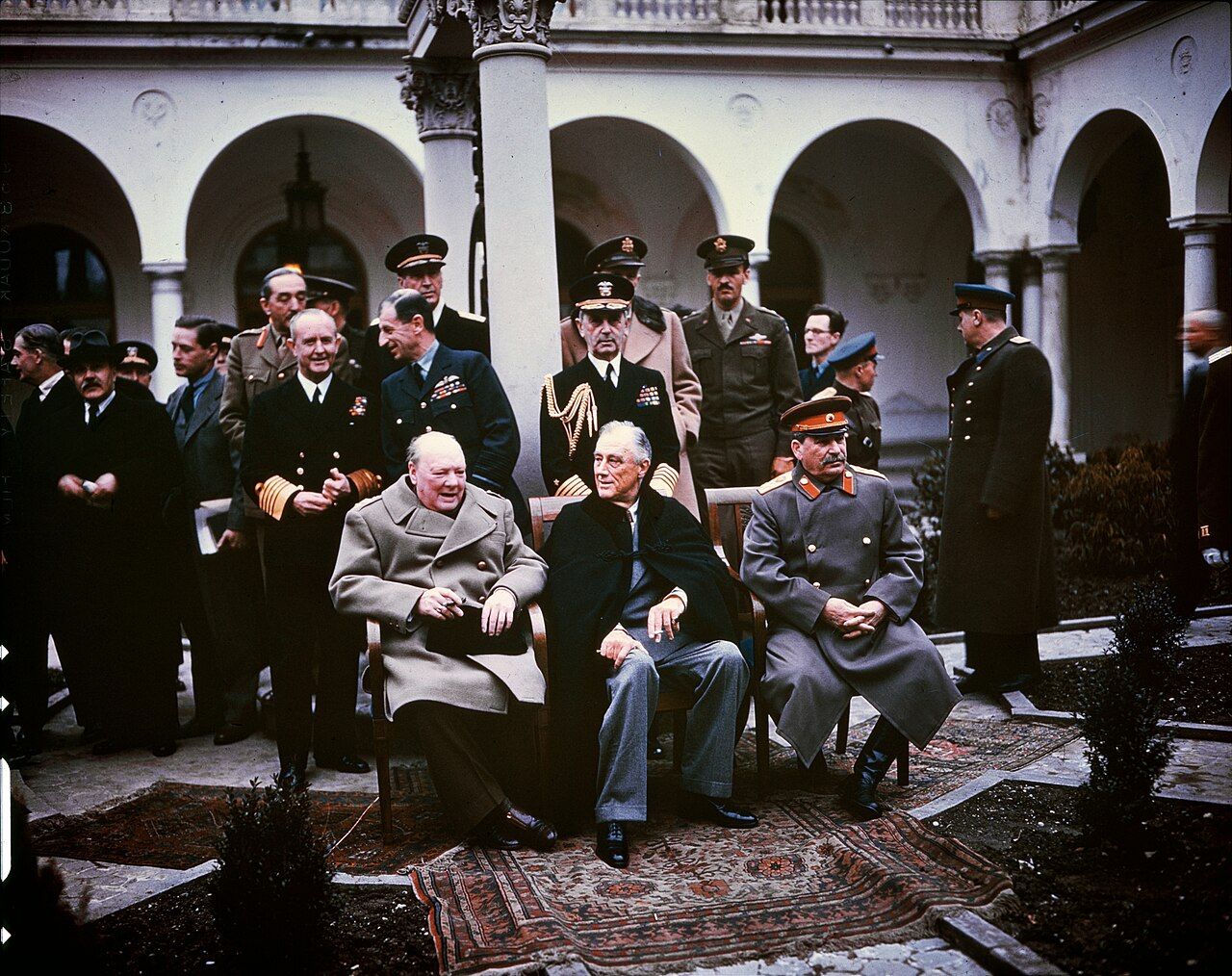
The Grand Alliance of the United States, Britain and the Soviet Union was a marriage of necessity. Franklin Roosevelt, Winston Churchill and Joseph Stalin shared exactly one durable objective: the destruction of Nazi Germany. Beyond that they disagreed about almost everything, and they had good historical reasons to distrust one another. Western troops had intervened against the Bolsheviks in the Russian Civil War. Stalin had signed a pact with Hitler in August 1939 and taken half of Poland. Stalin, for his part, believed the Western Allies had deliberately delayed the second front until the Wehrmacht and the Red Army had bled each other white — and the casualty figures did nothing to dispel the suspicion. The Soviet Union lost roughly twenty-seven million people; the United States lost about four hundred thousand.
At Yalta in February 1945 the three men agreed to divide Germany into occupation zones, to bring the Soviet Union into the war against Japan, and to hold “free and unfettered elections” in liberated Europe. That last phrase was the problem. To Roosevelt and Churchill it meant genuinely competitive politics. To Stalin it meant governments that would never again let an invading army cross Poland into Russia — which in practice meant governments he controlled. By the Potsdam Conference in July and August 1945 Roosevelt was dead, Churchill was voted out mid-conference, and Harry Truman had in hand the report of a successful atomic test carried out in New Mexico on 16 July, the day before the talks opened. The personnel had changed and so had the balance of power.
What followed was less a decision than a slide. Between 1945 and 1948 Communist-dominated governments were installed across Eastern Europe by a repeatable method: join a coalition, take the interior ministry, control the police, then eliminate rivals. Poland, Romania, Bulgaria and Hungary went this way. The Czechoslovak coup of February 1948 was the shock that crystallized Western opinion, partly because Czechoslovakia was a genuine interwar democracy and partly because the foreign minister Jan Masaryk died in a fall from a window two weeks later. Churchill had already named the emerging line in a speech at Fulton, Missouri, on 5 March 1946: an Iron Curtain had descended from Stettin in the Baltic to Trieste in the Adriatic.
Containment: the doctrine that organized forty years
The intellectual architecture came from a mid-level American diplomat in Moscow. George Kennan’s Long Telegram of February 1946, expanded into an anonymous 1947 article in Foreign Affairs, argued that Soviet hostility flowed from internal insecurity rather than from any specific Western provocation, that it could not be charmed away, but that it need not be fought either. Soviet power should be met with “long-term, patient but firm and vigilant containment.” Kennan meant something political and economic, concentrated on the handful of industrial centers that actually shifted the balance of power; he spent the rest of his life complaining that policymakers turned containment into an open-ended global military commitment. He had a point, and the distinction matters when you assess Vietnam.
Containment acquired institutions with astonishing speed. In March 1947 Truman asked Congress for four hundred million dollars for Greece and Turkey, framing it as a worldwide choice between two ways of life — the Truman Doctrine. In June, Secretary of State George Marshall proposed a European Recovery Program; roughly thirteen billion dollars flowed to sixteen participating countries between 1948 and 1952. The Marshall Plan was generous and it was self-interested: a prosperous Western Europe would resist communism and buy American exports. Stalin forbade the Eastern bloc to participate, which had the effect of making the economic division of Europe permanent.
Germany was the flashpoint. When the Western powers merged their zones and introduced a new currency, the Deutsche Mark, Stalin cut the land routes into West Berlin on 24 June 1948. Rather than force the blockade or abandon the city, the Western allies flew in food and coal — some 2.3 million tons over the fifteen months the airlift operated, at its peak a landing every few minutes. The Berlin Blockade ended on 12 May 1949, and its political consequences were exactly the reverse of what Stalin intended: West Germans came to see the occupiers as protectors, two German states were founded in 1949, and twelve nations signed the North Atlantic Treaty on 4 April 1949, committing themselves in Article 5 to treat an attack on one as an attack on all. The Soviet bloc answered with the Warsaw Pact in May 1955, prompted by West German rearmament and NATO membership.
1949–1950: the year the stakes changed
Two events in 1949 transformed a European standoff into a global one. On 29 August the Soviet Union tested an atomic bomb, years earlier than most American estimates predicted, aided by espionage from the Manhattan Project. On 1 October Mao Zedong proclaimed the People’s Republic of China after the Communist victory in the civil war. In Washington these were read together as evidence of a coordinated communist advance — a reading we now know overstated Sino-Soviet unity considerably, since Mao and Stalin distrusted each other and the alliance would rupture within a decade.
The policy response was NSC-68, a National Security Council paper of April 1950 that called for a massive, permanent, peacetime military buildup. It was expensive and initially unpopular. Then on 25 June 1950 North Korean forces crossed the 38th parallel, and the argument was over. The Korean War drew in a United Nations coalition under American command, Chinese “volunteers” in their hundreds of thousands, and roughly three million deaths before the armistice of 27 July 1953 restored a line close to where it started. No peace treaty was ever signed. American defense spending more than tripled between 1950 and 1953 and never returned to its prewar level.
| Date | Event | Why it mattered |
|---|---|---|
| Feb 1945 | Yalta Conference | Agreed occupation zones and “free elections” — a phrase each side defined differently |
| Mar 1946 | Churchill’s Fulton speech | Named the “iron curtain” and made division public language |
| Mar 1947 | Truman Doctrine | Committed the U.S. to supporting free peoples resisting subjugation — open-ended by design |
| Jun 1947 | Marshall Plan announced | Tied European recovery to the Western bloc; Soviet refusal locked in the split |
| Feb 1948 | Czechoslovak coup | Convinced Western publics that coexistence was failing |
| Jun 1948–May 1949 | Berlin Blockade and Airlift | First direct confrontation; produced two German states |
| Apr 1949 | North Atlantic Treaty | Permanent U.S. military commitment to Europe in peacetime |
| Aug–Oct 1949 | Soviet atomic test; PRC founded | Ended the American nuclear monopoly and globalized the conflict |
| Jun 1950 | Korean War begins | Militarized containment; more than tripled U.S. defense spending |
Where historians disagree
Blame for the Cold War has been assigned three different ways, and the debate is worth knowing because it is a good model of how historical interpretation moves. The orthodox view of the 1950s held that Soviet expansionism forced a reluctant America to respond. Revisionist historians of the 1960s, writing under the shadow of Vietnam, argued that American economic ambitions and atomic diplomacy provoked a defensive Soviet Union. Post-revisionists from the 1970s onward, and especially historians working in Soviet archives opened after 1991, tend toward a middle position: Stalin was opportunistic rather than following a master plan, he wanted a buffer more than a world revolution, but his methods in Eastern Europe were brutal enough to make Western alarm reasonable. Most specialists today emphasize misperception on both sides without treating the two systems as morally equivalent.
The Cold War emerged not from a single decision but from a chain of defensive moves between 1945 and 1950 that hardened a temporary occupation line into two permanent, armed, ideologically opposed blocs.
Section 2Living with the Bomb: Crises, Deterrence and the Frozen Order
Thaw, secret speech, and the limits of reform
Stalin died on 5 March 1953. What followed was not liberalization exactly, but a loosening. Millions were released from the Gulag. At the Twentieth Party Congress on 25 February 1956, Nikita Khrushchev delivered a four-hour closed-session speech denouncing Stalin’s “cult of personality,” his purges of loyal Communists, and his catastrophic unpreparedness in 1941. The Secret Speech did not stay secret. Read aloud in party meetings and leaked to the West, it detonated across the bloc.
In Poland, protests in Poznań produced a negotiated change of leadership. In Hungary the result was a revolution. Beginning on 23 October 1956, students, workers and eventually army units took Budapest; the reform Communist Imre Nagy announced a multiparty system and Hungarian withdrawal from the Warsaw Pact. That last step crossed the line. Soviet armor returned on 4 November, killing some twenty-five hundred Hungarians; roughly two hundred thousand fled west; Nagy was executed in 1958. The West, loudly sympathetic and simultaneously distracted by the Suez Crisis, did nothing military. The lesson learned in Eastern Europe was bitter and lasting: reform was possible only inside limits Moscow set, and the West would not come.
The nuclear balance
The 1950s and 1960s were the years in which humanity acquired the capacity to end itself and then built the political machinery to live with that fact. The United States tested a thermonuclear device in November 1952; the Soviet Union answered with a hydrogen bomb in August 1953 and a true two-stage weapon in 1955. The Soviet launch of Sputnik on 4 October 1957 demonstrated a rocket that could carry a warhead to North America and triggered an American panic about a “missile gap” that turned out not to exist — the gap ran the other way. Both sides built triads of bombers, land-based missiles and submarines, and by the end of the 1960s each could absorb a first strike and still annihilate the other. This condition, mutually assured destruction, was grotesque and, most strategists concluded, stabilizing: it made deliberate war between the superpowers close to unthinkable and pushed their competition into proxies, propaganda, sport and space.
Berlin remained the pressure point. Between 1949 and 1961 roughly 2.7 million people left East Germany, most of them simply walking out through the open border in Berlin, and they were disproportionately young, trained and mobile — a hemorrhage the East German state could not survive. On the night of 13 August 1961 barbed wire went up, then concrete. The Berlin Wall was an admission of failure dressed as an anti-fascist protective barrier, and it stabilized the German question for twenty-eight years by making it insoluble.
Thirteen days in October
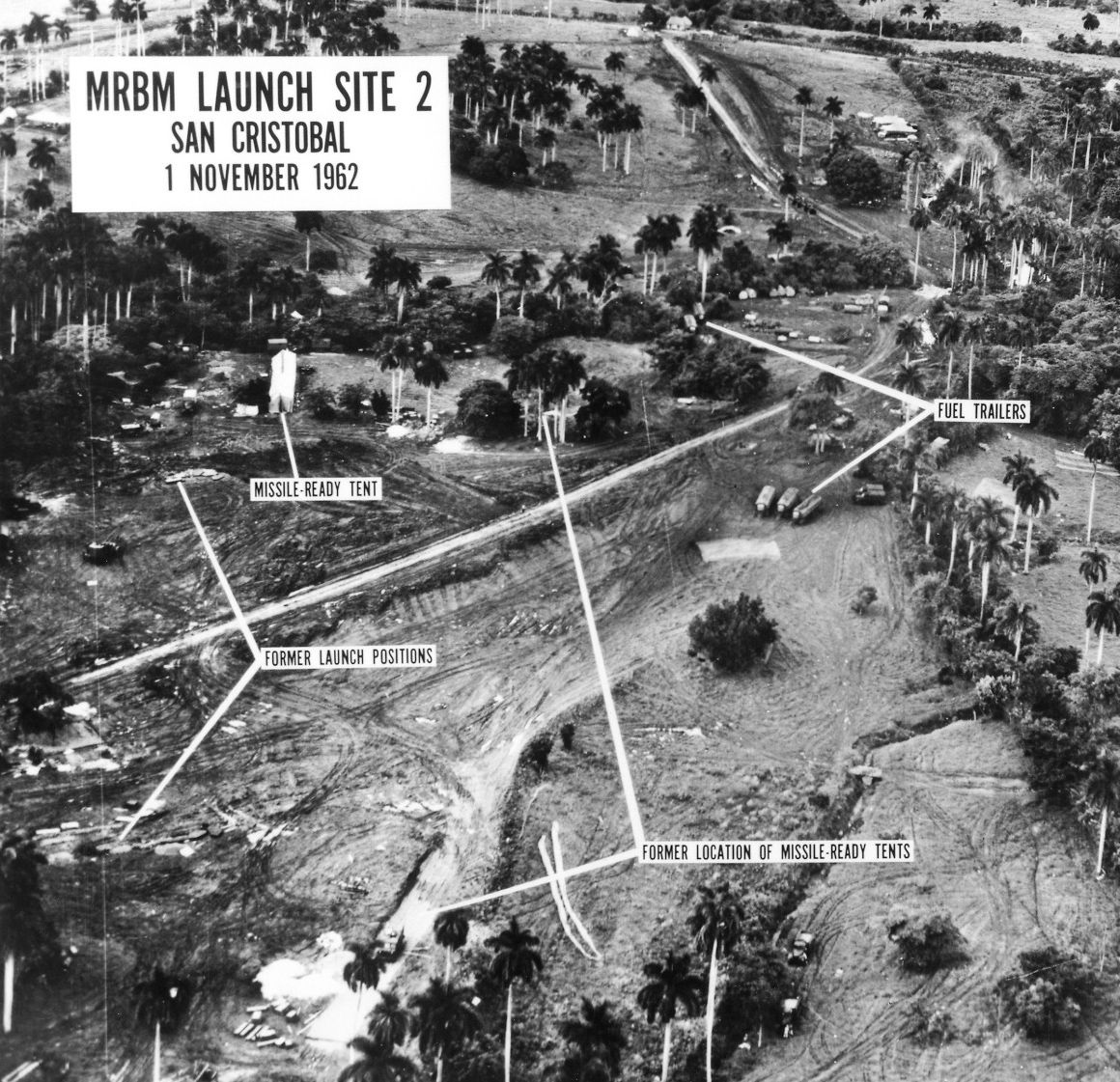
The closest the world came to nuclear war began with photographs. In October 1962 American U-2 flights confirmed that the Soviet Union was installing medium-range nuclear missiles in Cuba, ninety miles from Florida. Khrushchev’s motives were mixed: deterring another American invasion attempt after the Bay of Pigs fiasco of 1961, and offsetting American Jupiter missiles already deployed in Turkey and Italy. John F. Kennedy rejected the initial advice to bomb the sites and chose a naval “quarantine” instead, buying time.
For thirteen days — 16 to 28 October — both leaders looked for an exit that would not humiliate either. The settlement was public and private: the Soviets withdrew the missiles, the Americans publicly pledged not to invade Cuba, and secretly agreed to remove the Jupiters from Turkey within months. Later revelations made the episode look worse, not better. Soviet forces in Cuba already had tactical nuclear weapons; a Soviet submarine officer, Vasili Arkhipov, refused to consent to launching a nuclear torpedo while under depth-charge harassment. The Cuban Missile Crisis frightened both governments into arms control: a Moscow–Washington hotline in 1963, the Limited Test Ban Treaty the same year, and the Nuclear Non-Proliferation Treaty opened for signature in 1968.
| Crisis | Date | Trigger | Outcome |
|---|---|---|---|
| Berlin Blockade | 1948–49 | Western currency reform in Germany | Airlift succeeded; two German states; NATO founded |
| Hungarian Revolution | Oct–Nov 1956 | De-Stalinization; withdrawal from Warsaw Pact | Soviet invasion; ~2,500 killed; no Western intervention |
| Suez Crisis | Oct–Nov 1956 | Nasser nationalized the Suez Canal | U.S. pressure forced British and French withdrawal; end of their great-power pretensions |
| Berlin Wall | Aug 1961 | Mass emigration through West Berlin | Border sealed; German question frozen until 1989 |
| Cuban Missile Crisis | Oct 1962 | Soviet missiles in Cuba | Missiles withdrawn; secret Jupiter deal; hotline and test-ban treaty |
| Prague Spring | 1968 | Dubček’s “socialism with a human face” | Warsaw Pact invasion; Brezhnev Doctrine proclaimed |
1968 and the closing of the reform road
In January 1968 Alexander Dubček became Czechoslovak party leader and began dismantling censorship, promising “socialism with a human face.” The Prague Spring was an attempt to reform communism from inside, not to leave the bloc. It was still intolerable: on the night of 20–21 August, Warsaw Pact forces — a quarter of a million at the outset, building toward half a million — occupied the country. Leonid Brezhnev then articulated what the West called the Brezhnev Doctrine: the socialist community had the right and duty to intervene where socialism was threatened. Many Western European Communists broke with Moscow permanently after 1968, and inside the bloc a generation concluded that the system was not reformable — a conclusion that would matter enormously in 1989.
Nuclear weapons made direct superpower war effectively unthinkable, which froze Europe’s dividing line in place and pushed the real fighting, and the real reform struggles, into proxies and satellites.
Section 3The End of Empire and the Making of a Third World
Why the empires went, and went fast
In 1945 European states governed roughly a third of the world’s population. By 1975 nearly all of it was gone. The speed demands explanation, and the explanation is layered. First, the war itself had shattered the prestige of empire: the fall of Singapore in 1942 and the German occupation of France showed colonized peoples that European power was neither natural nor invincible. Second, the metropoles were broke. Britain finished the war owing more than three billion pounds in sterling balances, much of it to India. Third, colonial subjects had fought — over two million Indians served in the British Indian Army; hundreds of thousands of Africans served in French and British forces — and returned with claims that were hard to refuse. Fourth, both superpowers were formally anti-colonial, which meant that Europe’s empires now embarrassed their own protectors.
Fifth, and most important, colonized peoples organized. The Indian National Congress, the Vietnamese Viet Minh, Ghana’s Convention People’s Party, the Algerian FLN and the Kenyan movements built mass politics that made governing without consent expensive. Where the imperial power judged the cost tolerable, it fought; where it did not, it left.
Partition, war, and the varieties of independence
India and Pakistan became independent on 14–15 August 1947, an event that fused triumph with catastrophe. The Partition line drawn by Cyril Radcliffe, who had never been to India, cut through Punjab and Bengal. Between ten and fifteen million people moved; estimates of the dead in the accompanying communal violence range from several hundred thousand to a million. Mohandas Gandhi, who had opposed partition, was assassinated by a Hindu nationalist in January 1948. Kashmir remains disputed and both states are now nuclear-armed.
Elsewhere, transitions ranged from negotiated to savage. Ghana became Britain’s first sub-Saharan African colony to win independence, on 6 March 1957, under Kwame Nkrumah. In 1960 alone seventeen African states became independent — the “Year of Africa.” But France fought eight years in Indochina, losing decisively at Dien Bien Phu in May 1954, and then seven and a half years in Algeria (1954–1962), a war involving systematic torture, roughly a million European settlers displaced, and Algerian death estimates ranging from three hundred thousand to over a million depending on the source. The Algerian war destroyed the French Fourth Republic and brought Charles de Gaulle back to power in 1958; it was de Gaulle who eventually negotiated the Evian Accords of March 1962 and let Algeria go. Portugal held on longest, until its own dictatorship fell in the Carnation Revolution of 1974.
| Territory | Imperial power | Independence | Path |
|---|---|---|---|
| India / Pakistan | Britain | 1947 | Negotiated, but partition killed hundreds of thousands |
| Indonesia | Netherlands | 1949 | Four years of armed struggle plus U.S. pressure on the Dutch |
| Vietnam (north) | France | 1954 | Military defeat of France; country divided at the 17th parallel |
| Ghana | Britain | 1957 | Mass party politics and negotiated transfer |
| Congo | Belgium | 1960 | Abrupt withdrawal; secession, Lumumba’s murder, Mobutu’s dictatorship |
| Algeria | France | 1962 | War from 1954 to 1962; settler exodus; collapse of the Fourth Republic |
| Angola / Mozambique | Portugal | 1975 | Guerrilla wars ended by revolution in Lisbon; then Cold War civil wars |
Non-alignment and the cost of taking sides
New states faced an unwelcome choice: line up with Washington, with Moscow, or try to avoid both. At Bandung in Indonesia in April 1955, twenty-nine Asian and African states met to assert a third path; the Non-Aligned Movement was formally founded at Belgrade in 1961 under Yugoslavia’s Tito, Egypt’s Nasser, India’s Nehru, Indonesia’s Sukarno and Ghana’s Nkrumah. Non-alignment was never neutrality in practice — most members took aid from someone — but it gave smaller states leverage and a voice in the United Nations, whose membership grew from sixty at the start of 1955 to one hundred and twenty-seven by 1970.
The superpowers competed for these states with weapons, dams, scholarships and coups. The results were often disastrous for local populations. In the Congo, independent on 30 June 1960, the elected prime minister Patrice Lumumba was deposed and murdered in January 1961 with Belgian complicity and American approval of his removal; Mobutu Sese Seko then ruled for thirty-two years. In Iran, a British- and American-backed coup in August 1953 removed the elected prime minister Mohammad Mosaddegh, who had nationalized Anglo-Iranian Oil, and restored the Shah — a decision whose bill came due in the Iranian Revolution of 1979. Vietnam became the extreme case: American forces peaked above half a million in 1969, the Tet Offensive of January 1968 destroyed official claims that the war was being won and with them much of the domestic support for it, and Saigon fell on 30 April 1975. Somewhere between two and three million Vietnamese died, along with about fifty-eight thousand Americans.
Decolonization dismantled Europe’s overseas empires within thirty years, but because it happened inside a superpower rivalry, independence frequently arrived attached to proxy wars, arbitrary borders and client dictatorships.
Section 4The Western Settlement: Affluence, Welfare, Integration and Revolt
Thirty glorious years
Between roughly 1948 and 1973 Western Europe experienced the fastest sustained economic growth in its history — the French called it les trente glorieuses, the Germans the Wirtschaftswunder. West German output grew at about eight percent a year through the 1950s; Italy averaged near six. The causes were unglamorous: rebuilding from a low base, American aid and open American markets, cheap oil, rapid movement of labor from farms into factories, and a currency system fixed at Bretton Woods that made trade predictable. Real wages roughly doubled in a generation. Car ownership, refrigerators, paid holidays and television moved from luxury to normal.
The politics that accompanied prosperity were consciously anti-1930s. Everyone remembered that mass unemployment had produced fascism. So Western European states built welfare states: Britain’s National Health Service opened in 1948 on the model of the 1942 Beveridge Report, which named “five giants” — want, disease, ignorance, squalor and idleness — to be defeated. France, Italy and West Germany expanded pensions, family allowances and health insurance. Christian Democratic and Social Democratic parties, historic enemies, converged on a mixed economy with strong unions, high taxes and a broad safety net. This settlement is often called the postwar consensus, and it held until the oil shock of 1973 and the inflation that followed cracked its economic assumptions.
Building Europe out of coal and steel
The most original institutional invention of the era began with a technical proposal. On 9 May 1950 Robert Schuman, prompted by Jean Monnet, proposed pooling French and German coal and steel production under a common authority — making war between them, in his phrase, materially impossible. The European Coal and Steel Community (1951) linked France, West Germany, Italy, Belgium, the Netherlands and Luxembourg. The Treaty of Rome, signed 25 March 1957, created the European Economic Community with a customs union and common agricultural policy. Britain stayed out, applied late, and was vetoed twice by de Gaulle before joining in 1973.
The method was deliberate: integrate the boring things first — tariffs, standards, agricultural prices — and let political union follow the economics. It worked for four decades and generated real prosperity, but it also created a body of European law and administration with weak democratic accountability, a “democratic deficit” that critics have raised ever since and that surfaced with force in the Brexit referendum.
| Step | Year | What it did |
|---|---|---|
| Schuman Declaration | 1950 | Proposed pooling Franco-German coal and steel |
| European Coal and Steel Community | 1951 | First supranational authority; six members |
| Treaty of Rome (EEC) | 1957 | Customs union, common market, common agricultural policy |
| First enlargement | 1973 | Britain, Ireland and Denmark join after de Gaulle’s vetoes lapse |
| Single European Act | 1986 | Committed to a single market by 1992; expanded majority voting |
| Maastricht Treaty | 1992 | Created the European Union, EU citizenship and the path to the euro |
| Eastern enlargement | 2004–2007 | Twelve mostly post-communist states join; the continent formally reunites |
Who the prosperity was for — and 1968
Growth needed workers, and Western Europe imported them. West Germany signed labor recruitment agreements with Italy (1955), Turkey (1961) and others; the Gastarbeiter, or guest workers, were expected to leave and largely did not. Britain drew migrants from the Caribbean and South Asia, a movement symbolized by the arrival of the Empire Windrush in 1948; France drew from the Maghreb. By the 1970s Western Europe contained large settled minority populations whose legal status, housing and citizenship rights lagged far behind their economic contribution — the origin of debates that still dominate European politics.
The postwar order also produced children who did not share their parents’ gratitude for stability. University enrollments exploded — France had about two hundred thousand students in 1960 and over five hundred thousand by 1968 — into institutions and cities that had not expanded to hold them. In May 1968 student protests in Paris escalated into a general strike of roughly nine million workers that briefly paralyzed France. De Gaulle survived, and his party won the June elections handily; the immediate political result was conservative. The cultural result was not. The 1968 movements — in Berkeley, Berlin, Prague, Mexico City, Rome and Warsaw — helped legitimize a shift in authority relations inside families, universities, churches and workplaces.
Two parallel movements changed more lives than the barricades did. Second-wave feminism, drawing on Simone de Beauvoir’s The Second Sex (1949) and Betty Friedan’s The Feminine Mystique (1963), won equal-pay legislation, access to contraception and divorce reform across Western Europe — Italy legalized divorce in 1970 and upheld it by referendum in 1974. And the American civil rights movement, culminating in the Civil Rights Act of 1964 and Voting Rights Act of 1965, dismantled legal segregation while exposing how much of racial inequality was economic rather than statutory. Meanwhile the Roman Catholic Church remade its own relationship to modernity at the Second Vatican Council (1962–1965), permitting vernacular liturgy and repudiating the charge of collective Jewish guilt for the death of Jesus.
Western Europe answered the catastrophe of 1914–1945 with a deliberate package — welfare states, mixed economies and supranational integration — that delivered a generation of unprecedented prosperity while deferring hard questions about migration, empire and democratic accountability.
Section 5Collapse and Aftermath: 1975 to the Present
Stagnation, détente, and the human rights loophole
By the mid-1970s the Soviet economy was visibly failing at the thing it had once done well: producing more. Growth rates fell through the Brezhnev years, agriculture required grain imports from the United States, and consumer goods were scarce enough that queuing became a way of life. Military spending consumed a share of output usually estimated at fifteen to twenty-five percent — the uncertainty itself tells you how opaque the system was. Meanwhile détente produced real agreements: SALT I in 1972 capped missile launchers, and the Helsinki Final Act of August 1975 recognized existing European borders, which Moscow wanted.
Helsinki also contained “Basket Three,” a set of human rights commitments the Soviets regarded as decorative. They were not. Dissidents from Moscow to Prague began citing them, forming monitoring groups — Charter 77 in Czechoslovakia, the Moscow Helsinki Group — and holding governments to promises made in their own signatures. In Poland the combination was explosive: a Polish pope, John Paul II, elected in 1978 and greeted by millions on his 1979 visit; then in August 1980 the Gdańsk shipyard strike that produced Solidarity, an independent trade union that within a year had close to ten million members. General Jaruzelski imposed martial law in December 1981 and drove it underground, but did not kill it. Détente itself collapsed after the Soviet invasion of Afghanistan in December 1979 and the deployment of new intermediate-range missiles on both sides.
Gorbachev and the unintended revolution
Mikhail Gorbachev became general secretary in March 1985 believing the Soviet system could be saved by reform. Perestroika (restructuring) tried to introduce limited market mechanisms; glasnost (openness) allowed criticism in the press, initially to expose bureaucratic obstruction. The Chernobyl reactor explosion of 26 April 1986, and the days of official silence that followed it, convinced Gorbachev that secrecy was itself lethal. He also concluded that the arms race was unaffordable, signing the INF Treaty in December 1987 — the first agreement to eliminate an entire class of nuclear weapons — and, decisively, abandoning the Brezhnev Doctrine. Eastern European regimes were told they would not be rescued by Soviet tanks.
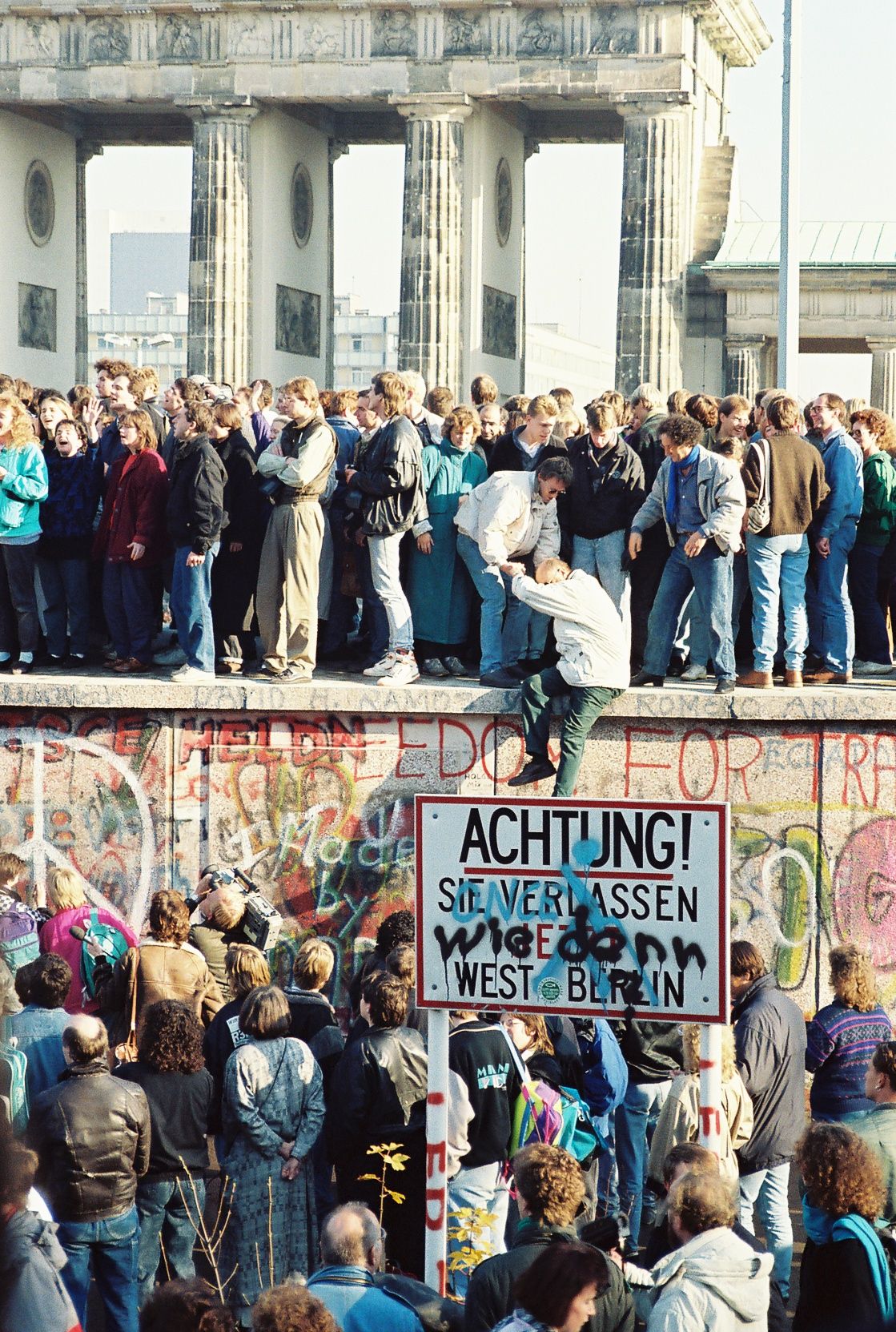
Nineteen eighty-nine followed with a speed no intelligence agency predicted. Poland held partly free elections on 4 June; Solidarity won essentially every seat it was allowed to contest. Hungary opened its border with Austria, and East Germans began escaping through it by the thousands. Mass demonstrations in Leipzig grew weekly. On the evening of 9 November a garbled East German press announcement about travel rules brought crowds to the checkpoints, and overwhelmed guards opened the gates. Czechoslovakia’s Velvet Revolution installed the playwright Václav Havel as president within seven weeks. Romania was the exception: Nicolae Ceaușescu and his wife were shot on 25 December after a violent uprising. Germany reunified on 3 October 1990. The Soviet Union itself dissolved on 26 December 1991, after a failed hard-line coup in August had discredited the center and empowered Boris Yeltsin and the republics.
| Country | 1989 turning point | Character of the change |
|---|---|---|
| Poland | Round Table talks; June elections | Negotiated; Solidarity sweeps contested seats |
| Hungary | Border with Austria opened; party dissolves itself | Reform from within the ruling party |
| East Germany | Leipzig marches; Wall opens 9 November | Mass pressure; regime loses will to shoot |
| Czechoslovakia | Velvet Revolution, November–December | Rapid, nonviolent, led by Charter 77 dissidents |
| Bulgaria | Zhivkov removed by his own politburo | Palace coup followed by gradual opening |
| Romania | Timișoara and Bucharest uprisings | Violent; Ceaușescu executed 25 December |
What the 1990s promised and what arrived
The mood of 1991 was triumphal. Francis Fukuyama’s 1989 essay “The End of History?” argued that liberal democracy had won the argument about how to organize a society; it was widely misread as a prediction that nothing more would happen. What actually happened was uneven. Poland, the Czech Republic and the Baltic states built functioning democracies and joined NATO and then the EU, which took in ten new members in 2004 alone. Russia’s “shock therapy” produced hyperinflation, a collapse in male life expectancy and an oligarchy, conditions that made an authoritarian restoration under Vladimir Putin, in power from 2000, broadly popular at home.
And Yugoslavia disintegrated in war. Slovenia and Croatia declared independence in 1991 and Bosnia in 1992; the fighting in Croatia and Bosnia was waged largely through ethnic cleansing, the forced removal of populations to make territory ethnically uniform. The massacre of roughly eight thousand Bosniak men and boys at Srebrenica in July 1995, in a United Nations “safe area,” was later ruled a genocide by international tribunals. NATO airstrikes and the Dayton Accords ended the Bosnian war in 1995. NATO intervened again in 1999 to stop the expulsion of Kosovo’s Albanians, this time without Security Council authorization, opening a debate about humanitarian intervention that has never been settled; Kosovo remained under United Nations administration until it declared independence in 2008.
The world we are actually in
Three forces have defined the decades since. Globalization — container shipping, the internet, China’s entry into the World Trade Organization in 2001 — lifted roughly a billion people out of extreme poverty while hollowing out industrial employment in Western democracies, a distributional fact that later showed up in their politics. Terrorism and its aftermath: the attacks of 11 September 2001 killed nearly three thousand people and led to wars in Afghanistan and Iraq, the latter launched in 2003 on claims about weapons of mass destruction that proved false, with lasting damage to Western credibility. And the return of hard power: Russia’s annexation of Crimea in 2014 and full-scale invasion of Ukraine on 24 February 2022 ended the assumption that borders in Europe would no longer be changed by force, and brought Finland and Sweden into NATO in 2023 and 2024.
Layered on top are stresses the Cold War framework never addressed: the financial crisis of 2008 and the eurozone crisis that followed; migration pressures from Syria and the Sahel; the COVID-19 pandemic beginning in 2020; the rise of populist and nationalist parties across Europe and North America, including the British vote to leave the European Union on 23 June 2016; and climate change, the first genuinely planetary problem, addressed by the Paris Agreement of 2015 with commitments that most assessments judge insufficient. Historians are properly cautious about the recent past — we lack archives, distance and outcomes — but the pattern is legible: the institutions built between 1945 and 1957 are under strain from problems they were never designed to solve.
The Soviet bloc fell because economic stagnation, civil-society movements and Gorbachev’s refusal to shoot converged in a single year — and the liberal order that inherited the victory has since been tested by globalization, war in Europe and problems no Cold War institution was built to handle.
The chapter in one breath
Out of the wreckage of 1945 came a divided world. The United States and the Soviet Union, allies only against Hitler, hardened an occupation line into two blocs by 1949 through a chain of moves — Truman Doctrine, Marshall Plan, Berlin airlift, NATO — that each side experienced as defensive. Nuclear weapons then froze that line: because direct war would be suicidal, the conflict was fought in Korea, Vietnam, the Congo and Afghanistan, and at moments like October 1962 the whole species came closer to extinction than most people knew. Under the nuclear umbrella, Europe’s overseas empires dissolved in thirty years, sometimes by negotiation and often by war, leaving new states to navigate a rivalry not of their making. Western Europe meanwhile built something new out of the memory of the 1930s: welfare states, mixed economies, and a coal-and-steel community that grew into the European Union, financed by a quarter-century boom that ended with the oil shocks. In the East the same period produced stagnation, and by 1989 a system whose own leaders no longer believed in it. Its collapse was fast, mostly peaceful and almost entirely unforeseen. What replaced it — a globalized, unequal, warming and once again contested world — is the one we live in.
Words worth knowing
| Term | What it means |
|---|---|
| Cold War | The armed political rivalry between the U.S.-led and Soviet-led blocs, roughly 1947–1991, waged everywhere except in direct war between the two. |
| Iron Curtain | The phrase Churchill made famous at Fulton in 1946 for the closed boundary separating Soviet-controlled Eastern Europe from the West. |
| Containment | Kennan’s strategy of patiently blocking Soviet expansion rather than rolling it back or accommodating it. |
| Truman Doctrine | The 1947 pledge of U.S. support to peoples resisting subjugation; the open-ended justification for later interventions. |
| Marshall Plan | The European Recovery Program, about 13 billion dollars of U.S. aid to sixteen countries, 1948–1952. |
| NATO / Warsaw Pact | The Western alliance of 1949 with its mutual-defense Article 5, and the Soviet counter-alliance of 1955. |
| NSC-68 | The 1950 U.S. planning document calling for permanent large-scale peacetime rearmament. |
| Mutually assured destruction | The condition in which each side can survive a first strike and still destroy the other, making deliberate attack irrational. |
| Secret Speech | Khrushchev’s February 1956 denunciation of Stalin, which loosened the bloc and triggered unrest in Poland and Hungary. |
| Brezhnev Doctrine | The claim, stated after the 1968 invasion of Czechoslovakia, of a right to intervene where socialism was threatened. |
| Decolonization | The dissolution of European overseas empires, roughly 1945–1975, by negotiation, revolt or both. |
| Non-Aligned Movement | A bloc of states, founded at Belgrade in 1961 after Bandung, refusing formal alignment with either superpower. |
| Trente glorieuses | The roughly 1948–1973 boom that doubled Western European living standards. |
| Welfare state | The postwar package of health care, pensions and social insurance funded by taxation and designed to prevent a return to the 1930s. |
| European integration | The stepwise pooling of sovereignty from the Coal and Steel Community (1951) through the Treaty of Rome (1957) to the EU (1992). |
| Détente | The 1969–1979 relaxation of superpower tension, producing SALT I and the Helsinki Final Act. |
| Helsinki Final Act | The 1975 agreement recognizing European borders while committing signatories to human rights that dissidents then invoked. |
| Solidarity | The independent Polish trade union born at Gdańsk in 1980, suppressed under martial law and victorious in 1989. |
| Perestroika and glasnost | Gorbachev’s economic restructuring and political openness, intended to save the Soviet system and instead fatal to it. |
| Ethnic cleansing | The forced removal of a population from a territory on ethnic grounds; central to the Yugoslav wars of 1991–1999. |