Viruses, Fungi & Parasites
Not every microbe is a bacterium. Step outside the bacterial world and the cast gets stranger. Viruses are barely alive. They cannot make copies of themselves without taking over a living cell. Fungi are built much more like us than like bacteria, so they are hard to poison on purpose. Then come the parasites. Some are single cells, called protozoa. Others are worms with many cells. Between them they cause some of the most common diseases on earth. This chapter shows how each agent is built, how it copies itself, and how it causes harm. One idea ties it all together: what a pathogen is made of decides how you kill it, how it spreads, and how you stop it from spreading again.
By the end of this chapter you can
- Name the parts of a virus: the capsid, the genome, and sometimes an envelope. Explain why an envelope changes the choice of disinfectant.
- Walk through the viral replication cycle. Explain how latency lets a virus hide and come back.
- Tell a yeast from a mold, name the common mycoses, and explain why antifungal drugs are harder on the body than antibiotics.
- Explain how protozoa cause disease, using malaria and giardiasis as your two anchors.
- Sort the parasitic roundworms from the flatworms, and spot clues like eosinophilia that point to a worm.
- Link each pathogen's structure to its route of transmission and to the step that breaks that route.
- Explain why so many of these infections turn up in people who are immunocompromised.
Section 1How a virus is built
Alive, or not quite?
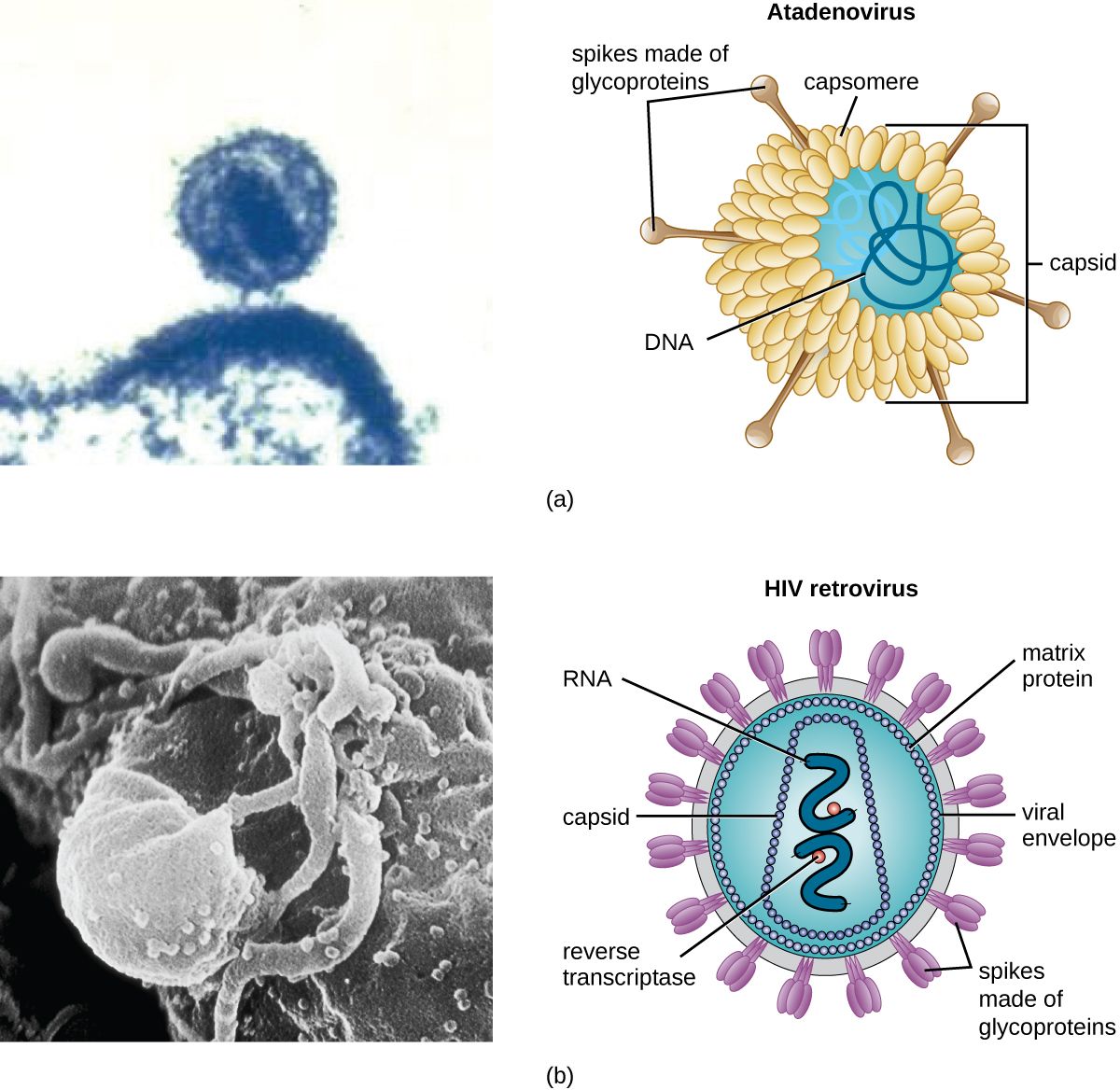
A virus sits on the fence between living and non-living. That in-between spot is the key to everything else about it. A virus is acellular, which means it is not a cell. It has no cytoplasm and no ribosomes. It cannot make its own energy. It has no tools for copying itself. Left alone on a countertop, a virus just sits there. It acts more like a complicated chemical than like an organism.
A virus only comes to life inside a host cell. There it borrows the cell's machinery and puts it to work. Because it can never copy itself alone, a virus is called an obligate intracellular parasite. "Obligate" means it has no other option. This is also why antibiotics do nothing to a virus. Antibiotics attack parts that only bacteria have, such as the cell wall or the bacterial ribosome. A virus has none of those parts to attack.
The capsid and the genome
Strip a virus down and two parts are always there. At the center is the genome, the virus's set of genetic instructions. Your own cells always use double-stranded DNA. Viruses are far less tidy. A virus may carry DNA or RNA, never both, and that strand may be single or double. The choice matters in the clinic. RNA viruses copy their genomes sloppily, so they change fast. Influenza, HIV, SARS-CoV-2, and hepatitis C are all RNA viruses. Their quick drift is the reason a new flu shot is needed each year.
Wrapped around the genome is the capsid, a shell built from repeating protein blocks called capsomeres. The capsid guards the fragile genome. It also holds the surface proteins that grip a host cell. Capsids come in a few classic shapes. A helical capsid is a rod, like a coil of beads around the genome. An icosahedral capsid is a round cage with 20 flat faces. A complex capsid mixes parts, the way a bacteria-eating phage has a head and a tail. The genome and capsid together are called the nucleocapsid.
The envelope, and why cleaning depends on it
Some viruses add a third layer. The envelope is a lipid membrane that the virus steals from its host cell as it leaves. Stuck through that envelope are viral spike proteins, also called glycoproteins. They are the keys for the next break-in. The SARS-CoV-2 spike and the influenza hemagglutinin are the famous ones.
Whether a virus has an envelope turns out to be very practical. An enveloped virus needs its lipid coat in order to infect, and lipids are easy to wreck. Soap, alcohol-based hand rub, and plain drying pull the envelope apart. So flu, COVID, HIV, and herpes are all fairly easy to kill outside the body. There is one exception you must not smooth over. Hepatitis B has an envelope, yet it stays infectious in dried blood for a week or more. Spills of blood and body fluid are cleaned with an EPA-registered hospital disinfectant that carries a tuberculocidal or HBV claim, or with household bleach diluted 1:10. An alcohol wipe is not enough.
A non-enveloped virus, also called a naked virus, has only its tough protein capsid on the outside. It shrugs off alcohol and can last for days on a surface. Norovirus and poliovirus are the classic hardy naked viruses. They call for bleach and for careful scrubbing of surfaces.
| Feature | Enveloped virus | Non-enveloped (naked) virus |
|---|---|---|
| Outer layer | Lipid envelope with spike proteins | Protein capsid only |
| Survival outside the body | Usually fragile; dries out and is short-lived on surfaces (exception: hepatitis B lasts 7+ days in dried blood) | Hardy; lasts for days |
| Alcohol / soap | Usually destroyed, because the lipid coat dissolves; blood spills (HBV) still need bleach or a hospital disinfectant | Often resistant |
| Best disinfectant | Alcohol hand rub, soap and water | Bleach (hypochlorite) plus scrubbing |
| Examples | Influenza, SARS-CoV-2, HIV, herpes, hepatitis B | Norovirus, rotavirus, poliovirus, hepatitis A |
- A virus is acellular and an obligate intracellular parasite. It cannot copy itself without a host cell.
- Every virus has a genome, either DNA or RNA, single or double stranded, inside a protein capsid. RNA viruses change fast.
- Some viruses add a stolen lipid envelope carrying spike proteins, the keys they use to attach.
- Enveloped viruses usually die to soap and alcohol. Hepatitis B in dried blood is the exception. Naked viruses resist alcohol and need bleach.
Section 2How viruses replicate
The five-step cycle
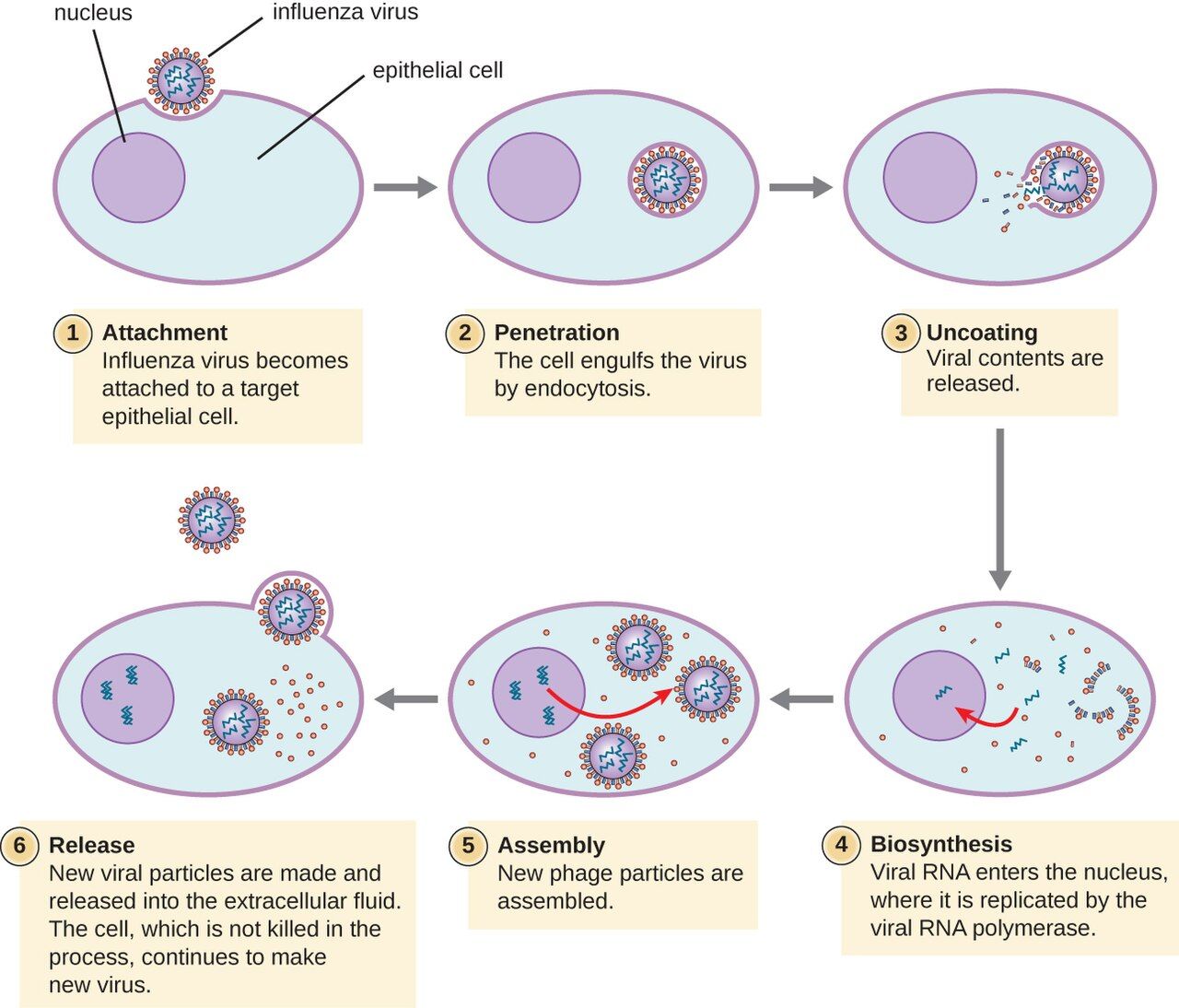
A virus has no factory of its own, so replication is really a story of hijacking. In almost every virus the order of events is the same. First comes attachment. A surface protein on the virus fits a matching receptor on the host cell, like a key in a lock. That fit is why one virus infects only certain cells. HIV binds CD4 on T cells. Rhinovirus binds cells lining the airway. Second comes entry, also called penetration, as the whole virus or just its genome slips inside.
Third, and this is the heart of it, comes biosynthesis. The viral genome takes over the cell's ribosomes, enzymes, and raw material. The cell starts mass-producing viral proteins and copies of the viral genome. Fourth comes assembly, also called maturation, when those fresh parts snap together into whole virus particles. Fifth comes release, when the new particles escape to infect the cells next door. One infected cell can turn out hundreds or thousands of particles before it is done.
The genome decides how step three runs
Step three is where the three great kinds of virus part ways. Most DNA viruses send their genome into the nucleus. There they use your own enzymes, plus a few of their own, to make viral messenger RNA and new DNA copies. Herpesviruses work this way, and they bring along their own DNA polymerase. That extra enzyme is what acyclovir is built to jam.
Most RNA viruses never bother with the nucleus. They set up shop in the cytoplasm instead. Your cells have no enzyme that copies RNA into RNA, so most RNA viruses carry their own, an RNA polymerase. Some RNA genomes can be read by ribosomes the moment they arrive, because the genome already reads like messenger RNA. Others have to be copied into a readable strand first. Influenza is the odd one out here, because it does copy its RNA inside the nucleus.
A retrovirus is stranger still. HIV carries reverse transcriptase, an enzyme that writes a DNA copy of the viral RNA. A second enzyme, integrase, then pastes that DNA into one of the host chromosomes. From that moment the cell copies the virus along with its own genes, every time it divides. Later, a viral protease cuts long protein chains into finished pieces, and only then is the new particle able to infect anything.
Budding versus bursting
The last step comes in two flavors, and the split lines up with the envelope from Section 1. Naked viruses usually escape by lysis. The host cell fills with new particles until it bursts and dies, releasing them all at once. Enveloped viruses more often leave by budding. They push out through the host membrane and wrap themselves in a piece of it, which is where the envelope comes from. Budding can be slower and gentler, and that is part of how some enveloped viruses settle into long, smoldering infections instead of a quick blaze. Either way, host cells are destroyed or worn out, and that damage is a big part of why a viral infection makes a person feel ill.
Latency: the virus that waits
Some viruses do not replicate and leave. They hide. In latency, a virus enters a cell, goes quiet, and parks its genome there. It makes few or no new particles and causes no symptoms, sometimes for decades. Later, often when the immune system is stressed or weakened, it reactivates and starts copying again.
The herpesvirus family are the masters of this. Varicella-zoster causes chickenpox, retreats into nerve roots, and can wake up years later as painful shingles. Herpes simplex hides in nerves between cold-sore or genital outbreaks. These viruses keep their genome in the nucleus as a free-floating ring, so it rides along without joining the host DNA. HIV plays a harder version of the same trick. It splices a DNA copy of itself, called a provirus, straight into the host chromosome, where it can sit silently. That is exactly why HIV can be held down but not yet cured.
| Step | What happens | Where drugs can strike |
|---|---|---|
| 1. Attachment | A viral protein binds a specific host receptor | Attachment blockers (maraviroc in HIV) |
| 2. Entry | The virus or its genome crosses into the cell | Fusion inhibitors (enfuvirtide) |
| 3. Biosynthesis | Host machinery mass-produces viral genome and proteins | Most antivirals: acyclovir, HIV reverse-transcriptase inhibitors, integrase inhibitors |
| 4. Assembly | New parts snap together into complete particles | Protease inhibitors (the HIV "-navir" drugs) |
| 5. Release | New particles bud off or burst the cell | Neuraminidase inhibitors (oseltamivir for flu) |
- Viral replication runs in five steps: attachment, entry, biosynthesis, assembly, release.
- Attachment is receptor-specific, and that is what decides which cells and which hosts a virus can infect.
- DNA viruses mostly copy in the nucleus. RNA viruses mostly copy in the cytoplasm with their own polymerase. Retroviruses use reverse transcriptase and integrase to join the host DNA.
- Naked viruses tend to exit by bursting (lysis). Enveloped viruses often exit by budding.
- Latency lets herpesviruses and HIV hide and reactivate. Antivirals hit active copying, not a sleeping genome.
Section 3Fungi
Yeasts and molds
Fungi are eukaryotes. Like our cells, theirs keep DNA inside a nucleus, and they are far more complex than a bacterium. That family likeness is just what makes a fungal infection hard to treat. A drug that harms a fungal cell can easily harm a human cell too.
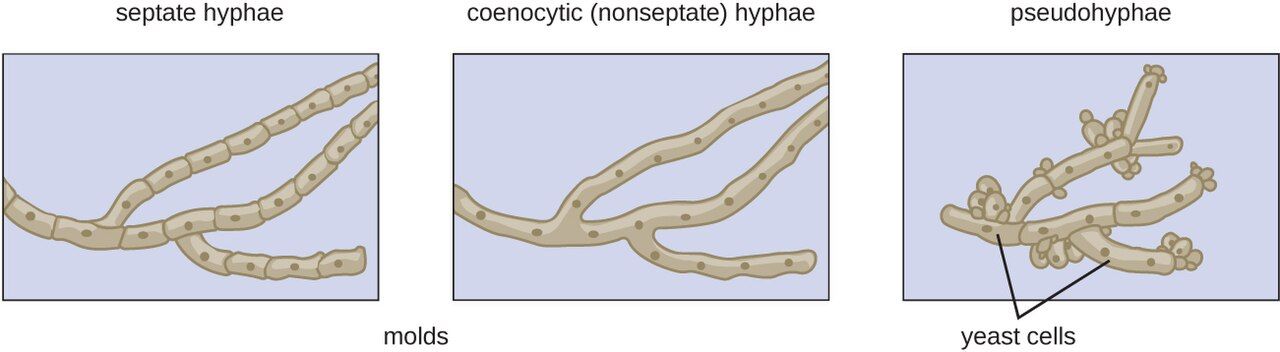
Fungi grow with one of two body plans. A yeast is a single oval cell that reproduces by budding, pinching off a small copy of itself. Candida is the classic yeast. A mold grows as long branching threads called hyphae, which mat together into a visible fuzzy colony known as a mycelium. The green fur on old bread is a mycelium. Molds spread by releasing tiny airborne spores.
Some fungi are dimorphic. They live as a mold out in the cool environment, then switch to a yeast at body temperature. Several dangerous lung fungi work this way. Coccidioides is a near miss worth knowing: in tissue it does not form a true yeast but a round sac called a spherule, packed with spores. Two structural facts drive fungal drug choice. The fungal cell wall is made of chitin and glucan, not the peptidoglycan that bacteria use. The fungal membrane is built on ergosterol, where ours uses cholesterol. Ergosterol is the chink in the armor that most antifungals aim for.
How fungal infections are grouped
Fungal diseases are called the mycoses, and they are sorted mostly by how deep they reach. Superficial and cutaneous mycoses stay in the skin, hair, and nails. These are the dermatophyte infections, the ones named "tinea": ringworm, athlete's foot, jock itch. Subcutaneous mycoses are pushed deeper by an injury, such as a thorn prick. Systemic mycoses travel through the body and are the dangerous group, often landing in the lungs.
One theme runs through all of it. Many serious fungal infections are opportunistic, which means they take hold only when defenses are down. The people most at risk are on chemotherapy, on long courses of antibiotics or steroids, living with poorly controlled diabetes, or living with HIV and AIDS.
The mycoses that turn up most
A short list of fungi accounts for most infections seen in care settings. Candida albicans is everywhere. It causes oral thrush, the white plaques that scrape off a sore mouth, along with vaginal yeast infections and diaper rash. When it reaches the bloodstream of a very ill person it causes candidemia, which can be deadly. Dermatophytes cause the itchy, ring-shaped tinea rashes. Aspergillus is a mold breathed in as spores, and it can carve out serious lung disease in someone immunocompromised.
Cryptococcus, picked up from dried bird droppings, causes a dangerous meningitis in advanced AIDS. Pneumocystis jirovecii causes the pneumonia, shortened to PJP or PCP, that is a hallmark of advanced HIV. That last one is a true oddity. It is a fungus, but its membrane has no ergosterol, so the usual antifungals miss it and the treatment of choice is trimethoprim-sulfamethoxazole instead. Notice the pattern across the whole list: the more suppressed a person's immune system, the more the fungi matter.
| Fungus | Type | Classic infection | Who is at risk |
|---|---|---|---|
| Candida albicans | Yeast | Thrush, vaginal yeast infection, candidemia | Antibiotic or steroid use, diabetes, intensive care |
| Dermatophytes (Trichophyton and others) | Mold | Ringworm, athlete's foot, jock itch (tinea) | Anyone; warm, moist skin |
| Aspergillus | Mold | Invasive lung aspergillosis | Low neutrophil count, transplant recipients |
| Cryptococcus neoformans | Yeast | Cryptococcal meningitis | Advanced HIV and AIDS |
| Pneumocystis jirovecii | Unusual fungus, no ergosterol | PJP pneumonia | Advanced HIV and AIDS, immunosuppressed |
- Fungi are eukaryotes. A yeast is a single cell that buds, a mold grows as threads called hyphae, and a dimorphic fungus switches between the two with temperature.
- The fungal wall holds chitin and the membrane holds ergosterol, which is the target of most antifungal drugs.
- The mycoses run from skin tinea and Candida thrush all the way to deadly systemic disease in someone immunocompromised.
- Because fungi resemble our own cells, antifungals have narrower selective toxicity and more side effects.
Section 4Protozoa
Single-celled animals
Protozoa are single-celled eukaryotes that behave like tiny animals. Many hunt, most move under their own power, and a great number live as parasites of people. Many protozoa lead a two-stage life. The trophozoite is the active form. It feeds, divides, and causes the symptoms. The cyst is a tough walled-off resting form that survives outside the body, in water, on hands, or in food. The cyst is usually the form that reaches the next person.
That split is worth holding onto. The cyst is what clean water and hand hygiene are meant to block. The cyst is also why some of these parasites ride straight through ordinary chlorination.
Malaria: the world's great killer
Malaria is caused by the protozoan Plasmodium and spread by the bite of a female Anopheles mosquito. That makes it a vector-borne disease. After the bite, the parasite first multiplies quietly in the liver. Then it pours into the blood and invades red blood cells, multiplying inside them until they burst in waves that are roughly in step with each other. Those bursts give malaria its signature: cycles of fever, chills, and drenching sweats that return every two or three days.
The most dangerous species is Plasmodium falciparum. It can clog the small vessels of the brain and cause fatal cerebral malaria. The habit of mind that matters most is this one: a fever in someone who has recently traveled to a malaria region is an emergency until proven otherwise. Falciparum malaria can kill within days.
Giardia and the other protozoa worth knowing
Giardia is the protozoan you are most likely to meet close to home. Its hardy cysts contaminate lakes and streams, so it causes the diarrhea that campers and hikers bring back. The stools are foul-smelling, greasy, and float, with gas and cramps alongside. It spreads fecal–oral through contaminated water. Because the cysts shrug off normal chlorine levels, prevention means boiling or filtering water rather than just treating it.
A few other protozoa come up again and again. Entamoeba histolytica invades the colon wall and causes bloody amebic dysentery, and it can seed an abscess in the liver. Trichomonas vaginalis is a common sexually transmitted infection. Toxoplasma gondii, picked up from cat feces or undercooked meat, is dangerous in pregnancy and in AIDS. Cryptosporidium causes waterborne diarrhea that turns severe and drags on in someone immunocompromised.
| Protozoan | Disease | How it spreads | Hallmark |
|---|---|---|---|
| Plasmodium | Malaria | Anopheles mosquito bite (vector) | Cycles of fever and chills; invades red cells |
| Giardia lamblia | Giardiasis | Fecal–oral; cysts in contaminated water | Greasy, foul, floating diarrhea |
| Entamoeba histolytica | Amebic dysentery | Fecal–oral | Bloody diarrhea; liver abscess |
| Trichomonas vaginalis | Trichomoniasis | Sexual contact | Frothy discharge; itching |
| Toxoplasma gondii | Toxoplasmosis | Cat feces; undercooked meat | Danger in pregnancy and in AIDS |
- Protozoa are single-celled eukaryotes. Many switch between an active trophozoite and a tough cyst that carries the infection onward.
- Malaria comes from Plasmodium by way of the Anopheles mosquito. It invades red blood cells and causes cycles of fever, and falciparum can kill quickly.
- Giardia spreads fecal–oral in cyst-contaminated water and causes greasy, foul diarrhea. Its cysts resist chlorine.
- Recent travel and pregnancy both reshape the list of likely protozoa, so both are worth asking about.
Section 5Helminths: the parasitic worms
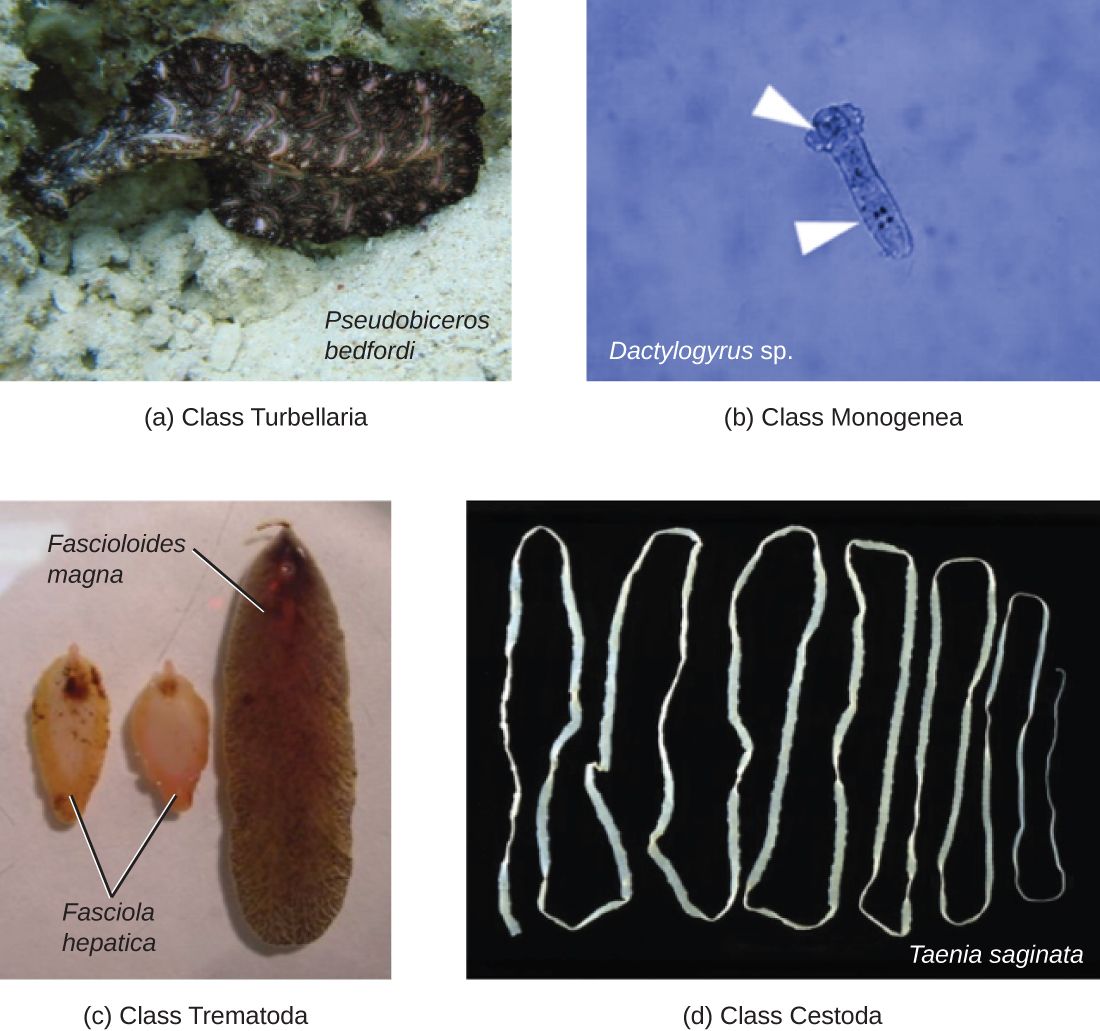
Worms as pathogens
The helminths are parasitic worms, and strictly speaking they are not microbes at all. An adult tapeworm can be meters long. They earn a place in microbiology because they are found the way microbes are found, by spotting their microscopic eggs and larvae in stool, blood, or tissue.
Worms harm people slowly. They steal nutrients, bring on anemia and malnutrition, block the bowel or the bile ducts, and set off allergy-like immune reactions. That last habit leaves a useful clue. Worm infections classically drive up the eosinophils, a white blood cell aimed at parasites. So an unexplained eosinophilia on a blood count should raise the question, "could this be a worm?" The clue is strongest for worms that push into tissue. A worm that stays in the gut lumen, such as pinworm, often leaves the count alone.
Roundworms (nematodes)
Nematodes are the roundworms. They are smooth, round in cross-section, unsegmented, and tapered at both ends, and males and females are separate worms. The one you are sure to meet is the pinworm, Enterobius, the most common worm infection in the United States and a frequent visitor in schools. The female crawls out at night to lay eggs on the skin around the anus. That causes fierce itching, and the eggs then travel easily on hands and bedding through a whole household.
Other roundworms matter too. Ascaris is a large intestinal worm that can reach about 35 centimeters, longer than a new pencil, and a heavy load of them can block the bowel. Hookworms latch onto the gut wall and suck blood, which leads to iron-deficiency anemia. Trichinella comes from undercooked pork, and its larvae settle into muscle.
Flatworms: tapeworms and flukes
The platyhelminths, or flatworms, split into two groups in the clinic. The cestodes are the tapeworms: long, flat, ribbon-like worms made of repeating segments. The head, called a scolex, grips the gut wall with suckers, and the pork tapeworm adds a crown of hooks. Tapeworms have no gut of their own and soak up nutrients through their surface. People catch them from undercooked beef, pork, or fish.
The trematodes are the flukes. Most are flat and leaf-shaped, with two suckers, and nearly all of them pass through a snail on the way to a human host. Worldwide the most important fluke is Schistosoma, the blood fluke, a leading cause of long-term illness in parts of Africa, Asia, and South America. Its eggs damage the bladder, liver, and intestines over years. Blood flukes also break the usual fluke pattern twice over. They are slender and round-bodied rather than leaf-shaped, and the sexes are separate, with the male carrying the female in a groove along his body. In most settings tapeworms and pinworm come up far more often than flukes, but the flukes are a reminder of how much a travel or immigration history can change the list of suspects.
| Worm | Group | Classic story | Main harm |
|---|---|---|---|
| Pinworm (Enterobius) | Roundworm | Itchy bottom in a child at night | Perianal itching; spreads through households |
| Ascaris | Roundworm | A large worm passed in stool; heavy load | Bowel obstruction, malnutrition |
| Hookworm | Roundworm | Walking barefoot on contaminated soil | Iron-deficiency anemia from blood loss |
| Tapeworm (Taenia) | Flatworm (cestode) | Undercooked beef or pork | Stolen nutrients; segments in stool |
| Schistosoma | Flatworm (trematode) | Freshwater exposure abroad | Long-term bladder, liver, and gut damage |
- Helminths are parasitic worms, found under the microscope by their eggs and larvae. They cause slow, long-running harm.
- An unexplained eosinophilia is a classic clue to a worm, above all a worm that invades tissue.
- Roundworms (nematodes) include pinworm, Ascaris, and the blood-sucking hookworms.
- Flatworms (platyhelminths) are the tapeworms (cestodes) and the flukes (trematodes), including Schistosoma.
The chapter in one breath
- A virus is acellular: a genome inside a protein capsid, sometimes wrapped in a lipid envelope. It must hijack a host cell to reproduce.
- Enveloped viruses usually die to soap and alcohol, though hepatitis B lasts a week in dried blood. Naked viruses resist alcohol and need bleach, which makes this a real hand-hygiene decision.
- Viruses replicate in five steps: attach, enter, biosynthesize, assemble, release. DNA viruses, RNA viruses, and retroviruses part ways at step three, and latency lets herpesviruses and HIV hide and return.
- Fungi are eukaryotes. Yeasts bud and molds form hyphae, their ergosterol membrane is the antifungal target, and many mycoses are opportunistic.
- Protozoa are single-celled parasites. Malaria invades red cells and can kill fast, and Giardia rides cyst-contaminated water.
- Helminths are worms: roundworms such as pinworm, Ascaris, and hookworm, and flatworms such as tapeworms and flukes. They are found by their eggs and hinted at by eosinophilia.
- Across all four groups the greatest risk sits with the sickest and most immunocompromised people, and in every case the structure of the pathogen sets the way to prevent it.
One last exercise pulls the whole chapter together. Out in the world you rarely get the name of the agent first. You get a story, a specimen, and a few findings, and the group has to be worked out from them. The bench below deals you eight cases and lets you turn the clues over one at a time.
ReferenceWords worth knowing
A quick reference for the terms in this chapter. Skim it now, or come back whenever a word trips you up.
- Acellular
- Not made of cells. It describes viruses, which have no cytoplasm, no ribosomes, and no metabolism of their own.
- Budding
- Two meanings here: how a yeast reproduces, by pinching off a daughter cell, and how an enveloped virus leaves a host cell, by wrapping itself in host membrane.
- Capsid
- The protein shell, built of repeating capsomeres, that surrounds and protects a virus's genome.
- Cestode
- A tapeworm. A flatworm with a gripping head, or scolex, and a ribbon of repeating segments.
- Cyst
- The tough, resting, environment-proof form of many protozoa, and usually the form that spreads the infection.
- Dermatophyte
- A mold that infects skin, hair, and nails, causing the ringworm and tinea group of infections.
- Dimorphic fungus
- A fungus that grows as a mold out in the environment and converts to a yeast at body temperature.
- Envelope
- A lipid membrane, stolen from the host cell, that coats some viruses and usually makes them easy to kill with soap or alcohol. Hepatitis B is the notable exception, lasting a week or more in dried blood.
- Eosinophilia
- A raised eosinophil count on a blood test. A classic clue to a parasitic worm or to allergy.
- Ergosterol
- The sterol in fungal cell membranes, where human membranes use cholesterol. The main target of antifungal drugs.
- Helminth
- A parasitic worm, either a roundworm (nematode) or a flatworm (platyhelminth).
- Hyphae
- The branching threads that make up the body of a mold. A tangled mass of them is a mycelium.
- Latency
- A sleeping state in which a virus parks its genome in a host cell and causes no symptoms until it reactivates.
- Mycosis
- Any fungal infection. Mycoses are sorted as superficial, cutaneous, subcutaneous, or systemic by how deep they go.
- Nucleocapsid
- The genome and capsid of a virus taken together, inside the envelope if the virus has one.
- Nematode
- A roundworm, smooth and round in cross-section, such as pinworm, Ascaris, or hookworm.
- Obligate intracellular parasite
- An agent that cannot reproduce outside a host cell. Every virus qualifies.
- Protozoan
- A single-celled eukaryote, often able to move on its own. Many are human parasites, such as Plasmodium and Giardia.
- Provirus
- A DNA copy of a virus's genome spliced into the host chromosome, as HIV does during latency.
- Spike protein
- A glycoprotein standing out from a viral envelope, used by the virus to attach to host-cell receptors.
- Trematode
- A fluke. A flatworm with a snail stage in its life cycle, such as Schistosoma.
- Trophozoite
- The active, feeding, dividing form of a protozoan, and the form that causes symptoms.
- Yeast
- A single-celled fungus that reproduces by budding, such as Candida.