Microbial Growth & Metabolism
One bacterium you cannot even see can become a billion in a day. It needs only food, warmth and time. Everything a microbe does, from spoiling a wound to clouding a culture bottle, starts with one question: do its surroundings let it grow? This chapter is about those surroundings. What microbes eat. Whether they can stand oxygen. The heat and the acid they need. The steady arc a population follows from a few cells to a crowd. And how we coax them onto a plate so we can name them. Learn what makes microbes grow and you already know why samples go in the fridge, why cultures are drawn before the first dose of an antibiotic, and why some infections hide where air cannot reach.
By the end of this chapter you can
- Name the carbon and energy sources microbes use. Place any microbe in its nutritional type.
- List the nutrients microbes need. Say what makes an organism fastidious.
- Sort microbes by oxygen requirement. There are five groups. They are obligate aerobe, obligate anaerobe, facultative anaerobe, microaerophile and aerotolerant anaerobe.
- Explain why oxygen poisons some microbes. Give the jobs of catalase and superoxide dismutase.
- Describe how temperature, pH and osmotic pressure shape growth. Say where human pathogens sit on each scale.
- Draw the four phases of the bacterial growth curve. Define generation time and work it out.
- Explain why actively dividing cells matter so much for drug treatment and for timing a sample.
- Tell the main types of culture media apart. Describe how one isolated colony gives a pure culture.
Section 1What microbes need
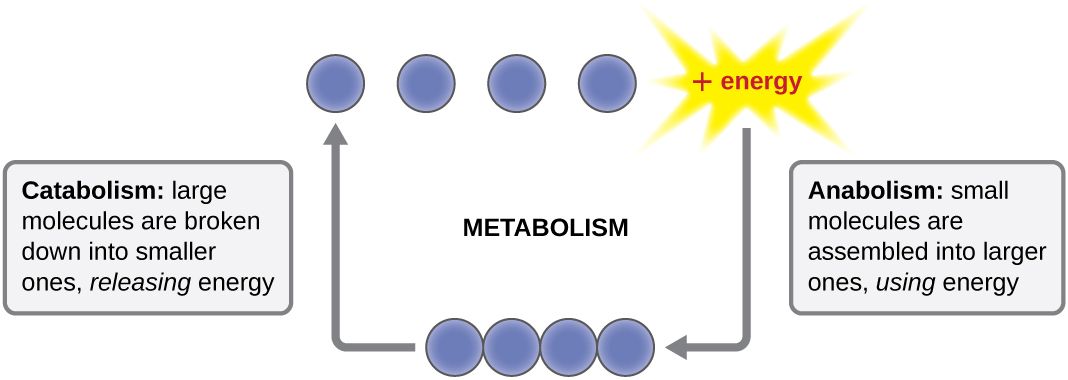
The raw materials of a cell
To grow, a microbe has to build more of itself. Building takes raw material. Most of any cell is made from just six elements. They are carbon, hydrogen, oxygen, nitrogen, phosphorus, and sulfur. These six are the macronutrients, the ones needed in bulk. They go into proteins, nucleic acids, membranes and sugars. Cells also need very small amounts of micronutrients, which are also called trace elements. Iron, zinc and copper are the common ones. They slot into enzymes as helpers. Some microbes can build every complex molecule they need from these simple parts. Others cannot. Those must be handed finished vitamins or amino acids. A ready-made extra like that is called a growth factor.
A microbe that cannot make one or more of its own growth factors is called fastidious. The word means fussy, and it is the right word. This is not a small detail. It is the reason some pathogens need special enriched plates to grow at all. It is also the reason a lab using the wrong medium can report no growth on someone who really is infected.
Where the carbon comes from
Carbon is the backbone of every molecule in a living cell. So the first question to ask about any microbe is where its carbon comes from. There are only two answers. An autotroph builds its own organic molecules out of carbon dioxide (CO₂), which is inorganic. The name means self feeder. Picture the soil bacteria that pull carbon from the air the way a plant does. A heterotroph cannot do that. The name means other feeder. It has to take in carbon that some other living thing already put together. It feeds on organic compounds such as sugars, proteins and fats. Every microbe that infects a person is a heterotroph. It lives off tissue, off body fluid, or off the nutrients left on a hospital surface.
Where the energy comes from
The second question is where the energy comes from. A phototroph catches energy from light. A chemotroph pulls energy out of chemical bonds by breaking compounds apart. Put the carbon source and the energy source together and you have the microbe's nutritional type. The last row of the table below is the one that matters most in medicine. A chemoheterotroph gets both its carbon and its energy from organic compounds. The bacteria, fungi, protozoa and helminths that cause disease are all chemoheterotrophs. So are you.
The four names look long, but they come apart cleanly. Read the front half for energy and the back half for carbon. Photo- means light. Chemo- means chemicals. An -autotroph builds itself from CO₂. A -heterotroph has to eat organic carbon. Put the halves together and the name tells you how that microbe makes a living.
| Nutritional type | Carbon source | Energy source | Who |
|---|---|---|---|
| Photoautotroph | CO₂ | Light | Cyanobacteria, algae, plants |
| Photoheterotroph | Organic compounds | Light | Some purple & green bacteria |
| Chemoautotroph | CO₂ | Inorganic chemicals | Certain soil & deep-sea bacteria |
| Chemoheterotroph | Organic compounds | Organic compounds | All human pathogens, fungi, animals |
- Microbes need macronutrients (C, H, O, N, P, S) and micronutrients (trace metals). Some also need ready-made growth factors.
- The carbon source splits microbes in two. Autotrophs build from CO₂. Heterotrophs take in organic compounds.
- The energy source splits them again. Phototrophs use light. Chemotrophs use chemicals.
- All human pathogens are chemoheterotrophs. A fastidious organism needs enriched media to grow at all.
Section 2Oxygen requirements
Oxygen: fuel for some, poison for others
We tend to think of oxygen as life itself. For a microbe it cuts both ways. Burning fuel with oxygen releases far more energy than any other route. That is why organisms that can use it grow fast. But oxygen chemistry also throws off reactive oxygen species. The main ones are superoxide and hydrogen peroxide (H₂O₂). They tear up proteins, membranes and DNA. To live with oxygen safely, a microbe needs enzymes that clean them up. Superoxide dismutase (SOD) neutralizes superoxide. Catalase splits hydrogen peroxide into water and oxygen. A microbe without these enzymes is killed by ordinary air.
The five oxygen classes
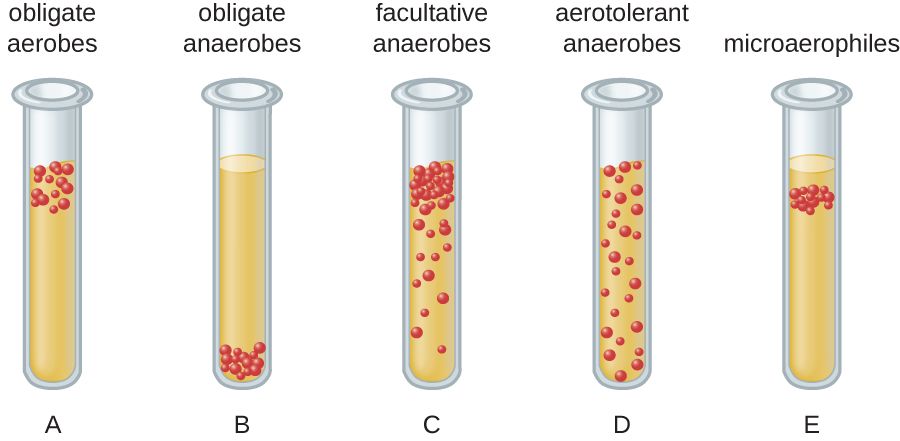
Microbes fall into five groups by how they handle oxygen. The classic way to see it is a thioglycolate tube. The broth is rich in oxygen at the top and free of it at the bottom. Each organism grows only in the band where it can survive. An obligate aerobe must have oxygen, so it grows only at the top. An obligate anaerobe is poisoned by oxygen, so it grows only at the bottom. A facultative anaerobe prefers oxygen but can switch to fermentation without it. It grows all through the tube, thickest near the top. A microaerophile needs oxygen but only a little. It forms a thin band just under the surface. An aerotolerant anaerobe pays oxygen no attention at all. It never uses oxygen and is not harmed by it, so it grows evenly from top to bottom.
| Class | Uses O₂? | Harmed by O₂? | Clinical example |
|---|---|---|---|
| Obligate aerobe | Yes — required | No | Pseudomonas aeruginosa, M. tuberculosis |
| Obligate anaerobe | No | Yes — killed | Clostridioides difficile, Bacteroides |
| Facultative anaerobe | Yes if present; ferments if not | No | E. coli, Staphylococcus, Klebsiella |
| Microaerophile | Yes — low levels only | Yes at normal levels | Helicobacter pylori, Campylobacter |
| Aerotolerant anaerobe | No | No (tolerates it) | Streptococcus, Cutibacterium, some lactobacilli |
One more group is worth knowing. Capnophiles grow best in air that holds extra carbon dioxide. Neisseria and Haemophilus are the usual examples. The lab grows them in a jar enriched with CO₂.
- Oxygen yields the most energy, but it also makes toxic reactive oxygen species. Surviving them takes catalase and superoxide dismutase.
- Obligate aerobes must have oxygen. Obligate anaerobes are killed by it. Facultative anaerobes do well either way.
- Microaerophiles need a little oxygen. Aerotolerant anaerobes never use it but are not harmed by it.
- Anaerobic infections sit in tissue with very little oxygen. Their samples need special handling.
Section 3Temperature, pH & conditions
Temperature: everyone has a sweet spot
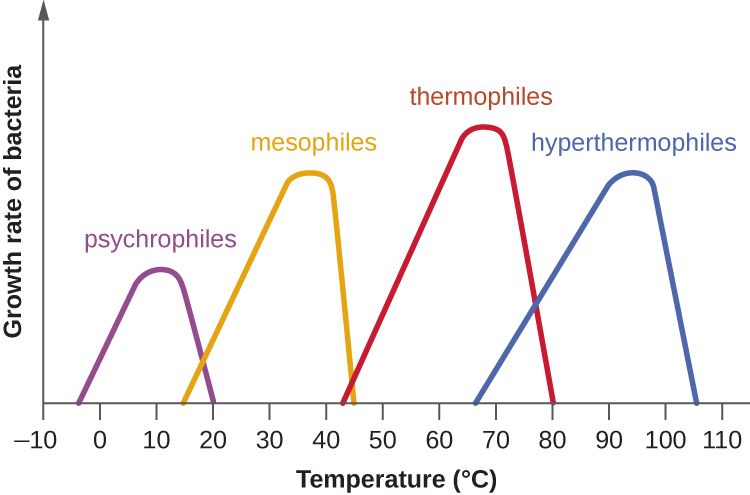
Every microbe has three cardinal temperatures. There is a minimum, below which it stops growing. There is an optimum, where it grows fastest. And there is a maximum, above which its proteins cook and the cell dies. Microbes are grouped by where that optimum falls. Psychrophiles love the cold and grow best near freezing. Mesophiles prefer middling warmth, close to body heat. Thermophiles thrive in hot springs and compost heaps. Hyperthermophiles flourish in water close to boiling. One fact here matters more than the rest. Human pathogens are mesophiles. Their optimum sits right around 37°C, which is body temperature. That is exactly why the body is such a welcoming home for them, and why lab incubators are set to 35–37°C.
| Group | Optimum range | Where you find them |
|---|---|---|
| Psychrophile | ~0–15°C | Arctic waters, deep ocean |
| Psychrotroph | ~4–25°C | Refrigerated food — Listeria, spoilage bacteria |
| Mesophile | ~20–40°C | Human body — nearly all pathogens |
| Thermophile | ~50–60°C | Hot springs, compost heaps |
| Hyperthermophile | ~80°C and above | Volcanic vents, geysers |
pH: living in acid, base, or neutral
Microbes also have a preferred acidity. Most human pathogens are neutrophiles. They grow best near neutral, about pH 6.5 to 7.5, which matches blood and most tissue. Acidophiles prefer acid. The lactobacilli that hold the vagina at a low, protective pH are acidophiles, and so are the bacteria that make yogurt and sauerkraut. Alkaliphiles go the other way and grow best in basic surroundings. The stomach sits near pH 2. It is a chemical wall that kills most microbes you swallow. That makes Helicobacter pylori all the more striking, because it neutralizes the acid around itself and settles into the stomach lining.
Water, salt, and the rest
Microbes need liquid water they can actually use. Anything that ties water up slows them down. Heavy salt or heavy sugar pulls water straight out of a cell by osmosis. That is exactly how salting meat and sugaring jam keep food. The surroundings simply become too dry for microbes to grow in. A few organisms turn this on its head. Halophiles actually require high salt. Osmotolerant organisms do not need it, but they put up with it. This is why Staphylococcus aureus handles salt so well. It grows on skin and in salty food that stops other bacteria cold. The lab uses that trait on purpose, with high-salt selective media.
- Every microbe has cardinal temperatures. Human pathogens are mesophiles, tuned to about 37°C.
- Most pathogens are neutrophiles. Stomach acid is a defense, and H. pylori is the one that beats it.
- Salt and sugar keep food by pulling water out of microbes through osmosis.
- Halophiles need high salt. Osmotolerant organisms such as S. aureus simply put up with it.
- Listeria grows in the fridge, so chilling something is not the same as sterilizing it.
Section 4The bacterial growth curve
Doubling: how bacteria multiply
Most bacteria reproduce by binary fission. One cell copies its DNA, grows, then splits into two identical daughter cells. The time it takes one cell to become two is the generation time, also called the doubling time. It can be startlingly short. Escherichia coli can double every 20 minutes when conditions are ideal. Each generation doubles the population, so the counts run 1, 2, 4, 8, 16 and on. Growth shaped like that is exponential.
One cell dividing every 20 minutes becomes more than a million in about seven hours. You can check that yourself. Seven hours is 420 minutes, and 420 divided by 20 gives 21 doublings. Two multiplied by itself 21 times is 2,097,152. The formula behind it is short. Write the starting count as N₀ and the count now as N. Then N = N₀ × 2ⁿ, where n is the number of doublings. Rearrange it and you get the generation time: divide the growing time by n. This is why a contaminated bag of fluid or a mishandled sample can turn from harmless to dangerous overnight, and why some illnesses come on so fast.
Generation time is not a fixed fact about a species. It is what that species manages under the conditions it happens to be in. Twenty minutes is what E. coli does in rich broth at 37°C with plenty of air. Cool the flask, sour it, starve it or take the oxygen away and the same cell takes far longer. Every condition in this chapter shows up inside that one number.
The four phases
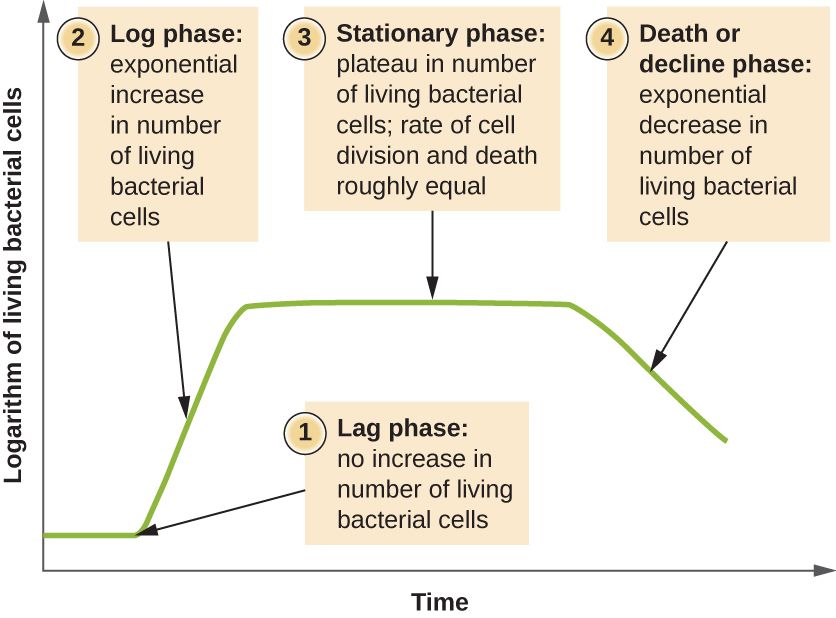
Drop a few bacteria into fresh broth and the whole population moves through four phases, in the same order every time. In the lag phase the cells are not dividing yet. They are gearing up, making enzymes and building blocks and settling into a new home. In the log phase, also called the exponential phase, they divide at full speed and the numbers explode. These are the healthiest, busiest cells of the whole run. Then nutrients run short and waste piles up. The population moves into the stationary phase, where new cells appear about as fast as old ones die and the total holds steady. Last comes the death phase, also called the decline phase. Conditions turn hostile and cells die faster than they can be replaced.
| Phase | What's happening | Why it matters clinically |
|---|---|---|
| Lag | Cells adapt; little or no division | Explains a delay before symptoms or before a culture turns positive |
| Log (exponential) | Rapid doubling; most active cells | Antibiotics work best here — they target growing cells |
| Stationary | Growth = death; nutrients depleted | Slow-growing cells tolerate drugs better; toxins/spores may form |
| Death (decline) | Cells die faster than they divide | Population collapses as the environment fails |
Why the log phase matters
The phase a population is in changes how it answers treatment. Many antibiotics can only kill bacteria that are actively building and dividing. The cell wall drugs are the clearest case of this. So those drugs work best against log-phase cells and far less well against the slow, nearly dormant cells of the stationary phase. That is one reason deep, walled-off and biofilm infections are so stubborn. The cells inside them are barely dividing at all. It is also why steady drug levels and a full course matter so much. You want the drug there and waiting whenever the surviving cells start dividing again.
- Bacteria multiply by binary fission. The generation time is how long one cell takes to become two.
- Doubling makes growth exponential, so a few cells become millions within hours. Use N = N₀ × 2ⁿ to work it out.
- The four phases run in order: lag, log (exponential), stationary, death.
- Antibiotics work best on log-phase cells, the ones actively dividing. Cultures should be drawn before antibiotics start.
Section 5Culturing microbes
Media: the food we grow microbes on
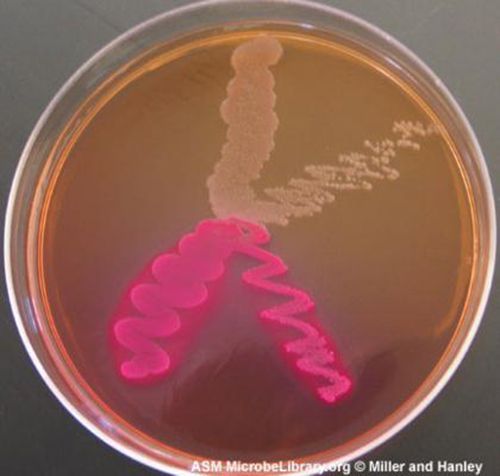
To study a microbe or to name it, we usually have to grow it in the lab on a culture medium. That can be a nutrient broth or a firm gel. Solid media are set with agar, a jelly pulled from seaweed. Microbes cannot digest agar, and it stays firm at body temperature, which is exactly what is needed. Media come in several types for several jobs. A general-purpose medium, also called an all-purpose medium, supports a wide range of organisms. An enriched medium adds extra nutrients such as blood or serum so fastidious pathogens can grow. A selective medium holds back the organisms you do not want, so only the target comes up. A differential medium holds a dye or a sugar that makes different organisms look different, so you can tell them apart at a glance. Plenty of real plates do both jobs at once. MacConkey agar is selective and differential together.
| Media type | What it does | Example |
|---|---|---|
| General-purpose | Grows a wide variety of microbes | Nutrient / tryptic soy agar |
| Enriched | Extra nutrients for fastidious organisms | Blood agar, chocolate agar |
| Selective | Inhibits some microbes so the target grows | MacConkey (Gram-negatives), MSA (staph) |
| Differential | Makes organisms look visibly different | Blood agar (hemolysis), MacConkey (lactose) |
| Transport | Keeps a specimen viable on the way to the lab | Anaerobic & swab transport systems |
One more type never tries to grow anything at all. A transport medium only keeps a sample alive and unchanged on the trip to the lab. It holds no extra food, so nothing multiplies on the way. The mix of organisms that left the body is the mix that arrives.
Colonies and the pure culture
Put a single bacterial cell on solid agar and leave it alone. It divides again and again on the same spot, until millions of its descendants pile up into a visible mound. That mound is a colony. Every cell in it came from one original cell, so a colony is a clone. Pick one and you have a pure culture, one organism with nothing else mixed in. Getting there is the whole point of the streak plate. An inoculating loop drags the sample across the plate in a shrinking pattern. By the last few streaks the cells are far enough apart that each one grows into its own separate colony. Pick a well separated colony and the pure culture is yours to identify and test.
Counting what grew
Colonies are also how we count microbes. We assume each colony started from one cell, or from one clump of cells stuck together. So lab counts are reported as colony-forming units, written CFU, rather than as exact cell numbers. This is more than bookkeeping. A urine culture growing a high CFU count of a single organism points to a real urinary tract infection. A low count, or a mix of many different organisms, often means the sample picked up contaminants during collection. A culture report has three parts worth reading together: the organism, the CFU count and the sensitivities.
- Agar sets the medium solid. A medium may be general-purpose, enriched, selective, differential or transport.
- Selective media hold back unwanted microbes. Differential media make organisms look different.
- A colony is the visible clone of one original cell. One isolated colony gives a pure culture.
- Counts are reported as colony-forming units (CFU). Good collection is the whole basis of a result worth reading.
The chapter in one breath
- Microbes need carbon, an energy source and nutrients. All human pathogens are chemoheterotrophs, and the fastidious ones need enriched media.
- Oxygen is fuel for some and poison for others. There are five classes. They are obligate aerobes, obligate anaerobes, facultative anaerobes, microaerophiles and aerotolerant anaerobes. Living with oxygen turns on two enzymes, catalase and SOD.
- Anaerobic infections hide in tissue with very little oxygen. Their samples need special handling.
- Human pathogens are mesophiles, tuned to about 37°C, and mostly neutrophiles. Salt and sugar keep food by osmosis, and Listeria still grows in the fridge.
- Bacteria double by binary fission. That gives exponential growth through the lag, log, stationary and death phases, with N = N₀ × 2ⁿ behind the numbers.
- Antibiotics work best on actively dividing log-phase cells, and cultures should be drawn before antibiotics start.
- We grow microbes on media. The types are general, enriched, selective, differential and transport. Then we isolate one colony to get a pure culture, and report counts as CFU.
ReferenceWords worth knowing
A quick list of the terms in this chapter. Skim it now, or come back whenever a word trips you up.
- Aerotolerant anaerobe
- A microbe that never uses oxygen but is not harmed by it. It grows evenly whether air is there or not.
- Agar
- A jelly from seaweed used to set culture media solid. Microbes cannot digest it, and it stays firm at body temperature.
- Autotroph
- An organism that builds its own organic molecules out of inorganic carbon dioxide.
- Binary fission
- The split of one bacterial cell into two identical daughter cells, with no sex involved.
- Capnophile
- A microbe that grows best in air holding extra carbon dioxide.
- Catalase
- An enzyme that clears hydrogen peroxide by splitting it into water and oxygen.
- Chemoheterotroph
- An organism that takes both its carbon and its energy from organic compounds. Every human pathogen is one.
- Colony-forming unit (CFU)
- A count of living microbes based on how many colonies grew, assuming each one started from a single cell or clump.
- Differential medium
- A medium that makes different organisms look different, usually through a color change.
- Enriched medium
- A medium with extra nutrients added, such as blood or serum, so fastidious organisms can grow.
- Facultative anaerobe
- A microbe that uses oxygen when it is there and ferments when it is not.
- Fastidious
- Said of a microbe with fussy nutritional needs that will only grow on enriched media.
- Generation time
- How long one cell takes to divide into two. Also called the doubling time.
- Growth curve
- The plot of a bacterial population over time, through the lag, log, stationary and death phases.
- Growth factor
- A finished vitamin or amino acid that a microbe cannot build for itself and must be handed ready made.
- Halophile
- A microbe that requires a high-salt setting in order to grow.
- Heterotroph
- An organism that has to get its carbon from organic compounds another organism already built.
- Mesophile
- A microbe whose best growth temperature is middling, about 20 to 40°C. Human pathogens are in this group.
- Microaerophile
- A microbe that needs oxygen, but only at levels lower than normal air.
- Neutrophile
- A microbe that grows best near neutral pH, about 6.5 to 7.5. Most human pathogens are neutrophiles.
- Obligate aerobe
- A microbe that must have oxygen to grow.
- Obligate anaerobe
- A microbe that is killed by oxygen and grows only where there is none.
- Osmosis
- The movement of water toward the saltier or sweeter side. It is how salt and sugar pull water out of a microbe.
- Pure culture
- A culture holding one kind of microbe and nothing else, usually taken from a single isolated colony.
- Selective medium
- A medium holding ingredients that block unwanted organisms so the target can grow.
- Streak plate
- A plate streaked in a shrinking pattern so the last cells land far enough apart to form separate colonies.
- Thermophile
- A microbe whose best growth temperature is high, about 50 to 60°C. Found in hot springs and compost.